
Close Menu
    Facebook X (Twitter) Instagram
    SciTechDaily
    • Biology
    • Chemistry
    • Earth
    • Health
    • Physics
    • Science
    • Space
    • Technology
    Facebook X (Twitter) Pinterest YouTube RSS
    SciTechDaily
    Home»Biology»Rewiring the Brain: Scientists Reverse Meth and PCP’s Cognitive Effects
    Biology

    Rewiring the Brain: Scientists Reverse Meth and PCP’s Cognitive Effects

    By Mario Aguilera, University of California - San DiegoOctober 4, 2024No Comments4 Mins Read
    Facebook Twitter Pinterest Telegram LinkedIn WhatsApp Email Reddit
    Share
    Facebook Twitter LinkedIn Pinterest Telegram Email Reddit
    Brain Memory Dream Concept
    Researchers at UC San Diego have identified neurotransmitter switching as a mechanism by which drugs such as methamphetamine and PCP impair memory and cognitive function. This involves a shift from glutamate to GABA in certain brain neurons, an effect reversible through targeted treatments.

    UC San Diego’s study reveals that meth and PCP impair memory by causing neurons to switch from glutamate to GABA, a process reversible with specific treatments.

    Sustained drug abuse can have many long-lasting effects, including memory loss and reduced cognitive functions, which can persist for years. Now, neurobiologists at the University of California San Diego have identified a reversible, shared mechanism in the brain by which drugs of different classes generate cognitive impairments.

    Investigating Mechanisms of Drug-Induced Cognitive Deficits

    Scientists in the Department of Neurobiology, School of Biological Sciences, investigated how methamphetamine and phencyclidine (PCP or “angel dust”), which take effect by activating different targets in the brain, induce a similar reduction in cognitive ability. How could the same difficulties in memory emerge in response to drugs that trigger different actions in the brain?

    Their research revealed that meth and PCP caused neurons to change the way they communicate through a process known as neurotransmitter switching. The results of this investigation, led by Assistant Project Scientist Marta Pratelli in Professor Nicholas Spitzer’s laboratory, are published in Nature Communications.
    Neuron Expression of Mice on Methamphetamine
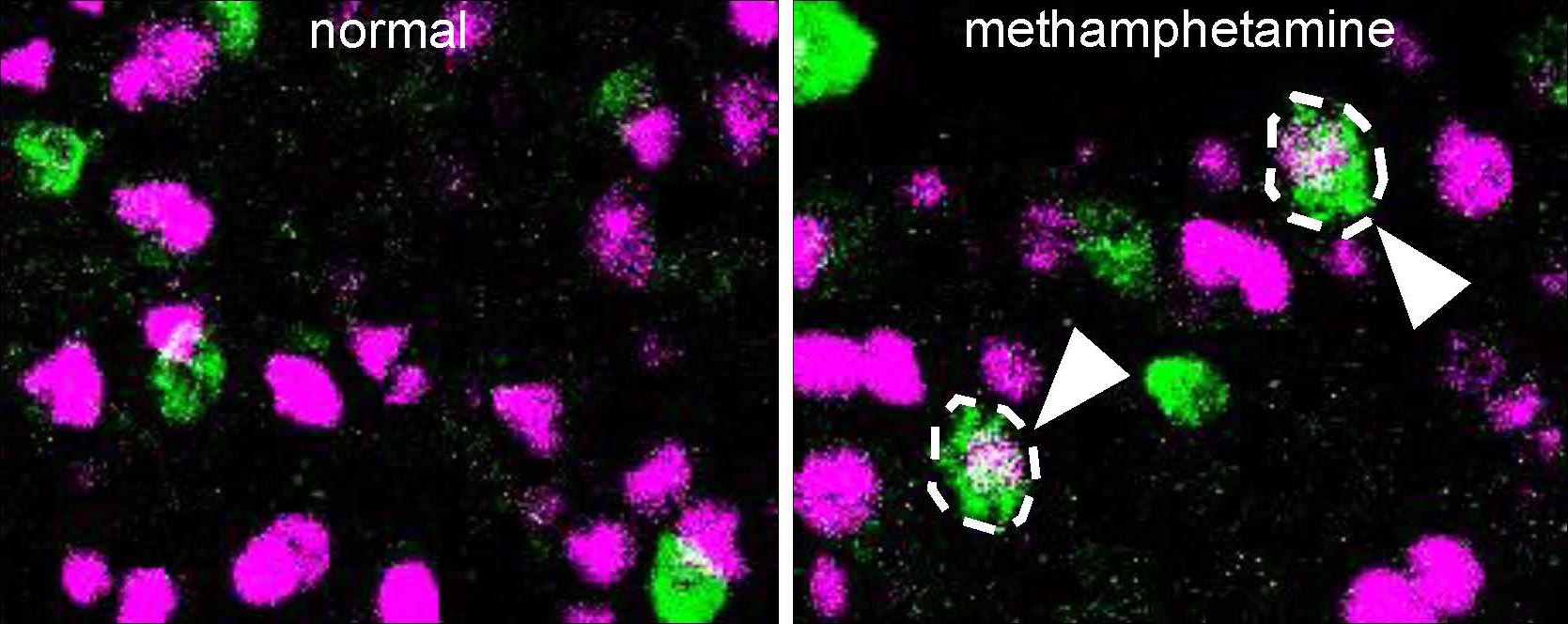
    In normal mice (left), magenta neurons express the excitatory transmitter glutamate and green neurons express the inhibitory transmitter GABA. Methamphetamine (right) causes glutamate-expressing neurons to express GABA, demonstrated by neurons co-expressing magenta and green labels (arrowheads) in methamphetamine-treated mice but not in untreated mice (normal). Credit: Spitzer Lab, UC San Diego

    Discoveries in Neurotransmitter Switching

    Neurotransmitter switching is a form of brain plasticity, an evolving area of research investigating how the brain changes function and structure in response to experience. In recent years, Spitzer and his colleagues have also identified roles for neurotransmitter switching in autism spectrum disorder, post-traumatic stress disorder, and exercise.

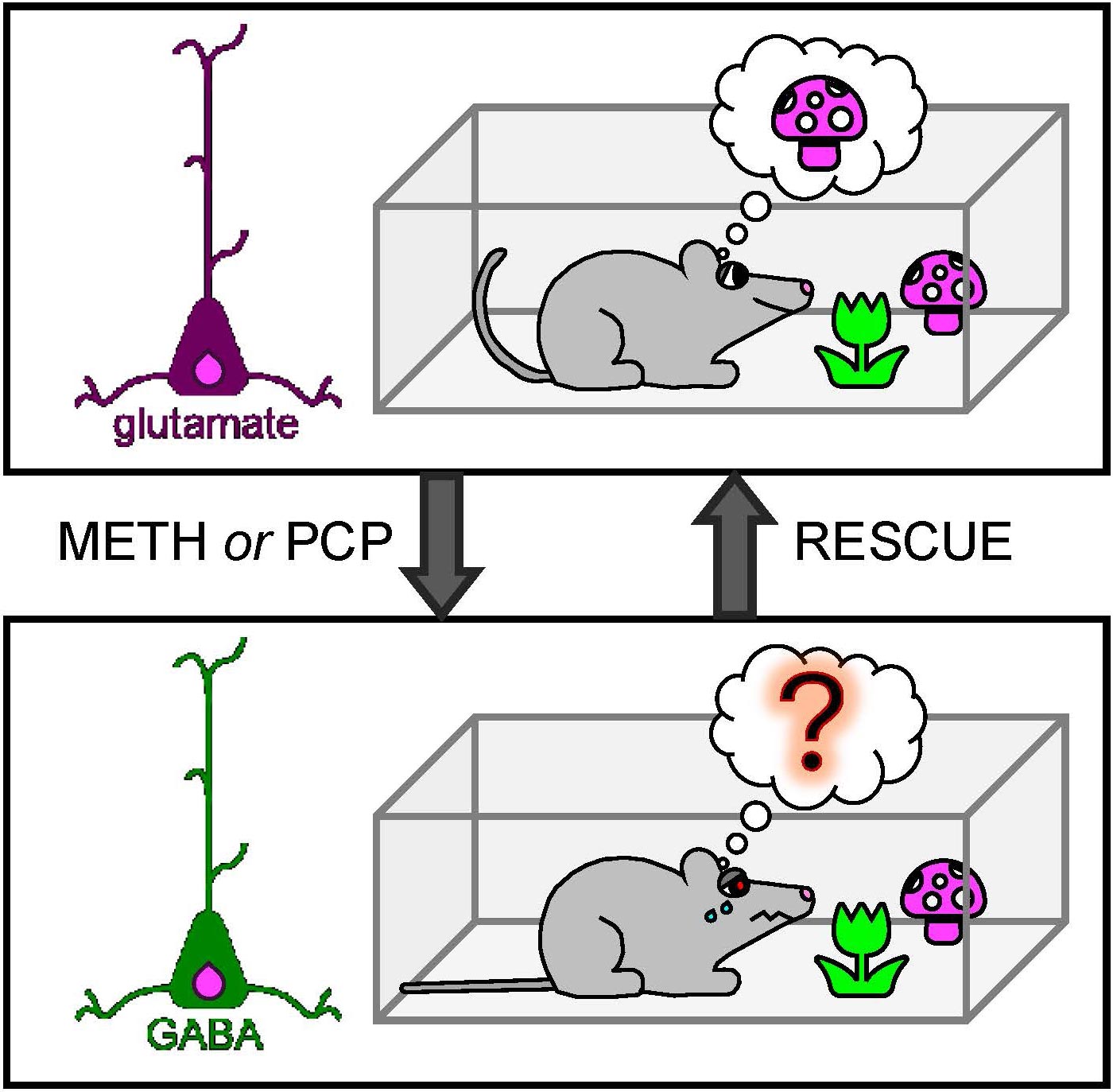
    Examining the cerebral cortex of mice, the investigators found that meth and PCP each caused a switch from the excitatory neurotransmitter glutamate to the inhibitory neurotransmitter GABA (gamma-aminobutyric acid) in the same neurons in the prelimbic region, an area of the frontal cortex involved in executive functions. This switch was linked to a decrease in memory task performance since drug-treated mice performed well in the tasks when the expression of GABA was blocked.
    Methamphetamine and PCP Mouse Object Recognition
    Recognition of objects is a measure of cognition. Having become used to seeing two flowers, the normal mouse (with neurons expressing glutamate) spends more time exploring a new object (a mushroom). After exposure to methamphetamine or PCP (when neurons start expressing GABA), the mouse does not recognize the new object and fails the recognition test. When the change in transmitter is rescued (when neurons are returned to expressing glutamate) the mouse recovers the ability to recognize objects. Credit: Spitzer Lab, UC San Diego

    Reversibility of Drug-Induced Cognitive Deficits

    Further experiments showed that even after repeated exposure to the drugs, the researchers were able to reverse this neurotransmitter switch using molecular tools to locally decrease the brain’s electrical activity or using clozapine, an antipsychotic drug. Each of these treatments reversed the memory loss, restoring the performance of mice in the cognitive tasks.

    “These results suggest that targeted manipulation of neuronal activity may be used to ameliorate some of the negative effects of repeated drug abuse,” said Pratelli.

    In this new study, the researchers found that a drug-induced increase in the release of dopamine, a neurotransmitter involved in reward, and an increase in the electrical activity of neurons in the cerebral cortex, were required to produce the neurotransmitter switch.

    Marta Pratelli and Nick Spitzer
    Assistant Project Scientist Marta Pratelli and Professor Nick Spitzer study neurotransmitter switching, an evolving area of research investigating how the brain changes function and structure in response to experience. Credit: Erik Jepsen, UC San Diego

    Conclusion and Implications for Future Therapies

    “This study reveals a shared and reversible mechanism that regulates the appearance of cognitive deficits upon exposure to different drugs,” said Spitzer.

    The researchers note in their paper that a deeper understanding of brain mechanisms tied to a loss of memory from drug use could boost prospects for new treatments, not only resulting in therapy for meth and PCP consumption but for other disorders as well.

    Reference: “Drug-induced change in transmitter identity is a shared mechanism generating cognitive deficits” by Marta Pratelli, Anna M. Hakimi, Arth Thaker, Hyeonseok Jang, Hui-quan Li, Swetha K. Godavarthi, Byung Kook Lim and Nicholas C. Spitzer, 26 September 2024, Nature Communications.
    DOI: 10.1038/s41467-024-52451-x

    Funding for the study was provided by the National Institute on Drug Abuse (R21 CEBRA grant DA048633; and R21 DA050821) and the Overland Foundation.

    Never miss a breakthrough: Join the SciTechDaily newsletter.
    Follow us on Google and Google News.

    Cognition Drugs GABA Memory Neuroscience UCSD
    Share. Facebook Twitter Pinterest LinkedIn Email Reddit

    Related Articles

    Rewriting the Rules: Scientists Solve an Episodic Memory Mystery

    Do You Remember When…? New Research Challenges Traditional Model of Memory

    Unraveling Brain Secrets: Scientists Probe the True Role of Key Cognitive Regions

    Contrary to Previous Belief – New Study Links Brain Waves Directly to Memory

    New Theory Challenges Classical View on Brain’s Memory Storage

    Scientists Uncover Brain Signals for Good Memory Performance

    Scientists Uncover Molecular Mechanisms Behind Childhood Memory Development

    Science Reveals: How Does Your Brain Be Creative?

    Neuroscientists Discover that Drosophila Orb2 Plays Role in Long-Term Memory

    Leave A Reply Cancel Reply

    • Facebook
    • Twitter
    • Pinterest
    • YouTube

    Don't Miss a Discovery

    Subscribe for the Latest in Science & Tech!

    Trending News

    Scientists May Have Found the Key to Jupiter and Saturn’s Moon Mystery

    Scientists Uncover Brain Changes That Link Pain to Depression

    Saunas May Do More Than Raise Body Temperature – They Activate Your Immune System

    Exercise in a Pill? Metformin Shows Surprising Effects in Cancer Patients

    Hidden Oceans of Magma Could Be Protecting Alien Life

    New Study Challenges Alzheimer’s Theories: It’s Not Just About Plaques

    Artificial Sweeteners May Harm Future Generations, Study Suggests

    Splashdown! NASA Artemis II Returns From Record-Breaking Moon Mission

    Follow SciTechDaily
    • Facebook
    • Twitter
    • YouTube
    • Pinterest
    • Newsletter
    • RSS
    SciTech News
    • Biology News
    • Chemistry News
    • Earth News
    • Health News
    • Physics News
    • Science News
    • Space News
    • Technology News
    Recent Posts
    • Ancient DNA Reveals Irish Goats Have a 3,000-Year-Old Lineage Still Alive Today
    • Historians Reveal Secrets of the Strange Hat Wars That Shook Early Modern England
    • “A Plague Is Upon Us”: The Mass Death That Changed an Ancient City Forever
    • This Strange Material Can Turn Superconductivity on and off Like a Switch
    • Scientists Discover Game-Changing New Way To Treat High Cholesterol
    Copyright © 1998 - 2026 SciTechDaily. All Rights Reserved.
    • Science News
    • About
    • Contact
    • Editorial Board
    • Privacy Policy
    • Terms of Use

    Type above and press Enter to search. Press Esc to cancel.