
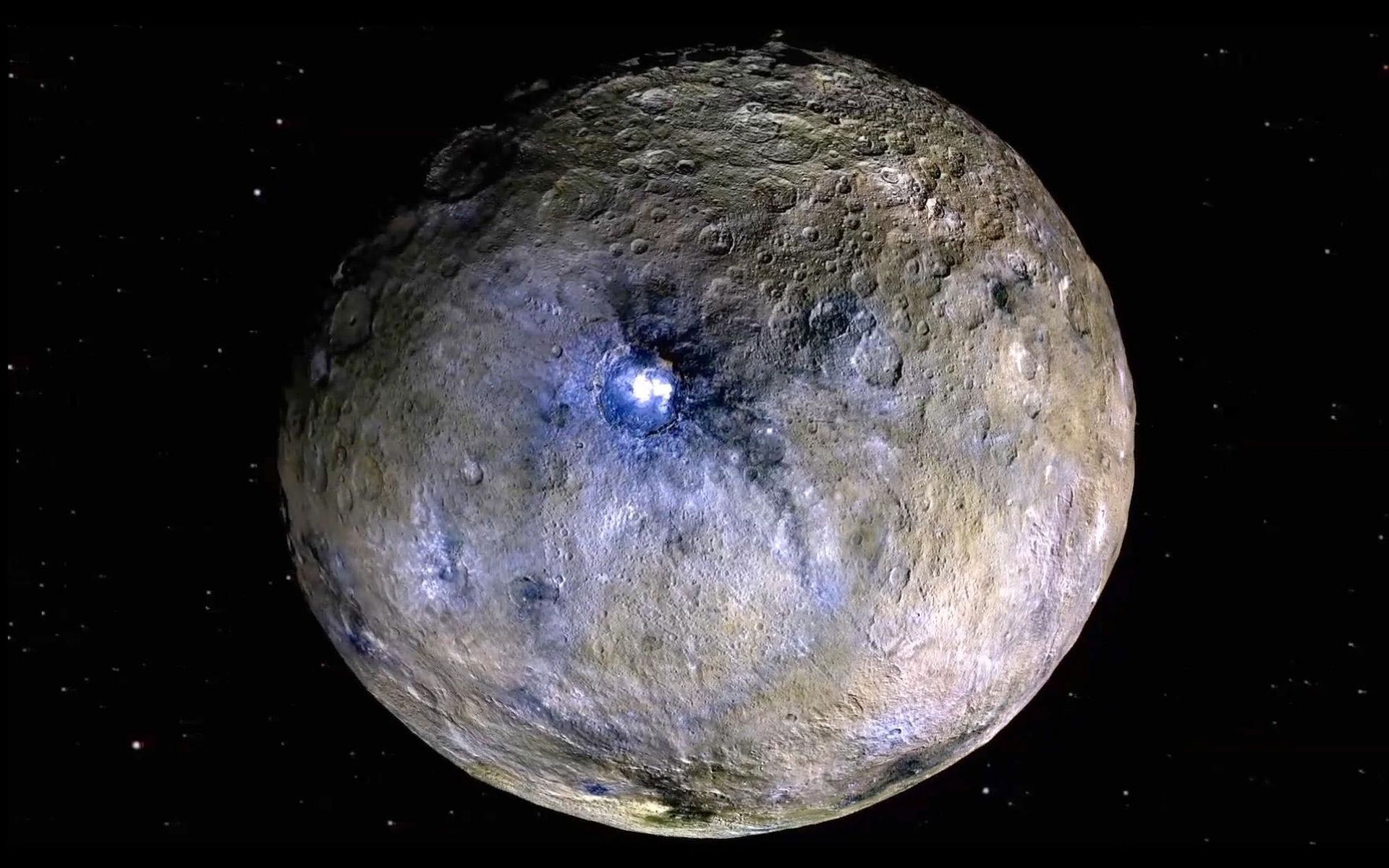
Research indicates that Ceres, initially believed to be rocky, is predominantly icy, challenging earlier views.
The findings reveal its potential past as a muddy ocean world, with simulations supporting the presence of a strong ice crust. This redefines Ceres as a key location for studying extraterrestrial oceans.
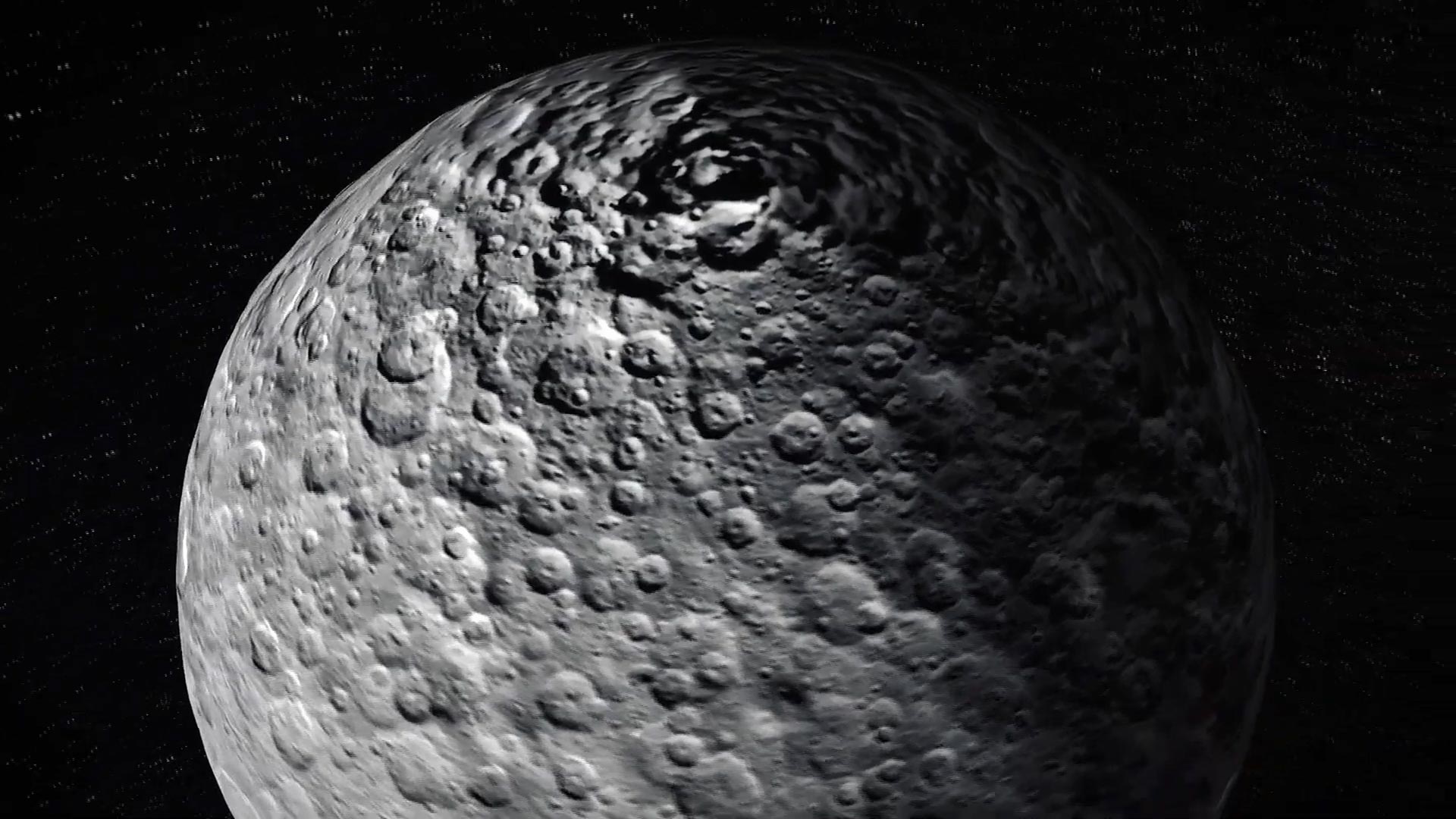
Since its discovery in 1801 by Giuseppe Piazzi, astronomers and planetary scientists have been fascinated by Ceres, the first asteroid ever spotted in our solar system. Its heavily cratered surface, marked by impacts, suggested to many that this asteroid/dwarf planet was not very icy.
New Insights Into Ceres’ Composition
However, recent research by Purdue University and NASA’s Jet Propulsion Lab (JPL) suggests otherwise. They now believe that Ceres is predominantly icy and may have once harbored a muddy ocean. This revelation about Ceres’ icy crust emerged from the work of Ian Pamerleau, a PhD student, and Mike Sori, an assistant professor in Purdue’s Department of Earth, Atmospheric, and Planetary Sciences, who published their findings in Nature Astronomy. Alongside Jennifer Scully, a research scientist at JPL, the team utilized computer simulations to study the deformation of Ceres’ craters across billions of years.
Rethinking Crater Deformation
“We think that there’s lots of water-ice near Ceres surface, and that it gets gradually less icy as you go deeper and deeper,” Sori said. “People used to think that if Ceres was very icy, the craters would deform quickly over time, like glaciers flowing on Earth, or like gooey flowing honey. However, we’ve shown through our simulations that ice can be much stronger in conditions on Ceres than previously predicted if you mix in just a little bit of solid rock.”
The team’s discovery is contradictory to the previous belief that Ceres was relatively dry. The common assumption was that Ceres was less than 30% ice, but Sori’s team now believes the surface is more like 90% ice.
Ceres: An Ancient Ocean World
“Our interpretation of all this is that Ceres used to be an ‘ocean world’ like Europa (one of Jupiter’s moons), but with a dirty, muddy ocean,’” Sori said. “As that muddy ocean froze over time, it created an icy crust with a little bit of rocky material trapped in it.”
Pamerleau explained how they used computer simulations to model how relaxation occurs for craters on Ceres over billions of years.
“Even solids will flow over long timescales, and ice flows more readily than rock. Craters have deep bowls which produce high stresses that then relax to a lower stress state, resulting in a shallower bowl via solid state flow,” he said. “So the conclusion after NASA’s Dawn mission was that due to the lack of relaxed, shallow craters, the crust could not be that icy. Our computer simulations account for a new way that ice can flow with only a little bit of non-ice impurities mixed in, which would allow for a very ice-rich crust to barely flow even over billions of years. Therefore, we could get an ice-rich Ceres that still matches the observed lack of crater relaxation. We tested different crustal structures in these simulations and found that a gradational crust with a high ice content near the surface that grades down to lower ice with depth was the best way to limit relaxation of Cerean craters.”
The Importance of Planetary Geophysics
Sori is a planetary scientist whose focus is planetary geophysics. His team addresses questions about the planetary interiors, the connections between planetary interiors and surfaces, and those questions might be resolved with spacecraft missions. His work spans many solid bodies in the solar system, from the Moon and Mars to icy objects in the outer solar system.
“Ceres is the largest object in the asteroid belt, and a dwarf planet. I think sometimes people think of small, lumpy things as asteroids (and most of them are!), but Ceres really looks more like a planet,” Sori said. “It is a big sphere, diameter 950 kilometers or so, and has surface features like craters, volcanoes, and landslides.”
NASA’s Dawn Mission Insights
On September 27, 2007, NASA launched the Dawn mission. This mission was the first and only spacecraft to orbit two extraterrestrial destinations — the protoplanet Vesta and Ceres. Although it was launched in 2007, Dawn didn’t reach Ceres until 2015. It orbited the dwarf planet until 2018.
“We used multiple observations made with Dawn data as motivation for finding an ice-rich crust that resisted crater relaxation on Ceres. Different surface features (e.g., pits, domes, and landslides, etc.) suggest the near subsurface of Ceres contains a lot of ice,” Pamerleau said. “Spectrographic data also shows that there should be ice beneath the regolith on the dwarf planet and gravity data yields a density value very near that of ice, specifically impure ice. We also took a topographic profile of an actual complex crater on Ceres and used it to construct the geometry for some of our simulations.”
Sori says that because Ceres is the largest asteroid there was suspicion that it could have been any icy object based on some estimates of its mass made from the Earth. those factors made it a great choice for a spacecraft visit.
“To me the exciting part of all this, if we’re right, is that we have a frozen ocean world pretty close to Earth. Ceres may be a valuable point of comparison for the ocean-hosting icy moons of the outer solar system, like Jupiter’s moon Europa and Saturn’s moon Enceladus,” Sori said. “Ceres, we think, is therefore the most accessible icy world in the universe. That makes it a great target for future spacecraft missions. Some of the bright features we see at Ceres’ surface are the remnants of Ceres’ muddy ocean, now mostly or entirely frozen, erupted onto the surface. So we have a place to collect samples from the ocean of an ancient ocean world that is not too difficult to send a spacecraft to.”
Reference: “An ancient and impure frozen ocean on Ceres implied by its ice-rich crust” by I. F. Pamerleau, M. M. Sori and J. E. C. Scully, 18 September 2024, Nature Astronomy.
DOI: 10.1038/s41550-024-02350-4
This research was supported by a NASA grant (80NSSC22K1062) in the Discovery Data Analysis Program.
Never miss a breakthrough: Join the SciTechDaily newsletter.
Follow us on Google and Google News.
1 Comment
No true it very unlikely that an ocean or any liquid water to have existed on ceres. It was described as muddy icy-rocky back in 2015