

The discovery of a Bronze Age settlement at Kach Kouch, Morocco, redefines the Maghreb’s history, proving early habitation, agriculture, and cultural exchanges before the Phoenicians.
Most Bronze Age settlements have been documented in European territory. Despite its geographical proximity, the Maghreb has long been absent from these historical narratives, erroneously characterized as an “empty land” until the arrival of the Phoenicians around 800 BC. A research study led by Hamza Benattia Melgarejo (University of Barcelona) has uncovered the first Bronze Age settlement in this region, predating the Phoenician period. This discovery holds great significance for the history of Africa and the Mediterranean.
According to findings published in Antiquity, excavations at Kach Kouch, located in northwest Morocco, reveal evidence of human occupation dating from 2200 to 600 BC. This makes it the earliest known site of this period in Mediterranean Africa, apart from Egypt.
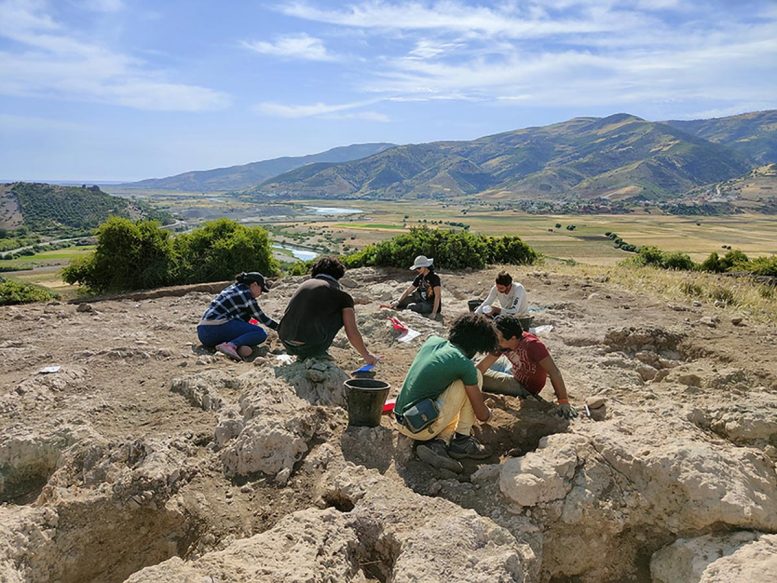
An international research team, led by Hamza Benattia Melgarejo, a PhD student at the University of Barcelona’s Faculty of Geography and History and a member of its Classical and Protohistoric Archaeology Research Group, has been studying the prehistoric settlement of Kach Kouch. The site spans approximately one hectare near the Lau River, ten kilometers from the present-day coast, near the Strait of Gibraltar, and thirty kilometers southeast of Tétouan.
Phases of Settlement and Cultural Development
Excavations have revealed different phases of occupation. The first, from 2200-2000 BC, is poorly represented but significant. The evidence suggests an initial contemporary occupation in the transition from the Bronze Age to neighboring Iberia.
The second phase, 1300-900 BC, is a vibrant period in the history of the settlement. A stable agricultural community was established at Kach Kouch and is the first definitive evidence of sedentary life before the Phoenician presence in the Maghreb. Wooden mud-brick buildings, rock-cut silos, and grinding stones reveal a thriving agricultural economy based on crops such as barley and wheat, supplemented by sheep, goats, and cattle.
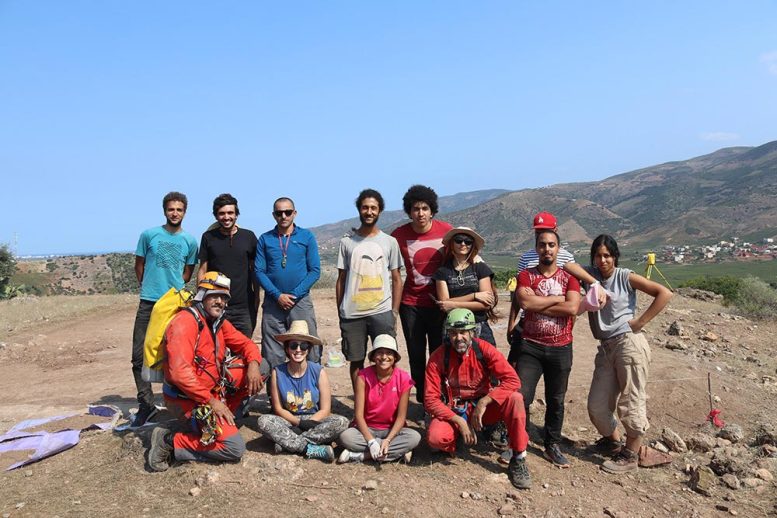
A third phase, extending from 800 to 600 BC, demonstrates the flexibility and adaptability of the inhabitants of Kach Kouch. During this period, several cultural innovations from the eastern Mediterranean were introduced, such as wheel-thrown pottery, iron tools, and new architectural traditions using stone. This mix of local and foreign practices illustrates how the community actively participated in Mediterranean exchange networks.
“Kach Kouch is one of the first well-documented examples of continuous settlement in the Maghreb and tells a very different story from the one that has existed for a long time: it shows the history of dynamic local communities that were far from isolated,” says Benattia. “The excavations at this site are another step towards correcting these historical biases and reveal that the Maghreb was an active participant in the social, cultural, and economic networks of the Mediterranean,” says the UB researcher.
Reference: “Rethinking late prehistoric Mediterranean Africa: architecture, farming and materiality at Kach Kouch, Morocco” by Hamza Benattia, Youssef Bokbot, Jorge Onrubia-Pintado, Meryem Benerradi, Bouchra Bougariane, Bouchra Bouhamidi, Jared Carballo-Pérez, Othman Echcherif-Baamrani, Asmae Elqably, Noufel Ghayati, Hassan Hachami, Mohamed Kbiri-Alaoui, Raluca Lazarescu, Lorena Lombardi, Giulio Lucarini, Rafael M. Martínez-Sánchez, Marta Mateu-Sagés, Pau Menéndez-Molist, Ignacio Montero-Ruiz, Zayd Ouakrim, Guillem Pérez-Jordà, Moad Radi, Joan Ramon-Torres, Eric Sobrevia-Corral, Tachfine Touri and Cyprian Broodbank, 17 February 2025, Antiquity.
DOI: 10.15184/aqy.2025.10
Never miss a breakthrough: Join the SciTechDaily newsletter.
Follow us on Google and Google News.