
New structural markers of memory storage uncovered by Scripps Research may pave the way for new treatments for memory loss.
Using advanced genetic tools, 3D electron microscopy, and artificial intelligence, scientists at Scripps Research and their collaborators have identified key hallmarks of long-term memory, known as an engram. Published in Science on March 20, 2025, their findings offer new insights that could lead to improved treatments for memory loss and other cognitive impairments linked to aging and neurodegenerative diseases.
“Our work leverages recent technological developments across multiple fields,” says Marco Uytiepo, a Scripps Research graduate student and the study’s lead author. “We used high-resolution 3D imaging to reveal the intricate architecture of brain circuits that store memory traces with unprecedented detail. Since analyzing these images with conventional computer programs could take years, we relied heavily on AI algorithms to accelerate data processing by several orders of magnitude.”
Uytiepo and his team focused on the hippocampus, a brain region essential for learning and memory in both animals and humans. Using mouse models, they labeled and identified neurons activated during a specific learning task. They then reconstructed the synaptic connections between these neurons, where communication occurs, at nanometer-scale resolution.
“We hoped to uncover something interesting since no similar approaches had been implemented before,” says Anton Maximov, professor of neuroscience and the study’s senior author. “What we did not expect was that our findings would challenge two long-standing dogmas.”
Challenging Established Views of Memory Formation
At neuronal synapses, chemical signals are typically transmitted from a single nerve terminal—a swollen region of an axon filled with vesicles that secrete these signals—to a single postsynaptic site on the dendrite of a receiving cell. Many previous studies (using lower-resolution optical imaging methods) have suggested that learning requires a bulk increase in synapse number.
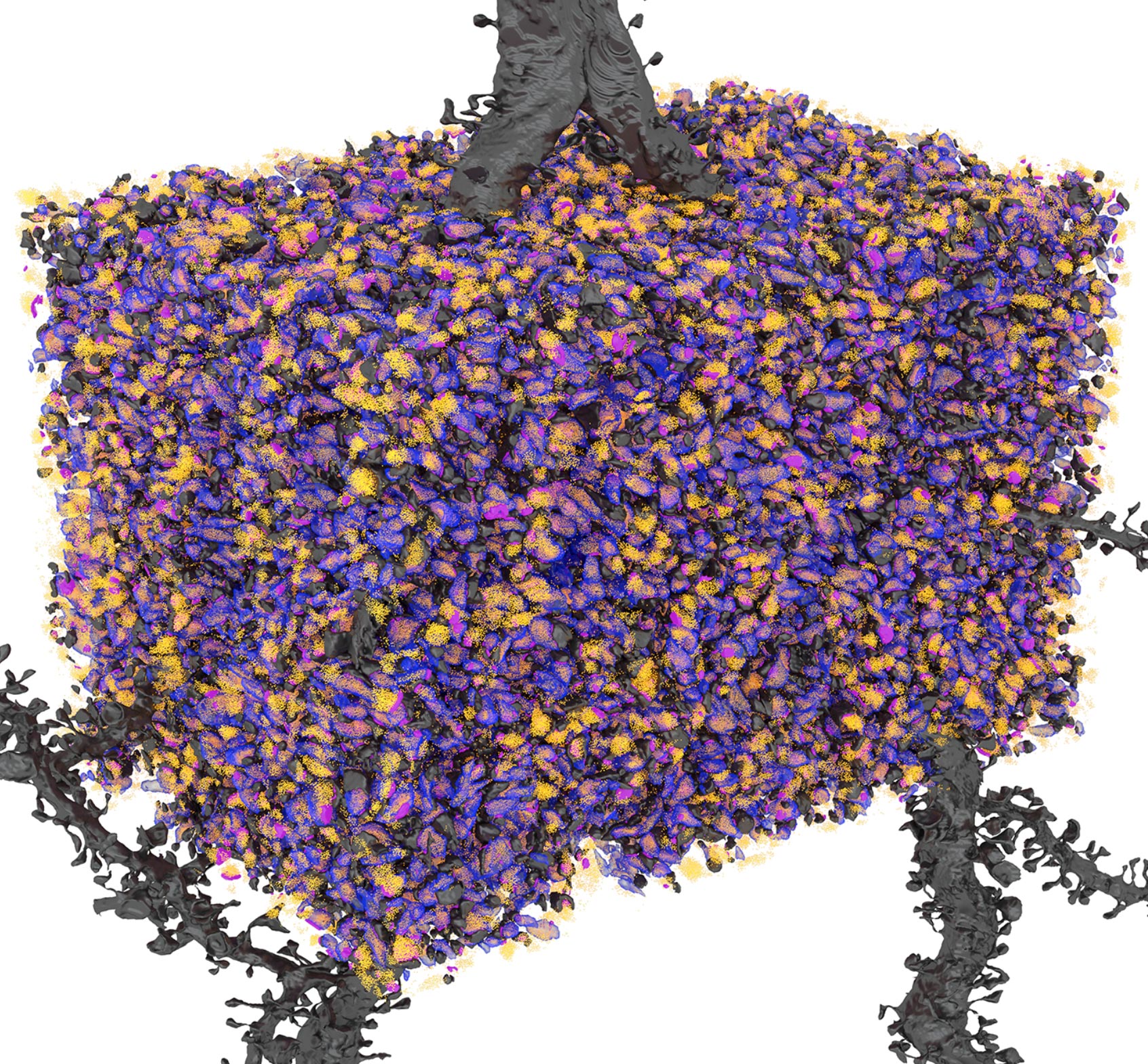
However, Maximov’s team found that this is not always the case—the total number and arrangement of isolated synapses remained unchanged after memory formation. Instead, neurons allocated to an engram expanded their connectivity through multi-synaptic boutons (MSBs)—specialized axonal terminals that simultaneously signal to up to six different dendrites rather than just one.
These MSBs were not only more abundant along the axons of activated neurons but also structurally more complex.
Unexpected Network Behavior and Cellular Changes
Secondly, Maximov’s team discovered that engram neurons in adjacent hippocampal regions do not preferentially connect with each other, counter to what is widely believed in the field. Instead, the expansion of their network through MSBs resulted in the recruitment of other neurons that were not engaged during learning. Moreover, the researchers found that engram neurons exhibited fine-scale alterations in the architecture of their individual synapses, including changes in intracellular organelles such as mitochondria and smooth endoplasmic reticulum. Additionally, these neurons displayed enhanced interactions with astrocytes—glial cells that regulate synaptic function and provide metabolic support.
Researchers now aim to determine whether similar mechanisms operate in other brain circuits and whether their dysfunction contributes to memory loss. Furthermore, MSBs have emerged as promising therapeutic targets.
“We are excited about the possibility of targeting MSBs with drugs to develop new and effective treatments for memory disorders,” says Maximov. “However, achieving this goal will require designing new tools to dissect the molecular composition of MSBs, which remains entirely unexplored. We are already making progress in this direction, but much work still lies ahead.”
As part of this effort, the researchers are also continuing to refine their AI pipelines to improve the efficiency and accuracy of analyzing large-scale imaging data.
This study was conducted in collaboration with the National Center for Microscopy and Imaging Research (NCMIR) at UC San Diego, directed by Distinguished Professor of Neurosciences Mark H. Ellisman. As an NIH BRAIN Initiative National Resource for Technology Integration and Dissemination, NCMIR provides cutting-edge imaging tools that advance neuroscience research.
“We feel incredibly fortunate to have joined forces with Mark and his team,” says Maximov. “Their deep knowledge, technical expertise, and access to state-of-the-art microscopes were instrumental to our success.”
Reference: “Synaptic architecture of a memory engram in the mouse hippocampus” by Marco Uytiepo, Yongchuan Zhu, Eric Bushong, Katherine Chou, Filip Souza Polli, Elise Zhao, Keun-Young Kim, Danielle Luu, Lyanne Chang, Dong Yang, Tsz Ching Ma, Mingi Kim, Yuting Zhang, Grant Walton, Tom Quach, Matthias Haberl, Luca Patapoutian, Arya Shahbazi, Yuxuan Zhang, Elizabeth Beutter, Weiheng Zhang, Brian Dong, Aureliano Khoury, Alton Gu, Elle McCue, Lisa Stowers, Mark Ellisman and Anton Maximov, 21 March 2025, Science.
DOI: 10.1126/science.ado8316
This work was supported by funding from the National Institute of Mental Health, the National Institute of Neurological Disorders and Stroke, and The Brain Research Through Advancing Innovative Neurotechnologies® Initiative, or The BRAIN Initiative®.
Never miss a breakthrough: Join the SciTechDaily newsletter.
Follow us on Google and Google News.
1 Comment
It’s becoming clear that with all the brain and consciousness theories out there, the proof will be in the pudding. By this I mean, can any particular theory be used to create a human adult level conscious machine. My bet is on the late Gerald Edelman’s Extended Theory of Neuronal Group Selection. The lead group in robotics based on this theory is the Neurorobotics Lab at UC at Irvine. Dr. Edelman distinguished between primary consciousness, which came first in evolution, and that humans share with other conscious animals, and higher order consciousness, which came to only humans with the acquisition of language. A machine with only primary consciousness will probably have to come first.
What I find special about the TNGS is the Darwin series of automata created at the Neurosciences Institute by Dr. Edelman and his colleagues in the 1990’s and 2000’s. These machines perform in the real world, not in a restricted simulated world, and display convincing physical behavior indicative of higher psychological functions necessary for consciousness, such as perceptual categorization, memory, and learning. They are based on realistic models of the parts of the biological brain that the theory claims subserve these functions. The extended TNGS allows for the emergence of consciousness based only on further evolutionary development of the brain areas responsible for these functions, in a parsimonious way. No other research I’ve encountered is anywhere near as convincing.
I post because on almost every video and article about the brain and consciousness that I encounter, the attitude seems to be that we still know next to nothing about how the brain and consciousness work; that there’s lots of data but no unifying theory. I believe the extended TNGS is that theory. My motivation is to keep that theory in front of the public. And obviously, I consider it the route to a truly conscious machine, primary and higher-order.
My advice to people who want to create a conscious machine is to seriously ground themselves in the extended TNGS and the Darwin automata first, and proceed from there, by applying to Jeff Krichmar’s lab at UC Irvine, possibly. Dr. Edelman’s roadmap to a conscious machine is at https://arxiv.org/abs/2105.10461