
Close Menu
    Facebook X (Twitter) Instagram
    SciTechDaily
    • Biology
    • Chemistry
    • Earth
    • Health
    • Physics
    • Science
    • Space
    • Technology
    Facebook X (Twitter) Pinterest YouTube RSS
    SciTechDaily
    Home»Earth»Rocking the Isles of Scilly – Magnificent Image Captured by Astronaut Aboard Space Station
    Earth

    Rocking the Isles of Scilly – Magnificent Image Captured by Astronaut Aboard Space Station

    By NASA Earth ObservatoryNovember 16, 2021No Comments2 Mins Read
    Facebook Twitter Pinterest Telegram LinkedIn WhatsApp Email Reddit
    Share
    Facebook Twitter LinkedIn Pinterest Telegram Email Reddit
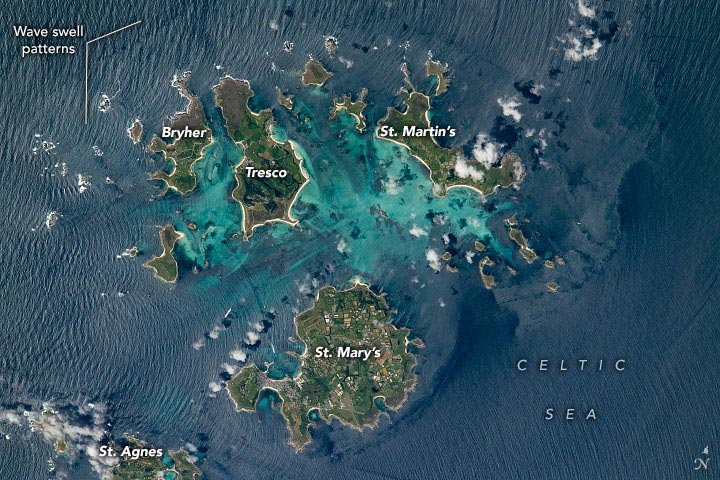
    Isles of Scilly Annotated
    Isles of Scilly, June 8, 2021

    Shallow rock formations and sandbars allow people to occasionally walk between the islands.

    An astronaut aboard the International Space Station (ISS) shot this photograph that captures some of the essence of tidal features around the Isles of Scilly, an archipelago located just southwest of Cornwall, England. The archipelago includes nearly 150 islands in the Celtic Sea, of which five are inhabited. Pictured are St. Mary’s, Tresco, St. Martin’s, Bryher, and St. Agnes—the largest islands in the chain.

    Some of the coastal waters surrounding the islands have a bright turquoise hue, indicating the presence of shallow reefs and shoals. Deeper waters have richer blue hues. This photo also captures swell patterns caused by waves that intersect one another as they move around the islands due to the westerly sea breeze.

    The Isles of Scilly are remnants of the underlying Cornubian Batholith—a mass of ancient volcanic rock (a plutonic intrusion) that formed the Cornish Peninsula. This intrusion originated with the crystallization of magma into igneous rock approximately 290 million years ago. It now sits an estimated 10 kilometers (6 miles) below the surface.

    Tides ebb and flow throughout the year and, at their lowest, can expose sandbars that allow people to walk between some islands. Low tides also can expose large rocks along the shore that are used by gray seals to bask in the sun. And bottlenose dolphins migrate with the tidal cycles here—most notably during high tides— in search of fish to feed on.

    Astronaut photograph ISS065-E-93698 was acquired on June 8, 2021, with a Nikon D5 digital camera using a focal length of 1150 millimeters. It is provided by the ISS Crew Earth Observations Facility and the Earth Science and Remote Sensing Unit, Johnson Space Center. The image was taken by a member of the Expedition 65 crew. The image has been cropped and enhanced to improve contrast, and lens artifacts have been removed. The International Space Station Program supports the laboratory as part of the ISS National Lab to help astronauts take pictures of Earth that will be of the greatest value to scientists and the public, and to make those images freely available on the Internet. Caption by Amber Turner, Jacobs, JETS Contract at NASA-JSC.

    Never miss a breakthrough: Join the SciTechDaily newsletter.
    Follow us on Google and Google News.

    Geography NASA NASA Earth Observatory
    Share. Facebook Twitter Pinterest LinkedIn Email Reddit

    Related Articles

    NASA Picturing Earth: Astronaut Photography In Focus [Video]

    Coloring the Great Salt Lake – Astronaut Takes Beautiful Photograph From Space Station

    Sea Ice in Denmark Strait – Drifted More Than 1,000 Km (600 Miles) From the Arctic Ocean

    NASA Scientists Map Beirut Blast Damage – Devastating Explosion Rocked Port Area

    NASA Advanced Rapid Imaging Satellite Maps Blast Damage: Beirut Explosion Aftermath

    NASA/NOAA Satellites Observe Surprisingly Rapid Increase in Scale and Intensity of Fires in Siberia

    Mars Terraforming: Cultivating Ideas for Mars on Earth

    Meandering Mississippi River: Photo Taken by Astronaut on Space Station Shows Divergence From State Boundaries

    Incredible Rare Peek at Patagonia in Winter

    Leave A Reply Cancel Reply

    • Facebook
    • Twitter
    • Pinterest
    • YouTube

    Don't Miss a Discovery

    Subscribe for the Latest in Science & Tech!

    Trending News

    Monster Storms on Jupiter Unleash Lightning Beyond Anything on Earth

    Scientists Create “Liquid Gears” That Spin Without Touching

    The Simple Habit That Could Help Prevent Cancer

    Millions Take These IBS Drugs, But a New Study Finds Serious Risks

    Scientists Unlock Hidden Secrets of 2,300-Year-Old Mummies Using Cutting-Edge CT Scanner

    Bread Might Be Making You Gain Weight Even Without Eating More Calories

    Scientists Discover Massive Magma Reservoir Beneath Tuscany

    Europe’s Most Active Volcano Just Got Stranger – Here’s Why Scientists Are Rethinking It

    Follow SciTechDaily
    • Facebook
    • Twitter
    • YouTube
    • Pinterest
    • Newsletter
    • RSS
    SciTech News
    • Biology News
    • Chemistry News
    • Earth News
    • Health News
    • Physics News
    • Science News
    • Space News
    • Technology News
    Recent Posts
    • 289-Million-Year-Old Reptile Mummy Reveals Origin of Human Breathing System
    • New Brain Discovery Challenges Long-Held Theory of Teenage Brain Development
    • Sharks Are Overheating as Warming Oceans Push Them to the Edge
    • Scientists Discover Plants “Scream” – We Just Couldn’t Hear Them Until Now
    • 25-Year Study Uncovers Hidden Paths and Early Warning Signs of Blood Cancer
    Copyright © 1998 - 2026 SciTechDaily. All Rights Reserved.
    • Science News
    • About
    • Contact
    • Editorial Board
    • Privacy Policy
    • Terms of Use

    Type above and press Enter to search. Press Esc to cancel.