
Close Menu
    Facebook X (Twitter) Instagram
    SciTechDaily
    • Biology
    • Chemistry
    • Earth
    • Health
    • Physics
    • Science
    • Space
    • Technology
    Facebook X (Twitter) Pinterest YouTube RSS
    SciTechDaily
    Home»Space»Rogue Revelations: Webb Identifies 540 Planetary Surprises in the Orion Nebula
    Space

    Rogue Revelations: Webb Identifies 540 Planetary Surprises in the Orion Nebula

    By Nancy Atkinson, Universe TodayNovember 6, 20231 Comment5 Mins Read
    Facebook Twitter Pinterest Telegram LinkedIn WhatsApp Email Reddit
    Share
    Facebook Twitter LinkedIn Pinterest Telegram Email Reddit
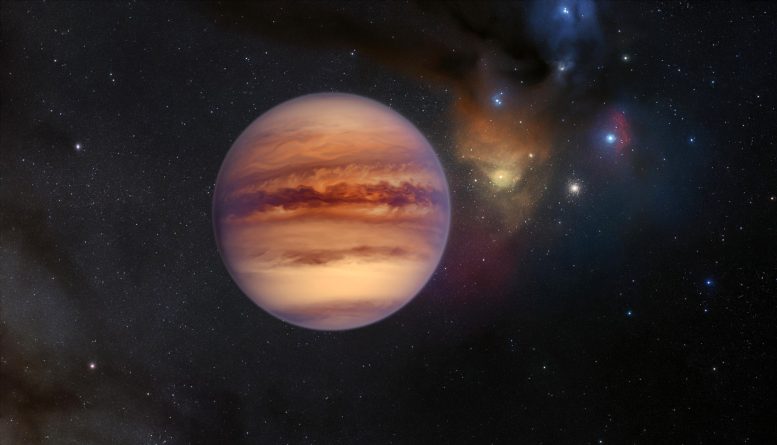
    Rogue Planet in Rho Ophiuchi
    This artist’s impression shows an example of a rogue planet with the Rho Ophiuchi cloud complex visible in the background. Rogue planets have masses comparable to those of the planets in our Solar System but do not orbit a star, instead roaming freely on their own. Credit: ESO/M. Kornmesser

    The James Webb Space Telescope has detected 540 planetary-mass objects, believed to be rogue planets, in the Orion Nebula and Trapezium Cluster.

    It appears that rogue planets – free floating worlds that aren’t gravitationally bound to a parent star – might be more common than we thought. New data from the James Webb Space Telescope have revealed 540 (yes, that’s right) planetary-mass objects in the Orion Nebula and Trapezium Cluster.

    If confirmed, this would be by far the largest sample of rogue planets ever discovered.

    Last year, astronomers found 70 free-floating worlds throughout the Milky Way.

    Astronomers Samuel Pearson and Mark McCaughrean of the European Space Agency made the observations and posted a preprint paper to arXiv. The paper has yet to be peer-reviewed but has been submitted to Nature.
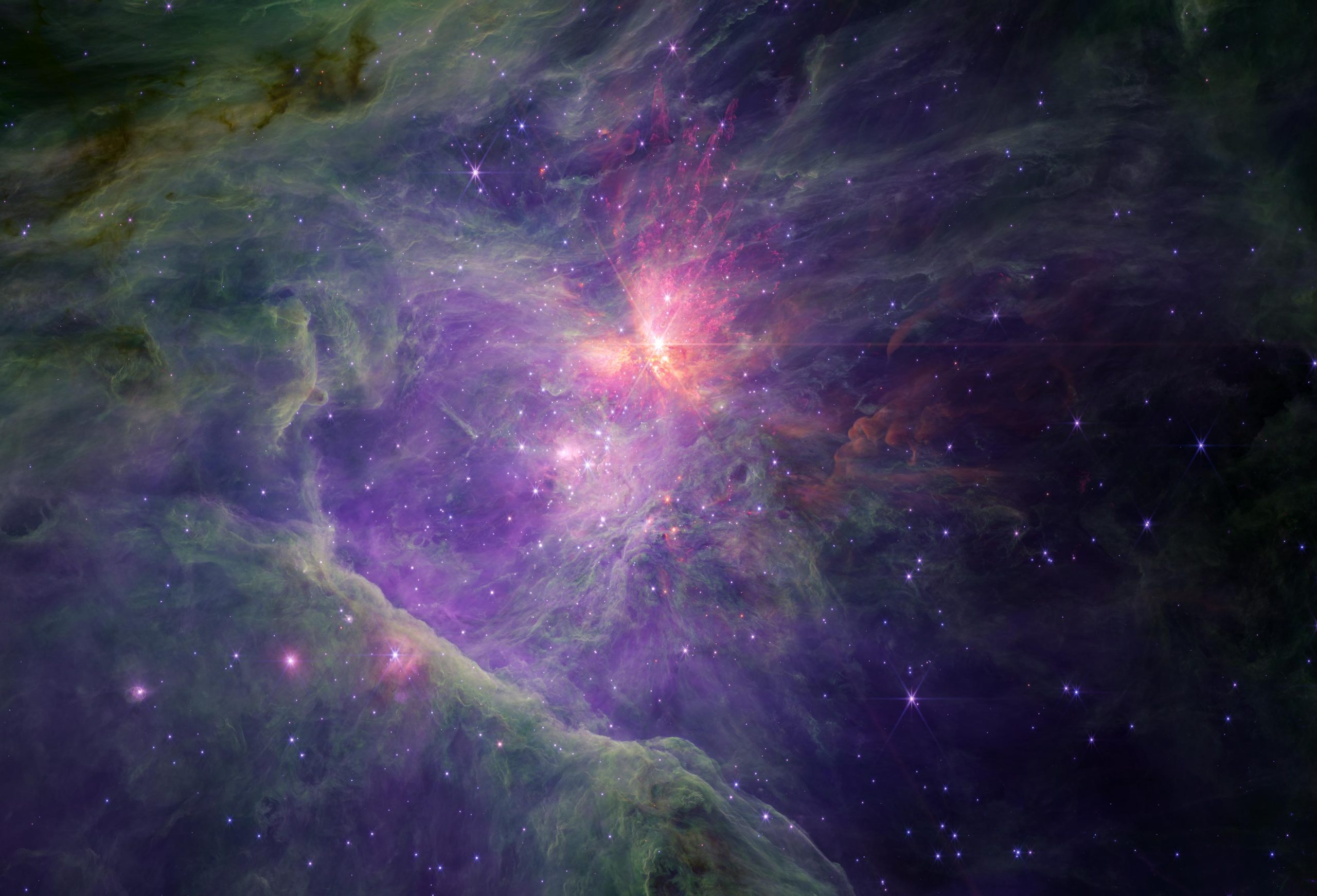
    Orion Nebula in Webb NIRCam Long-Wavelength Channel
    This image shows the full survey of the inner Orion Nebula and Trapezium Cluster made using the NIRCam instrument on the NASA/ESA/CSA James Webb Space Telescope. This is the long-wavelength colour composite, which focuses on the gas, dust, and molecules in the region with unprecedented sensitivity in the thermal infrared. Credit: NASA, ESA, CSA / Science leads and image processing: M. McCaughrean, S. Pearson

    The researchers say a near-infrared survey from JWST allowed them to discover and characterize this large sample of 540 planetary-mass candidates. The team says these planetary mass objects (PMOs) are too small to be stars, as their masses are well below the traditional cutoff for a deuterium-burning brown dwarf, even down to 0.6 Jupiter mass — not much more massive than Saturn.

    Within the large group of rogue planets are 42 pairs of planets that are gravitationally bound together, something that’s never been observed before. The astronomers named them Jupiter Mass Binary Objects, or JuMBOs.
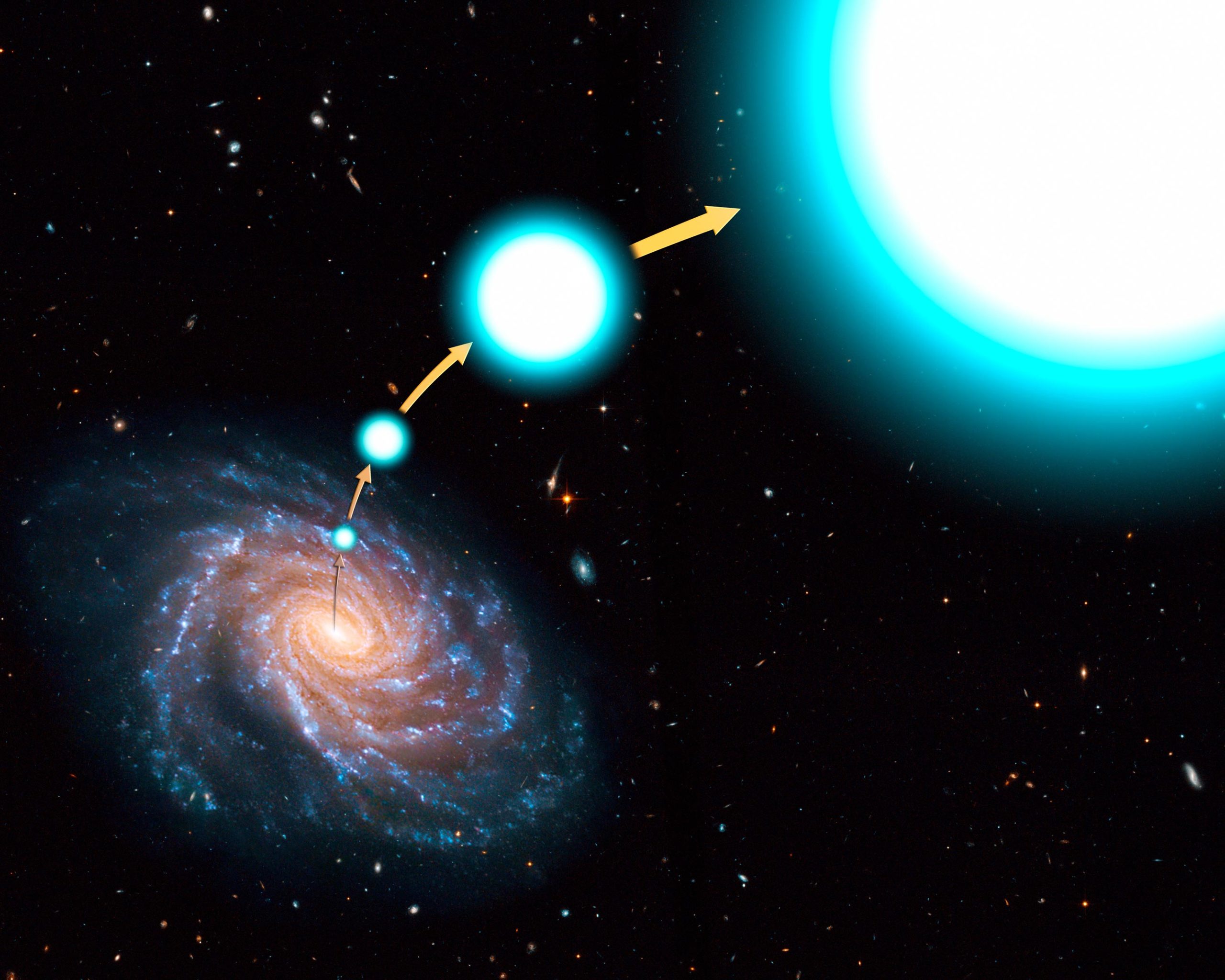
    Star Leaves the Milky Way
    Graphic of a rogue star being kicked out of a galaxy. Credit: NASA, ESA, and G. Bacon (STScI), O. Gnedin (University of Michigan, Ann Arbor), and W. Brown (Harvard-Smithsonian Center for Astrophysics, Cambridge, Mass.)

    “How pairs of young planets can be ejected simultaneously and remain bound, albeit weakly at relatively wide separations, remains quite unclear,” the researchers wrote in their paper.

    “The Jupiter Mass Binary Objects or JuMBOs are a really big discovery, we believe,” said McCaughrean, a senior adviser for science and exploration at ESA, on Mastodon.  In the pre-print, researchers said that these planetary-mass binary objects is “a result that is highly unexpected and which challenges current theories of both star and planet formation.”

    The conventional definition of a planet is that it is in orbit around a star. Additionally, current theories of planetary formation suggest that Jupiter-sized objects can only be formed through the process that gives rise to stars inside the clouds of dust and gas found in a nebula.

    “It is clear that further simulations and modeling will be needed to understand how a substantial population of objects can form below [5 Jupiter masses] and how a significant fraction of them can end up in multiple systems,” the team concluded.

    The exact mechanisms for how planets go “rogue” are unknown, but several theories exist. The theories include that planets are pulled away from one star by gravitational interactions with other passing stars, or that supernovae kick them out, or that they free float into space after their sun dies.

    Alternatively, for the JuMBOs, the researchers speculate that planetary ejections can be caused through planets scattering in a planetary disk or by dynamical interactions between stars.
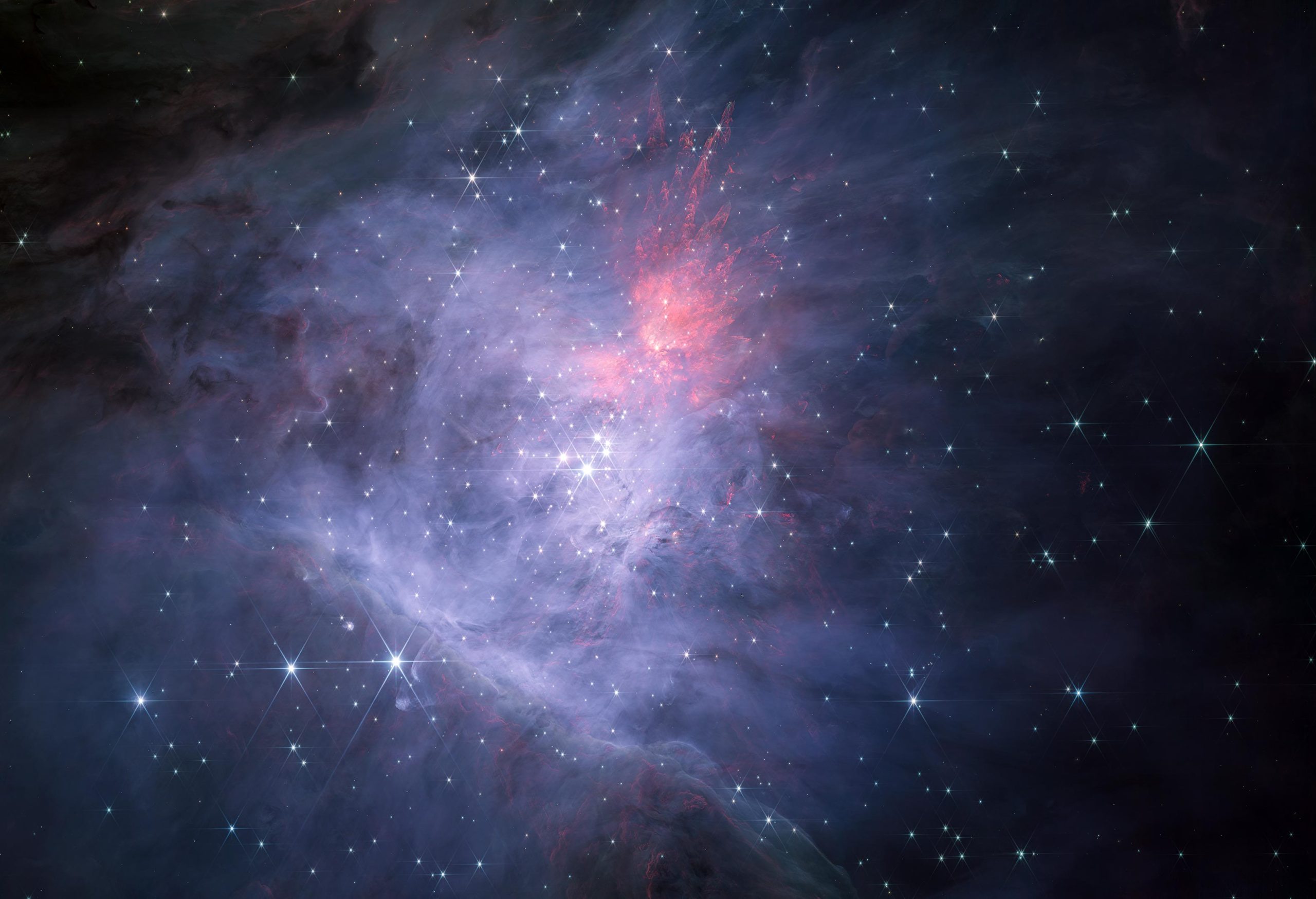
    Orion Nebula in Webb NIRCam Short-Wavelength Channel Aligned
    This image shows the full survey of the inner Orion Nebula and Trapezium Cluster made using the NIRCam instrument on the NASA/ESA/CSA James Webb Space Telescope. This is the short wavelength color composite, which reveals the nebula, its stars, and many other objects in unprecedented detail in the infrared. Credit: NASA, ESA, CSA / Science leads and image processing: M. McCaughrean, S. Pearson

    “The latter are relatively common in dense star-forming regions like the Trapezium Cluster,” the team wrote. “The ensemble of planetary mass objects and JuMBOs that we see in the Trapezium Cluster might arise from a mix of both of these “classical” scenarios, even if both have significant caveats, or perhaps a new, quite separate formation mechanism, such as a fragmentation of a star-less disk, is required.”

    Rogue planets are usually impossible to image in visible light, which makes JWST’s sensitive infrared vision the perfect tool to look for them.

    The Orion Nebula has been studied for decades to observe the formation and early evolution of stars and other celestial objects. It lies 1,350 light years away from Earth and is visible to the naked eye as a misty smudge at the bottom of the Orion constellation, part of the ‘sword’ of the mythical Greek hunter after whom the constellation is named.

    To see the images in detail, see ESA’s ESASky application, which has a user-friendly interface to visualize and download astronomical data. These are among the largest JWST mosaics observed to date.

    Orion Nebula in NIRCam short-wavelength channel on ESASky

    Orion Nebula in NIRCam long-wavelength channel on ESASky

    Adapted from an article originally published on Universe Today.

    Never miss a breakthrough: Join the SciTechDaily newsletter.
    Follow us on Google and Google News.

    Astronomy Astrophysics Exoplanet
    Share. Facebook Twitter Pinterest LinkedIn Email Reddit

    Related Articles

    Astronomers Discover Evidence for Substance on Liquid-Gas Boundary on Exoplanet WASP-31b

    Four New Exoplanets Orbiting a Nearby Sun-Like Star Discovered by TESS

    Four Exoplanets – Including a Super-Earth Planet – Discovered by High School Students

    Astronomers Uncover New Details About the Remarkable Seven Rocky Planets of TRAPPIST-1

    Unique Planetary System With Rhythmic Orbital Resonance Revealed by Exoplanet Watcher Cheops

    The 7 Rocky Earth-Size TRAPPIST-1 Planets Have Remarkably Similar Densities

    Puzzling Six-Exoplanet System Discovered With Resonant Rhythmic Movement

    Astronomers Discover First Cloudless, Jupiter-Like Planet – “Smoking Gun Evidence”

    A ‘Super-Puff’ Planet Like No Other – As Big as Jupiter but 10 Times Lighter

    1 Comment

    1. Doctor mehrdad iran on November 6, 2023 11:59 pm

      Thank you

      Reply
    Leave A Reply Cancel Reply

    • Facebook
    • Twitter
    • Pinterest
    • YouTube

    Don't Miss a Discovery

    Subscribe for the Latest in Science & Tech!

    Trending News

    New Study Reveals Why Ozempic Works Better for Some People Than Others

    Climate Change Is Altering a Key Greenhouse Gas in a Way Scientists Didn’t Expect

    New Study Suggests Gravitational Waves May Have Created Dark Matter

    Scientists Discover Why the Brain Gets Stuck in Schizophrenia

    Scientists Engineer “Tumor-Eating” Bacteria That Devour Cancer From Within

    Even “Failed” Diets May Deliver Long-Term Health Gains, Study Finds

    NIH Scientists Discover Powerful New Opioid That Relieves Pain Without Dangerous Side Effects

    Collapsing Plasma May Hold the Key to Cosmic Magnetism

    Follow SciTechDaily
    • Facebook
    • Twitter
    • YouTube
    • Pinterest
    • Newsletter
    • RSS
    SciTech News
    • Biology News
    • Chemistry News
    • Earth News
    • Health News
    • Physics News
    • Science News
    • Space News
    • Technology News
    Recent Posts
    • This 15,000-Year-Old Discovery Changes What We Know About Early Human Creativity
    • 35-Million-Year-Old Mystery: Strange Arachnid Discovered Preserved in Amber
    • Revolutionary Gas Turbine Generates Power Without Air Compression
    • Is AI Really Just a Tool? It Could Be Altering How You See Reality
    • JWST Reveals a “Forbidden” Planet With a Baffling Composition
    Copyright © 1998 - 2026 SciTechDaily. All Rights Reserved.
    • Science News
    • About
    • Contact
    • Editorial Board
    • Privacy Policy
    • Terms of Use

    Type above and press Enter to search. Press Esc to cancel.