
Close Menu
    Facebook X (Twitter) Instagram
    SciTechDaily
    • Biology
    • Chemistry
    • Earth
    • Health
    • Physics
    • Science
    • Space
    • Technology
    Facebook X (Twitter) Pinterest YouTube RSS
    SciTechDaily
    Home»Space»Rosetta Spacecraft Reveals Hidden Crater on Asteroid Lutetia
    Space

    Rosetta Spacecraft Reveals Hidden Crater on Asteroid Lutetia

    By European Space AgencyOctober 8, 2014No Comments5 Mins Read
    Facebook Twitter Pinterest Telegram LinkedIn WhatsApp Email Reddit
    Share
    Facebook Twitter LinkedIn Pinterest Telegram Email Reddit
    Rosetta Spacecraft Finds Grooves on Lutetia Asteroid
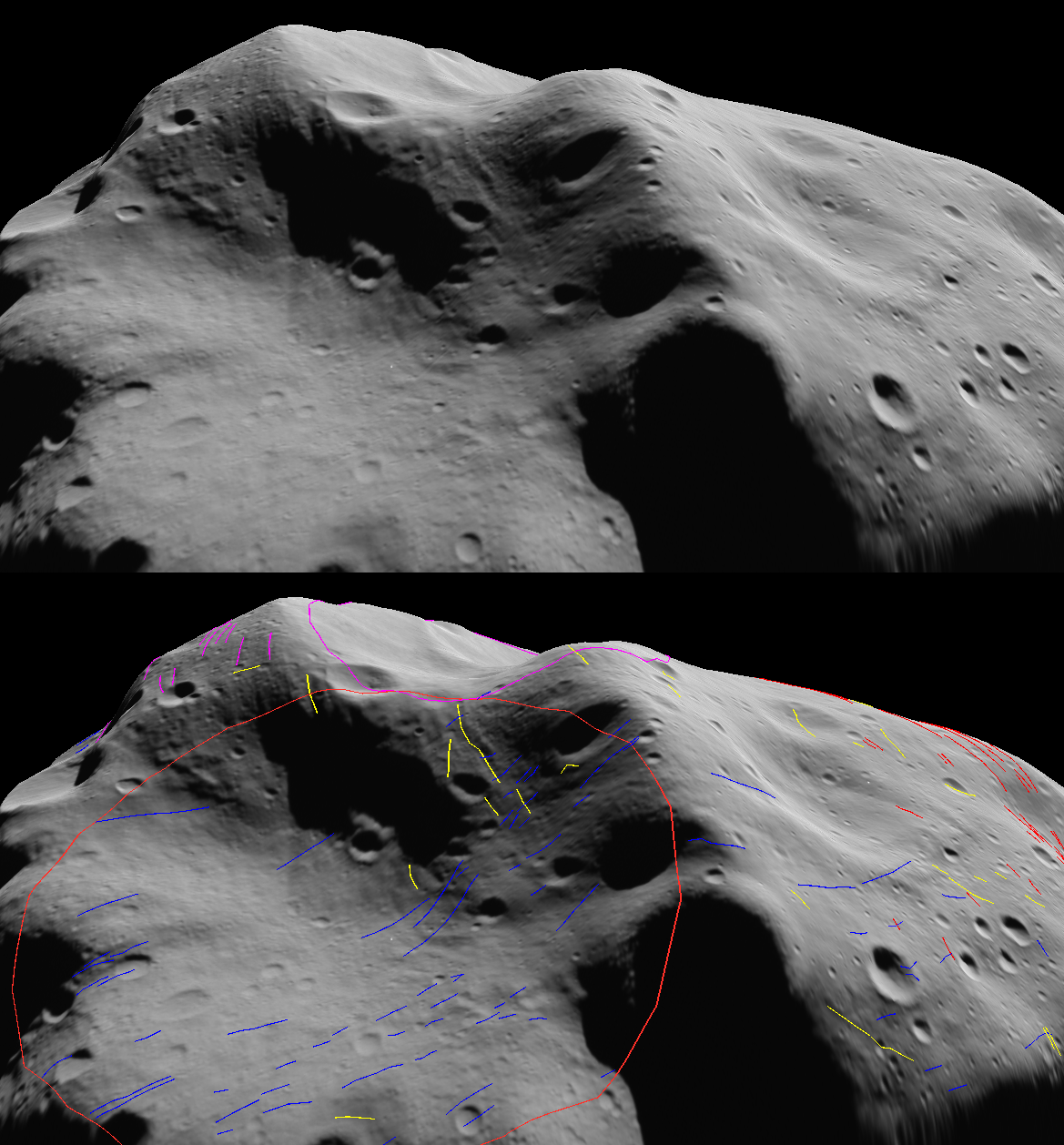
    A portion of asteroid Lutetia, looking into the 55 km-wide Massilia crater (red circular outline) with the North Pole Crater Cluster (NPCC) in the distance (purple outline). The grooves (or ‘lineaments’) are colored according to the crater to which they are associated, i.e. red for Massilia and purple for NPCC. The blue lineaments are associated with the ‘Suspicio’ crater, while the yellow lineaments are not associated with any crater discussed in this study. Credit: ESA/Rosetta/MPS for OSIRIS Team MPS/UPD/LAM/IAA/SSO/INTA/UPM/DASP/IDA

    Images by ESA’s Rosetta spacecraft reveal the existence of a large impact crater on the unseen side of the Lutetia asteroid.

    Rosetta flew past Lutetia at a distance of 3,168 km (1,968 mi) in July 2010, en route to its 2014 rendezvous with its target comet.

    The spacecraft took images of the 100 km-wide (62 mi-wide)  asteroid for about two hours during the flyby, revealing numerous impact craters and hundreds of grooves all over the surface.

    Impact craters are commonly seen on all Solar System worlds with solid surfaces, recording an intense history of collisions between bodies. However, grooves are much less prevalent. To date, they have been discovered by visiting spacecraft only on the Martian moon Phobos and the asteroids Eros and Vesta.

    The way in which grooves are formed on these bodies is still widely debated, but it likely involves impacts. Shock waves from the impact travel through the interior of a small, porous body and fracture the surface to form the grooves.

    “For Lutetia, by assuming that the grooves were formed in concentric patterns around their source impact crater, we identified 200 such features falling into distinct ‘families’, correlated with three different impact craters,” describes Sebastien Besse, a research fellow at ESA’s Technical Center, ESTEC, in the Netherlands, and lead author of the paper published in Planetary and Space Science this month.

    One of the groove systems on Lutetia is associated with the Massilia crater and another with the North Pole Crater Cluster, which comprises a number of superimposed craters. Both are on the asteroid’s northern hemisphere.

    But another group of grooves points to a crater not seen during Rosetta’s brief flyby, in the asteroid’s southern hemisphere.

    North Pole Crater Cluster on Asteroid Lutetia
    Looking face on at the North Pole Crater Cluster (purple outline) on asteroid Lutetia, with Massilia to the lower left (red outline). Marked on the image are the concentric grooves or ‘lineaments’ associated with the large craters. The lineaments colored blue infer the presence of a large crater – nicknamed Suspicio – on the unseen portion of Lutetia. Yellow denotes lineaments not associated with any of the craters discussed in this study. Credit: ESA/Rosetta/MPS for OSIRIS Team MPS/UPD/LAM/IAA/SSO/INTA/UPM/DASP/IDA

    Its implied presence has earned it the nickname ‘Suspicio’. The grooves related to Suspicio cover a large area on the asteroid, suggesting it may span several tens of kilometers. By comparison, Massilia, the largest known crater on Lutetia, is about 55 km (34 mi) wide, and the largest of the polar cluster is about 34 km (21 mi)across.

    “These three major impacts seriously deformed Lutetia’s surface,” adds Sebastien.

    “As with grooves seen on other asteroids that may also be associated with impact events, this study provides new insights into the catastrophic history of these small bodies.”

    By observing how subsequent small craters lie over the grooves on Lutetia, the scientists determined the relative ages of the three larger cratering events. Massilia is thought to be the oldest of the three craters and the polar cluster the youngest, with Suspicio between.

    The authors also looked at other, independent measurements of Lutetia, including ground-based observations with the Infrared Telescope Facility and space-based observations with ESA’s Herschel and NASA’s Spitzer.

    Shape models derived by Herschel and Spitzer before Rosetta’s flyby had already predicted a large depression at the location of Suspicio. The Infrared Telescope Facility suggested different compositions between the northern and southern hemispheres of the asteroid.

    Sebastien and his colleagues propose that a large impact, presumably the one forming Suspicio, excavated enough material of a different composition to account for the observed differences.

    “Our study ties together several independent analyses of Lutetia into one coherent story that is consistent with the presence of a large impact crater on the far side of the asteroid,” says co-author Michael Küppers, from ESA’s Space Astronomy Center in Spain.

    “Four years on and we are delighted still to be learning from just two hours’ worth of data collected during the Lutetia flyby,” says Matt Taylor, ESA’s Rosetta project scientist.

    “Rosetta is now in its main mission phase at its comet, where we are on the cusp of fantastic results. Rosetta is a true small bodies mission, two asteroids and one comet in a single trip.”

    Reference: “Lutetia׳s lineaments” by S. Besse, M. Küppers, O.S. Barnouin, N. Thomas and J. Benkhoff, 30 July 2014, Planetary and Space Science.
    DOI: 10.1016/j.pss.2014.07.007


    Never miss a breakthrough: Join the SciTechDaily newsletter.
    Follow us on Google and Google News.

    Asteroid Astronomy European Space Agency Rosetta Spacecraft
    Share. Facebook Twitter Pinterest LinkedIn Email Reddit

    Related Articles

    NEOMIR: Planetary Defense Mission for Finding Dangerous Asteroids Hidden by Sun

    Incredible Telescope View Captures DART Asteroid Impact

    Starquakes! Gaia Spacecraft Sees Strange Stars in Most Detailed Milky Way Survey to Date

    Astronomy & Astrophysics 101: Asteroids

    Feared Apophis Impact Ruled Out – Asteroid Will Pass Close Enough to Earth to See With Naked Eye

    Rosetta Spacecraft Picks Up a Mysterious “Song” From Comet 67P

    How to Land on a Comet Moving 40 Times Faster Than a Speeding Bullet

    Rosetta Orbiter Delivers First Batch of Science Data

    ESA Identifies Five Candidate Landing Sites on Comet 67P

    Leave A Reply Cancel Reply

    • Facebook
    • Twitter
    • Pinterest
    • YouTube

    Don't Miss a Discovery

    Subscribe for the Latest in Science & Tech!

    Trending News

    Breakthrough Bowel Cancer Trial Leaves Patients Cancer-Free for Nearly 3 Years

    Natural Compound Shows Powerful Potential Against Rheumatoid Arthritis

    100,000-Year-Old Neanderthal Fossils in Poland Reveal Unexpected Genetic Connections

    Simple “Gut Reset” May Prevent Weight Gain After Ozempic or Wegovy

    2.8 Days to Disaster: Scientists Warn Low Earth Orbit Could Suddenly Collapse

    Common Food Compound Shows Surprising Power Against Superbugs

    5 Simple Ways To Remember More and Forget Less

    The Atomic Gap That Could Cost the Semiconductor Industry Billions

    Follow SciTechDaily
    • Facebook
    • Twitter
    • YouTube
    • Pinterest
    • Newsletter
    • RSS
    SciTech News
    • Biology News
    • Chemistry News
    • Earth News
    • Health News
    • Physics News
    • Science News
    • Space News
    • Technology News
    Recent Posts
    • This Common Plant Could Be an Unexpected New Source of Protein
    • Birds in Cities Fear Women More Than Men and Scientists Don’t Know Why
    • Scientists Warn That This Common Pet Fish Can Wreck Entire Ecosystems
    • Scientists Just Made Carbon Capture Much Cheaper and Easier
    • Harvard Breakthrough Brings Powerful UV Light Sources Onto a Chip
    Copyright © 1998 - 2026 SciTechDaily. All Rights Reserved.
    • Science News
    • About
    • Contact
    • Editorial Board
    • Privacy Policy
    • Terms of Use

    Type above and press Enter to search. Press Esc to cancel.