
Close Menu
    Facebook X (Twitter) Instagram
    SciTechDaily
    • Biology
    • Chemistry
    • Earth
    • Health
    • Physics
    • Science
    • Space
    • Technology
    Facebook X (Twitter) Pinterest YouTube RSS
    SciTechDaily
    Home»Health»Saliva Testing for COVID-19 Is Quicker and Safer Than Nasal Swabs
    Health

    Saliva Testing for COVID-19 Is Quicker and Safer Than Nasal Swabs

    By American Society for MicrobiologyMarch 21, 2022No Comments3 Mins Read
    Facebook Twitter Pinterest Telegram LinkedIn WhatsApp Email Reddit
    Share
    Facebook Twitter LinkedIn Pinterest Telegram Email Reddit
    Saliva Test
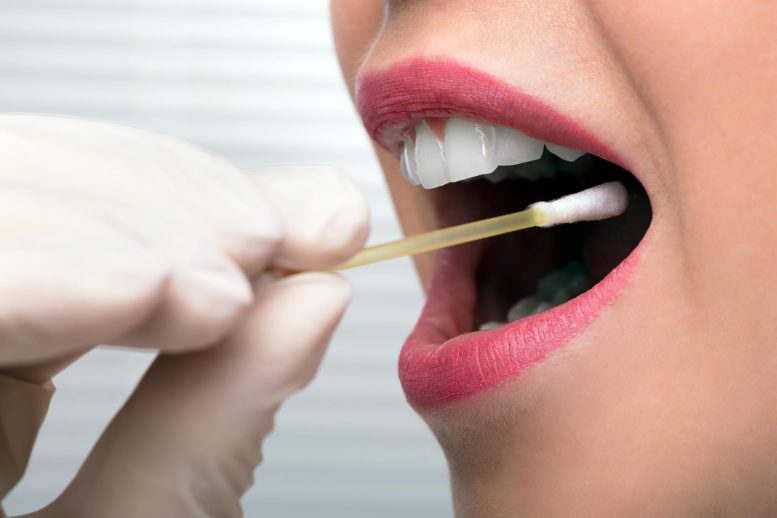
    Genetic testing of saliva samples detects the SARS-CoV-2 virus faster than nasal swab testing.

    Genetic testing of saliva samples identifies the SARS-CoV-2 virus more quickly than testing of nasal swabs. The research is published today (March 21, 2022) in Microbiology Spectrum, a journal of the American Society for Microbiology.

    “That is important because people can spread COVID-19 before they know that they have it,” said coauthor Donald K. Milton, M.D., DrPH, a professor of occupational and environmental health at the Institute for Applied Environmental Health, University of Maryland School of Public Health, College Park. “Earlier detection can reduce the disease’s spread.”

    The research was motivated by the problem that early in the pandemic, an urgent need to increase testing was accompanied by a shortage of supplies, notably nasal swabs, which were then the standard method for collecting samples for testing.

    To identify people with COVID-19 the investigators began conducting weekly tests of saliva samples from healthy community volunteers in May 2020 and continued over the next 2 years. Of the asymptomatic volunteers who tested positive, Milton and his colleagues found that those patients would typically show symptoms a day or 2 later. “That made us wonder whether saliva was better for catching pre-symptomatic patients than the traditional nasal swabs,” he said.

    Comparing Saliva Samples to Nasal Swabs

    To answer that question, the researchers used data from a companion study of close contacts of people with confirmed cases of COVID-19. In the study, “We collected saliva and mid-turbinate [nasal] swab samples from contacts every 2 or 3 days during their quarantine period,” said Milton. “All samples were tested using real-time reverse transcription polymerase chain reaction [RT-PCR] to detect SARS-CoV-2 and measure how much viral RNA was in the samples. We then analyzed how these results changed in the days before and after symptom onset.”

    “Early in the course of infection, saliva was significantly more sensitive than mid-turbinate nasal swabs,” notably so before onset of symptoms, according to the study, which noted that previous studies had shown that pre-symptomatic transmission plays a greater role than symptomatic transmission of SARS-CoV-2.

    The findings have implications for improving public acceptance of COVID-19 testing, reducing the cost of mass COVID-19 screening and improving the safety of healthcare workers who conduct testing. In the latter case, saliva self-testing avoids the close contact between patient and healthcare worker that nasal swabbing entails and avoids causing patients to cough and sneeze, thereby spreading virus particles as a result of swabbing the sensitive nasal passages, as well as discomfort to patients.

    “Our research supports the use of saliva in large-scale screening in schools and workplaces, as a means of improving screening rates, as well as early detection,” said Milton. “We expect that if rapid saliva tests become available, they could be a major advance from the current nasal swab-based rapid tests.”

    Reference: “Comparison of Saliva and Midturbinate Swabs for Detection of SARS-CoV-2” by Jianyu Lai, Jennifer German, Filbert Hong, S.-H. Sheldon Tai, Kathleen M. McPhaul and Donald K. Milton for the University of Maryland StopCOVID Research Group, 21 March 2022, Microbiology Spectrum.
    DOI: 10.1128/spectrum.00128-22

    Never miss a breakthrough: Join the SciTechDaily newsletter.
    Follow us on Google and Google News.

    American Society for Microbiology COVID-19 Immunology Infectious Diseases Public Health
    Share. Facebook Twitter Pinterest LinkedIn Email Reddit

    Related Articles

    NSAIDs – Such As Advil and Meloxicam – Might Exacerbate or Suppress COVID-19 Depending on Timing

    Antibodies Fade Quickly in Recovering COVID-19 Patients

    Ups and Downs in COVID-19 Data May Be Caused by Problems With Diagnosis and Reporting

    Common Molecular Feature of Antibodies That Neutralize SARS-CoV-2 Discovered, Boosting COVID-19 Vaccine Prospects

    Study Is First to Identify Potential Therapeutic Targets for Covid-19 Using Blood Samples From Critically Ill Patients

    MMR Vaccine Could Protect Against the Worst COVID-19 Symptoms – “A Low-Risk-High-Reward Preventive Measure”

    How Many People Actually Have COVID-19? Significant Global Differences in Undetected Cases

    FDA Approved Drug May Help Calm Cytokine Storm in COVID-19

    New Study Outlines a Roadmap for Effective Treatment of COVID-19

    Leave A Reply Cancel Reply

    • Facebook
    • Twitter
    • Pinterest
    • YouTube

    Don't Miss a Discovery

    Subscribe for the Latest in Science & Tech!

    Trending News

    “Strangest of Its Kind”: Scientists Uncover a Bizarre Bacterial Self-Destruct Switch

    Scientists Reverse 60 Years of Aging in Human Cells, Turning 80-Year-Old Cells Into 20-Year-Olds

    A Solar Storm Heading Toward Earth Suddenly Changed in Ways Scientists Didn’t Predict

    A Simple Diet Change Could Transform Kidney Disease Treatment, 10-Year Study Finds

    Eating 30% Less Food Has an Unexpected Effect on DNA, Study Finds

    Just Two Days on a Vegan Diet Triggered Unexpected Changes in the Liver

    Antarctica’s “Doomsday Glacier” Could Raise Sea Levels Twice As Much as Scientists Feared

    Snakebites Are Far Deadlier Than We Thought, New Study Reveals

    Follow SciTechDaily
    • Facebook
    • Twitter
    • YouTube
    • Pinterest
    • Newsletter
    • RSS
    SciTech News
    • Biology News
    • Chemistry News
    • Earth News
    • Health News
    • Physics News
    • Science News
    • Space News
    • Technology News
    Recent Posts
    • Scientists Discover a Hidden Weakness in Cancer Cells That Could Transform Treatment
    • Obesity Could Disable a Key Defense Against Breast Cancer, Study Finds
    • Ultra-Processed Foods May Be Changing How Children’s Brains Respond to Food
    • Hubble Finds a Stunning Twist in How the Universe Emerged From Darkness
    • This Giant Planet Orbits Its Star Every Two Days – but Something Is Very Wrong
    Copyright © 1998 - 2026 SciTechDaily. All Rights Reserved.
    • Science News
    • About
    • Contact
    • Editorial Board
    • Privacy Policy
    • Terms of Use

    Type above and press Enter to search. Press Esc to cancel.