

ESA’s innovative approach to satellite reentry begins with ‘Salsa,’ utilizing airborne experiments to capture live data on the satellite break-up process. This effort supports safer, more sustainable satellite end-of-life options.
On September 8, 2024, the first of four Cluster satellites will return home and burn up in Earth’s atmosphere in an uncontrolled ‘targeted reentry’ over a remote area of the South Pacific Ocean.
In the nearly 70 years of spaceflight about 10,000 intact satellites and rocket bodies have reentered the atmosphere. Yet we still lack a clear view on what actually happens during a reentry.
An airborne observation experiment will now attempt to witness the ‘Salsa’ (Cluster 2) reentry. Scientists on board a small plane will try to collect rare data on how and when a satellite breaks up, which can be used to make satellite reentries safer and more sustainable in the future.
Learning From Salsa’s Demise
“To keep Earth’s valuable orbits clean, it is important to remove a satellite quickly from orbits after their mission comes to an end, and thereby prevent more space debris,” says Holger Krag, Head of Space Safety at ESA.
“Reentry science is an essential element of these efforts. Cluster’s reentry can help us understand how to design and operate satellites so that they can be disposed of easily, safely and sustainably in the future.”
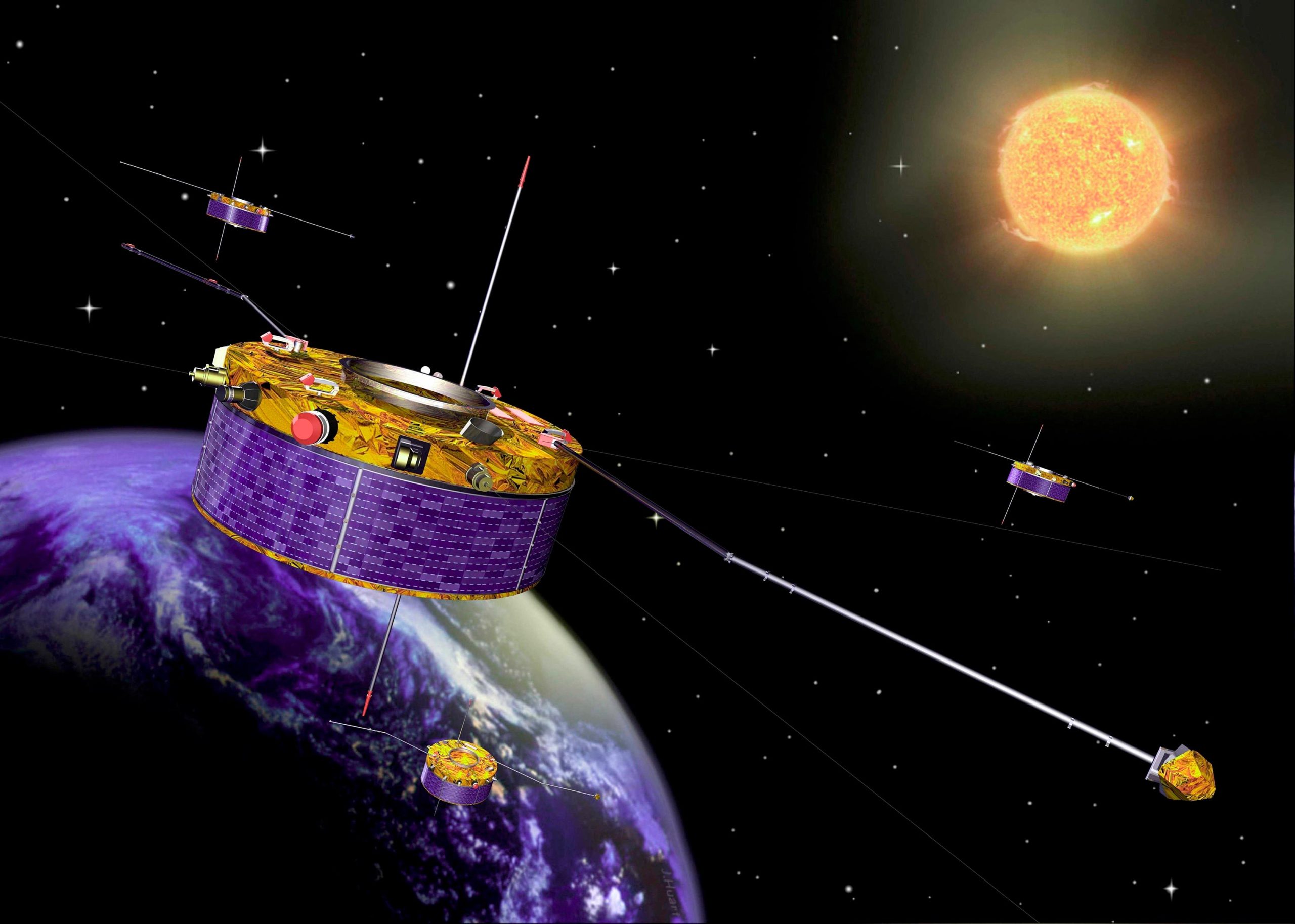
Cluster offers a unique opportunity with its quartet of identical satellites. Starting with Salsa, each of them will reenter under slightly different circumstances and angles, offering up a scientist’s dream: a repeatable experiment.
“Together with our partners at Astros Solutions we are sending a plane to observe Salsa’s reentry live from the sky to observe a satellite class and reentry conditions which have never been accessible before,” says Stijn Lemmens, Space Debris Analyst in the ESA Space Debris Office.
“There’s testing we can do on the ground, and we have virtual modeling, but we also need real-life observations right at the scene of a reentry to complete the picture. The observation experiment from a plane is an exciting new possibility for us to collect data and gain confidence in the modeling to support new missions.”
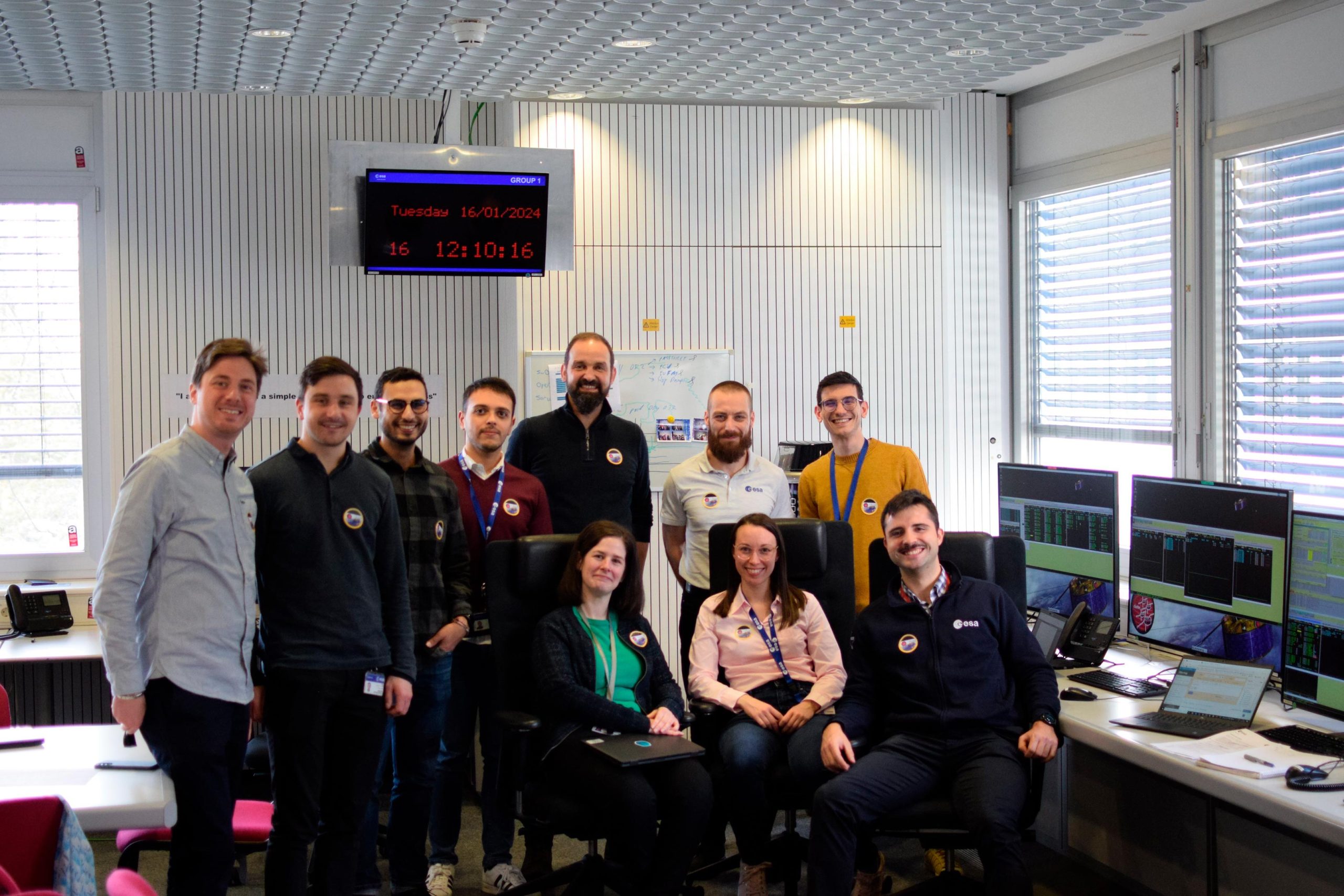
Having spent 24 years in orbit exploring interactions between the Sun and Earth, the veteran Cluster mission is now coming to an end. The first of the four satellites in the Cluster quartet, ‘Salsa’, will reenter Earth’s atmosphere in September 2024. This January, the operations team carried out a series of maneuvers to ensure this reentry will take place over a sparsely populated region in the South Pacific. Credit: ESA
Salsa’s Last Dance Targets the Pacific
Already in January 2024, operators set up Salsa to target a specific geographic location in one of the remotest regions on Earth on September 8, 2024.
It’s not quite now or never, but it is now or in 24 years’ time.
“Cluster’s orbit takes it very close to Earth and then very far away again on a 12-year cycle,” explains Cluster Operations Manager Bruno Sousa.
“Salsa naturally makes a close approach over the southern hemisphere this year, which we knew would lead to it being captured by the atmosphere. Its trajectory was slightly adjusted in January 2024, when we maneuvered it to target a specific region of the South Pacific Ocean that is as far from populated regions as possible.”
While most of the spacecraft will disintegrate within less than a minute, a few parts are likely to survive. Targeting open waters upon reentry is hugely reducing the amount of land over which fragments could fall, making the reentry as safe as possible.

Coordinating Aerial Observations
The team needs a fixed time and a location to prepare the airborne observation experiment. A controlled reentry would make that a breeze, but Cluster was not designed with this capability.
The Cluster satellites’ highly eccentric orbit does allow a ‘targeted reentry’. Its highly eccentric orbit means Salsa is experiencing a large loss of altitude at its closest point to Earth (perigee) from orbit to orbit due to the gravitational influence of the Sun and Moon. It is no coincidence this happens during Salsa’s last orbits.
Big drops of over 30 km in altitude between one orbit and the next means that the team can pinpoint the exact orbit when Salsa will go so low that it crosses the threshold where satellites start to burn up, at around 80 km altitude. That is how they know it will reenter and burn up on September 8.
“It’s because of this predictability in the reentry time and location that we can outfit a plane with scientific instruments and observe the reentry from as close as safely possible,” says Stijn.
“There is however one unknown: the atmospheric density as we go lower and lower. Therefore, over the next weeks, ground stations will keep listening for Salsa hoping it can send telemetry right until the end. Telescopes are also tracking the spacecraft, because minor deviations from its predicted trajectory, if there would be any, could be important for the flight plan from Easter Island.”

Innovative Airborne Experiment
It’s not easy to conduct an airborne, experimental observation campaign at a location picked because of its remoteness.
“The airborne observation mission ‘ROSIE-Salsa‘ is a joint effort of academic partners from University of Stuttgart (IRS/HEFDiG), Comenius University in Bratislava (CUB), University of Southern Queensland (UniSQ) and industrial partners from Hypersonic Technology Göttingen (HTG) and Astros Solutions, in close cooperation with ESA,” says Jiří Silha, CEO of Astros Solutions.
“It is a very challenging mission due to the unpredictable nature of reentry events, which makes the reentry break-up prediction as well as the planning of the aircraft positioning for the best observation very demanding. However, with experts in both science and technical preparation, our team consists of exceptionally capable people who will ensure that once the object is in sight, we will get all the relevant scientific data we need.”
The plane will be mounted with the scientific instruments in Australia before making a test flight to check if everything is ready for the big event. Then the team moves to Easter Island to set up communications there and wait until it’s time to fly out and meet up with Salsa.
Onboard the plane will be the science lead from IRS/HEFDiG, the mission lead from UniSQ and mission participants from CUB and Astros Solutions, hoping to catch the reentry live. HTG supports the scientific analysis and modeling of the data as well as support the creation of the precise flight plan for the plane.
Each window of the plane will have cameras and spectrographs peeking out of them. All in all, over 20 scientific instruments will be looking for the explosion, tracking the fragments and recording as much detail as possible.
The Challenges of Daylight Reentry
Because the reentry takes place during the day, it will be harder to spot the reentry against the bright backdrop of the sky than it would be at night. It shortens the time that the scientists have to tune their instruments. It also makes it more complicated for some of the instruments that will have to quickly filter out the Sun’s radiation from the signals they are trying to catch.
It will be a tense wait until there is confirmation if the observation was a success. It might take a few minutes, or even hours, because of the limited connectivity on the plane and its extremely isolated location.
Future of Reentry Science and Debris Reduction
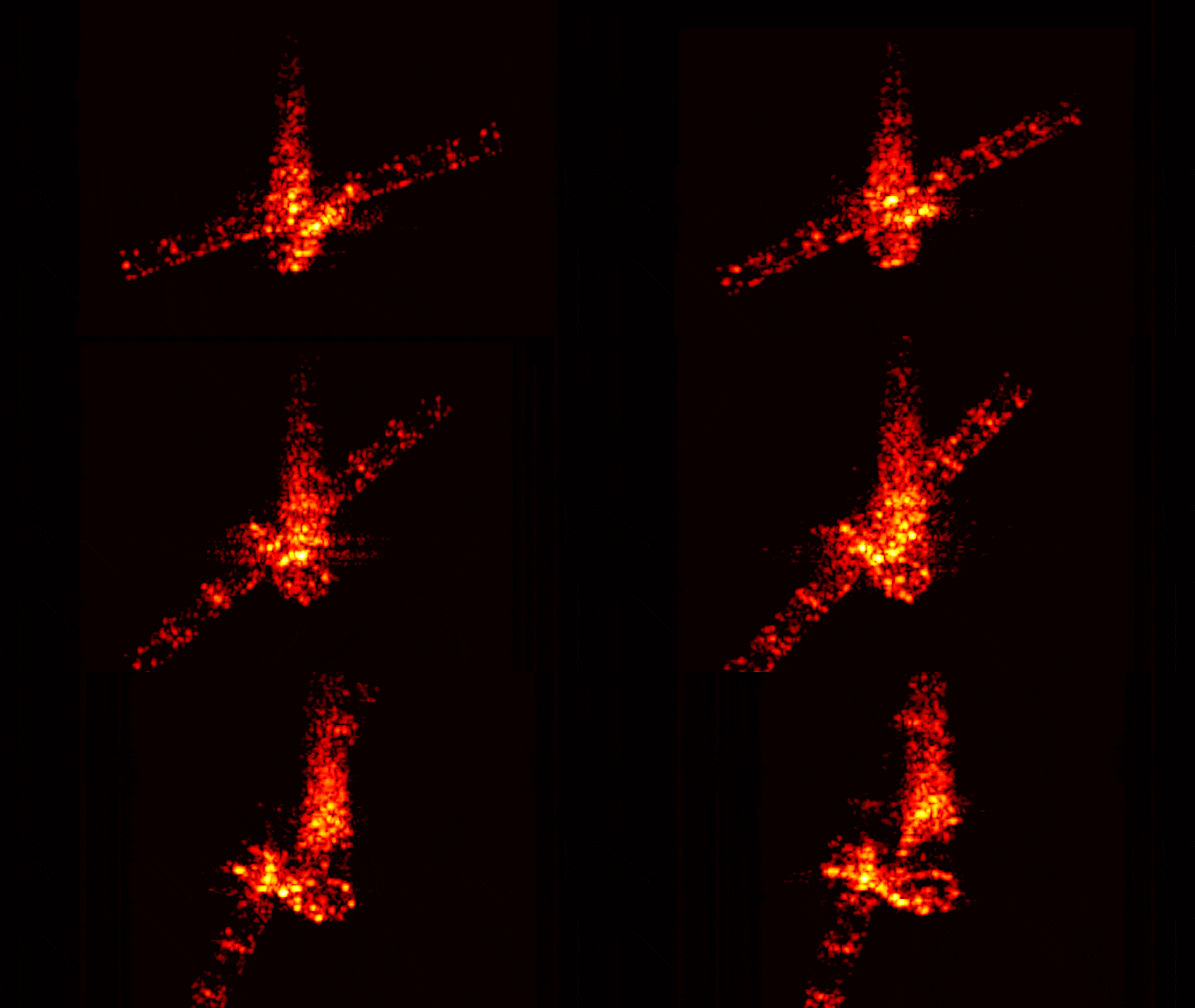
The exciting opportunity to send a plane to observe reentries live from the air is rare and promises a wealth of data on how and when exactly satellites break up.
Cluster’s reentry follows those of ESA’s s Aeolus and ERS-2 Earth observation missions. ESA is setting a precedent for a responsible approach to reduce the ever-increasing problem of space debris and uncontrolled reentries with its Zero Debris approach, committing to stop the creation of space debris by 2030.
Until the end of November 2024, ESA operators will maneuver the three remaining Cluster satellites to line them up for reentries in similarly remote locations over the South Pacific Ocean. ‘Rumba’ (Cluster 1) will come down in November 2025, and ‘Samba’ (Cluster 3) and ‘Tango’ (Cluster 4) in August 2026.
“On top of the four Cluster reentries, we are also looking ahead to ESA’s exciting DRACO mission. With DRACO, we want to get the telemetry from a satellite recording what is happening from the inside during its own reentry,” says Tim Flohrer, Head of the Space Debris Office at ESA.
“DRACO will be an actively controlled reentry of a satellite that is fitted out with a ‘black box’ that will provide the telemetry for us to learn from. If all goes well, we’re hopeful that we can have similar airborne observation campaigns of these reentries in the future.”
Never miss a breakthrough: Join the SciTechDaily newsletter.
Follow us on Google and Google News.