
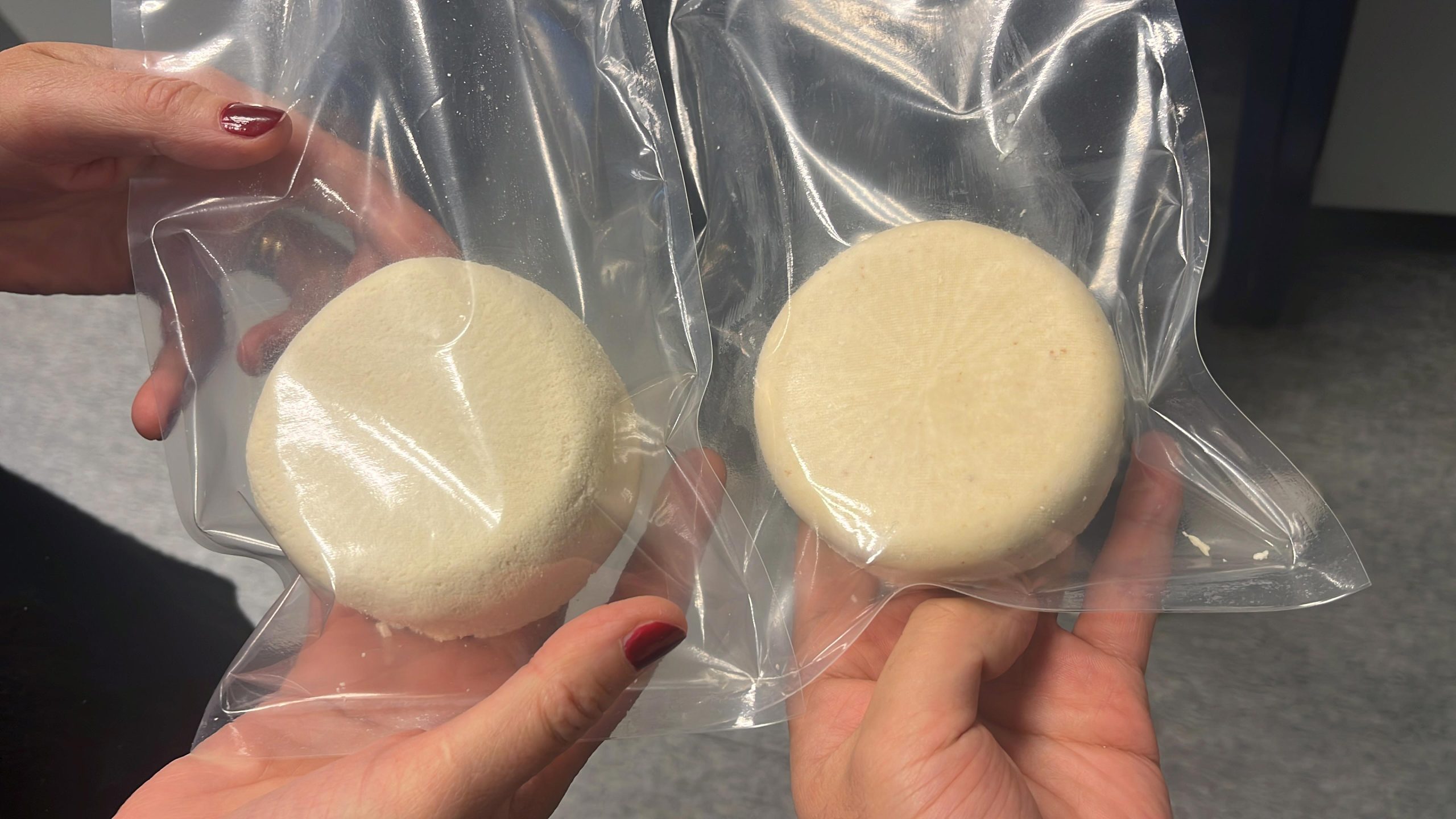
Hybrid cheese made with milk and pea protein could offer a more sustainable, tasty alternative to traditional cheese.
Creamy, crumbly, mild, or sharp — cheese is a true crowd-pleaser. From everyday meals to gourmet delights, it’s a staple across the Western world. In 2023, the average European consumed 20.5 kilograms (45 pounds) of cheese.
However, it’s no secret that, as a dairy product, heavy cheese consumption carries a significant environmental impact. As a result, extensive research is underway to develop plant-based cheeses. Unfortunately, creating a fully plant-based cheese that satisfies cheese lovers in both texture and taste has proven difficult, especially when it comes to getting the texture just right.
To address this, food researchers at the University of Copenhagen have taken a different approach: hybrid cheese. They view cheese made from a combination of milk and plant proteins as the way forward.
“It’s really difficult to create a texture that matches regular cheese if you only use plant proteins. Therefore, our strategy is to get the best of both worlds by replacing as much milk protein as possible with plant protein, without compromising on taste and texture,” says Professor Lilia Ahrné from the Department of Food Science. She continues:
“Because, consumers who don’t like the taste experience won’t buy a product just because you tell them it’s sustainable.”
She and her team have now successfully developed a recipe for a hybrid cheese similar to paneer, a widely-used South Asian cooking cheese. Their hybrid paneer consists partly of casein, the milk protein that is the main component of paneer, and partly of pea protein. And as peas are grown in Europe they are a more sustainable choice than, for example, soy-based protein.
25% peas
“We’ve investigated what happens to a cheese’s texture as we add more pea protein. How much can we add before it falls apart or loses its original paneer shape? Our experiments show that at least 25% of the milk proteins can be replaced with pea protein while still producing a cheese with a texture, shape, and taste similar to the original product,” says postdoc Wenjie Xia, first author of the study published in Food Research International.
When making paneer and most other cheeses, part of the process involves pressing it. In their experiments, the researchers applied higher pressure than usual to the hybrid cheese because pea proteins retain more water than milk proteins. This increased pressure helped the cheese maintain a solid shape despite its relatively high plant-based content.
“Hybrid cheeses like this are a solid step towards more sustainable dairy products. We demonstrate that it is possible to replace a significant portion of the milk in cheese with plant protein. With further research, we believe that it will be possible to reduce the milk content even more while still creating a product that people want to eat. In this way, there is great potential to reduce the climate footprint of a popular food category,” says Wenjie Xia.
Not only do hybrid cheeses lower the climate footprint, they can also have nutritional advantages, Lilia Ahrné points out:
“While dairy ingredients contribute with better protein quality (essential amino acids) and calcium, plant ingredients can bring dietary fibers to the product. So also nutrionally hybrid cheese has the potential to bring together qualities from both worlds.”
Grilled, baked, or fried
The researchers decided to focus on paneer because they see great potential in this type of cheese. Cooking cheeses such as paneer, halloumi, and feta are all characterized by the fact that they don’t melt when baked or fried.
“Because of paneer’s properties – that allow it to be both grilled and baked without melting – it has been a popular meat alternative in India for many years, where there are many vegans and vegetarians. That’s why we see this type of cooking cheese as a potential meat substitute in the West, where we enjoy grilling and frying our food,” says Lilia Ahrné.
The researchers emphasize that, despite the promising start that shows we get right the texture, further studies could help refine the taste experience before the cheese goes into production.
Reference: “Towards hybrid protein foods: Heat- and acid-induced hybrid gels formed from micellar casein and pea protein” by Wenjie Xia, Ilianna Drositi, Tomasz Pawel Czaja, Matias Via and Lilia Ahrné, 13 November 2024, Food Research International.
DOI: 10.1016/j.foodres.2024.115326
Never miss a breakthrough: Join the SciTechDaily newsletter.
Follow us on Google and Google News.
3 Comments
Hard to believe there are suckers out there that believe this crap.
No it isn’t. But it is sad.
Great to see research in this direction. I’m sure cows will be relieved when they no longer produce milk for humans