
We tend to avoid choosing apples with brown spots, assuming that they taste bad. But if we are to end food waste, we’ll need to upend that assumption. UCPH researcher emphasizes that there’s nothing wrong with oddly shaped or bruised apples.
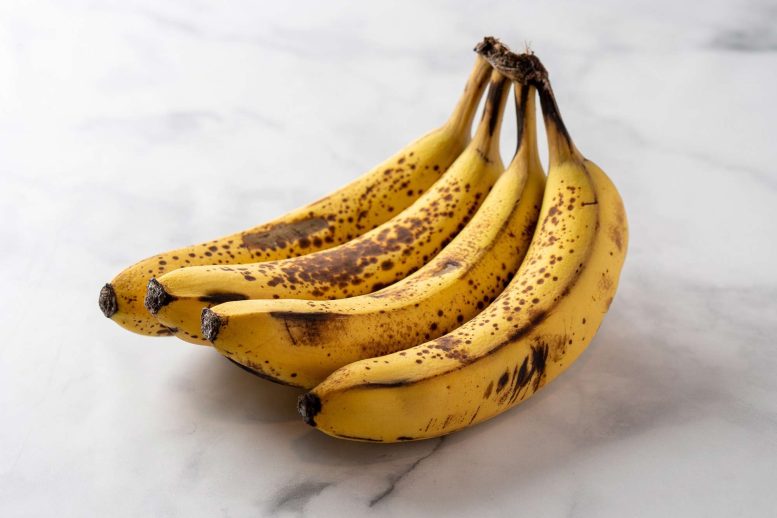
Which bananas end up in your shopping basket— the uniformly yellow ones or those with brown spots?
If you are like most people, you skip the spotted ones and select those that are perfectly yellow. This is because emotions play an oversized role in our shopping decisions, according to a study by Danish and Swedish researchers.
Don’t Eat Moldy Fruit
Even though you can easily eat a bruised apple or a brownspotted banana, you should never eat moldy or rotten foods.
“We choose food based upon an expectation of what it will taste like that is bound to our feelings. So, if we expect a brown banana to not match the taste of a yellow one, we opt for the latter,” explains Karin Wendin, an associate professor at University of Copenhagen’s Department of Food Science, and one of the researchers behind the study.
Approximately 716,000 tonnes of food are tossed out in Denmark every year—the majority of which are fruits and vegetables. Wendin laments this waste because brown fruit is not bad fruit:
“Bruised or oddly shaped fruit can easily be used. They usually taste just as good as nicely looking specimens. And in cases when an apple is bruised or a bit floury in texture, one can still use it for juice or pie. When an “ugly” piece of fruit gets tossed, it becomes food waste, which is a big problem— including financially. This is why we need to work on reevaluating our feelings about brown and oddly-shaped fruit,” she says.
The Stickiness of a Bad First Impression
In the study, 130 participants were asked to rate a series of images of apples with varying appearances. Unsurprisingly, apples with deformities and imperfections ranked lowest in terms of how many participants wanted to eat them.
The participants then had to taste a different apple. This is when it became apparent that the bad first impression became sticky.
“When participants saw a photo of an ugly apple, and then tasted one that was green and perfect, they stuck by their belief that it tasted awful. This speaks to the extent to which our emotions and psychology factor in with taste sensations,” says Karin Wendin.
“We remember negative feelings and expectations more than positive ones,” she elaborates.
Better Communication About Browning Food Can Help Limit Food Waste
This is why it is imperative that we discover strategies to disrupt the negative emotions associated with brown fruit. Karin Wendin explains in greater detail:
“As things stand, communication about our foods—and what is good or bad—does not work optimally. People don’t know where to seek advice and guidance. Few go online to investigate Nordic dietary recommendations on the Danish government’s website. Did you know, for example, that imperfect fruit is often cheaper than its more perfect neighbors, even though both products probably taste the same?” asks the food waste researcher.
This is why we need to help supermarkets communicate clearly about how to avoid food waste by grabbing an imperfect fruit, and also explore which platforms are most effective in getting messages about diet and food waste out to consumers, Karin Wendin believes.
“Or, should we instead communicate on social media, where people are, and spend time on lifestyle issues? It would be interesting to dive into,” she concludes.
Reference: “In the eye of the beholder: Expected and actual liking for apples with visual imperfections” by Laura Andreea Bolos, Carl-Johan Lagerkvist, Anne Normann and Karin Wendin, 21 August 2020, Food Quality and Preference.
DOI: 10.1016/j.foodqual.2020.104065
Never miss a breakthrough: Join the SciTechDaily newsletter.
Follow us on Google and Google News.
1 Comment
Ill take the bruised, brown banana with my bug burger. Thanks