
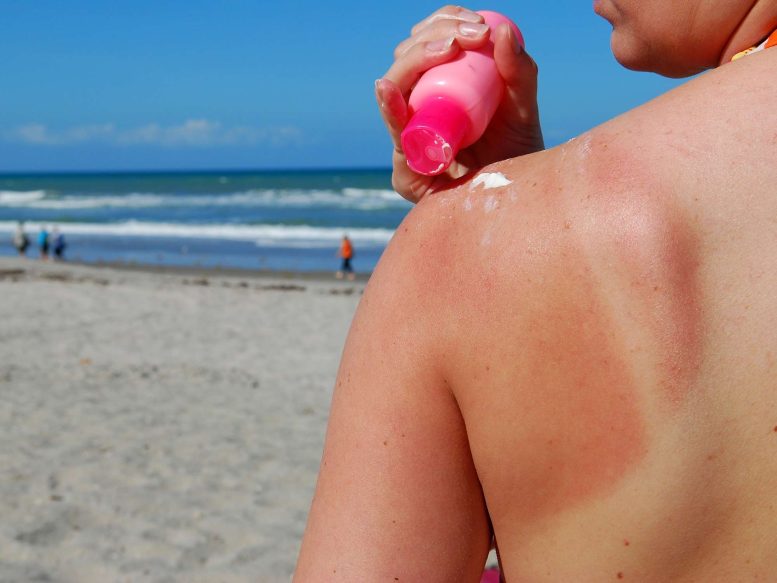
During use, some sunscreens offer very limited protection against dangerous sunrays and may even be harmful.
Chemical reactions involving a main ingredient — zinc oxide — mean many sunscreens become ineffective after just two hours of sun exposure, according to a new collaborative study between the University of Leeds, the University of Oregon, and Oregon State University.
Researchers are now calling for innovative new ingredients to be considered for use as ultraviolet (UV) filters to help provide effective protection.
Richard Blackburn, Professor of Sustainable Materials at Leeds’ School of Design, led the Leeds part of the study, and worked with the two US-based academic teams in Oregon.
He said current testing practices, which include examining ingredients individually rather than as part of a formulation exposed to sunlight, needed to change.
“On its own, zinc oxide is an effective and harmless UV blocker,” said Professor Blackburn. “Our research raises concerns about how the individual formulation ingredients react with each other during use and this isn’t currently tested by the industry.
“Once exposed to sunlight for two hours, zinc oxide destroys the UVA protection provided by other ingredients. In this context, putting on sunscreen could actually make things worse because people believe they are being protected from harmful UV rays and may stay in the sun longer.”
There are two main types of ultraviolet light: UVA and UVB, both of which are forms of electromagnetic radiation that can cause skin cancer.
UVB is most commonly associated with direct, short-term effects such as sunburn, while UVA can produce more long-term DNA damage, such wrinkling and skin aging.
Sunscreens use a 5-star UVA rating, which shows how much protection the lotion gives against the harmful ultraviolet rays.
Zinc Oxide Weakens UVA Protection
Many sunscreens include zinc oxide, which is proven to help block UV rays. During their tests, the researchers examined how the mineral reacted to other ingredients when it was exposed to sunlight and also calculated how much UVA the sunscreen blocked out to determine the UVA protection factor for each mixture.
Professor James Hutchison and University of Oregon colleague Dr. Aurora Ginzburg co-led the study.
“During tests, we found that zinc oxide causes degradation of other UV absorbers, and the protection provided by the sunscreens was reduced significantly over a relatively short time, particularly in the UVA region,” said Professor Hutchison, Lokey-Harrington Chair in Chemistry and senior associate vice president at the University of Oregon’s Phil and Penny Knight Campus for Accelerating Scientific Impact.
The Oregon and Leeds teams discovered that the UVA protection factor was reduced by between 84.3% and 91.8% in the sunscreen mixed with zinc oxide particles, while the original sunscreen without zinc oxide only showed a 15.8% loss in UVA protection factor, after UV exposure for two hours.
Toxicity Concerns in Sunlight
“The degradation of the UV filters not only decreased the effectiveness of the sunscreen, it also led to increased formula toxicity” said Professor Hutchison.
“So not only is the lack of effective UV protection an issue, the product itself may be causing harm during use in the sun.”
Zinc oxide is classified as a mineral and is widely used by brands as a “chemical-free” ingredient (despite it being a chemical) in a wide range of cosmetic products promoted as being “natural” ingredients that are kinder to skin.
But this study challenges those assertions and requires that alternatives be considered, said Dr. Ginzburg.
Designing Safer Future Sunscreens
“Zinc oxide particles are frequently combined with UV filters in hybrid sunscreens or through layering of multiple cosmetics,” she explained.
“Thus, in the design of future cosmetic formulations, it is critical that the potential for zinc oxide induced photodegradation of the whole formulation, or in combining products on the skin, be considered.
“Loss of UVA protection is especially problematic in US sunscreens where the list of approved filters is so small.”
The study is a call to action for the development of new sunscreen ingredients, said Professor Blackburn.
“As an alternative, there are some excellent potential candidates from nature that are effective UV filters, but under current legislation the process to achieve regulatory approval is extremely expensive and takes many years.
“This is proving to be a barrier to innovation, which could provide more effective, safer and sustainable alternatives to current ingredients.”
For more on this research, read Scientists Warn: Sunscreen That Includes Zinc Oxide Loses Effectiveness and Becomes Toxic After 2 Hours.
Reference: “Zinc oxide‐induced changes to sunscreen ingredient efficacy and toxicity under UV irradiation” by Aurora L. Ginzburg, Richard S. Blackburn, Claudia Santillan, Lisa Truong, Robyn L. Tanguay and James E. Hutchison, 14 October 2021, Photochemical & Photobiological Sciences.
DOI: 10.1007/s43630-021-00101-2
Never miss a breakthrough: Join the SciTechDaily newsletter.
Follow us on Google and Google News.