
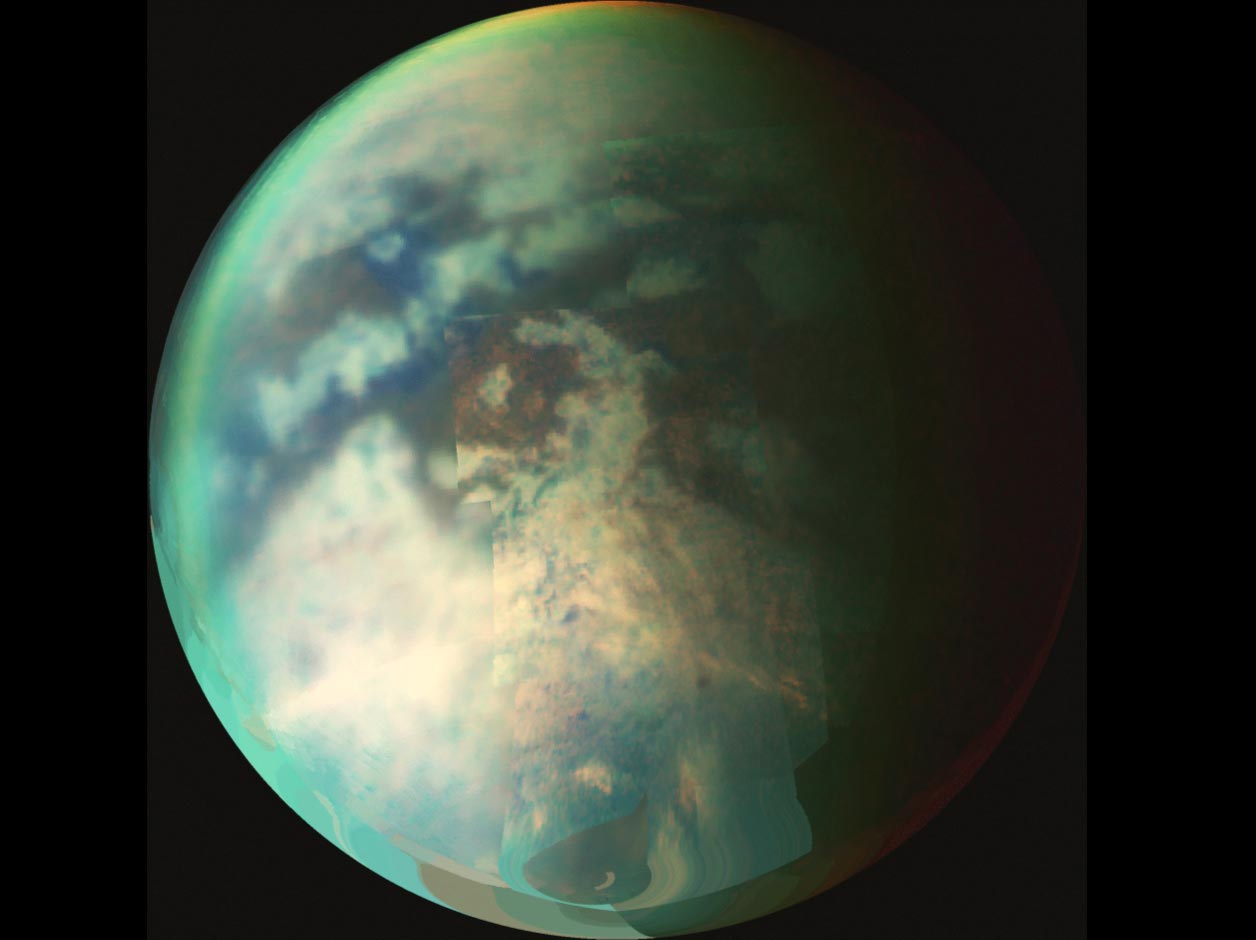
Despite its Earth-like rivers and lakes of liquid methane, Saturn’s moon Titan seems oddly lacking in river deltas — geological formations that are typically rich in historical clues. Using data from the Cassini spacecraft and simulations based on Earth’s landscapes, researchers expected to find deltas at the mouths of Titan’s rivers. Instead, they found almost none.
This surprising absence has raised new questions about how sediment and sea levels behave on Titan, and whether its dynamic coastal environment erases deltas before they can form. Even more intriguing, the analysis uncovered mysterious coastal pits and deep underwater channels, hinting that Titan’s geology holds secrets yet to be unraveled.
River Deltas Hold Clues to Planetary History
To understand a planet’s geological past, scientists often look to river deltas. These fan-shaped formations collect sediments from wide areas, preserving clues about a planet’s climate, tectonics, and even potential signs of life. That’s why NASA’s Perseverance rover was sent to Jezero Crater on Mars — it contains one of the best-preserved deltas on the planet.
Saturn’s moon Titan has also captured scientists’ interest. It’s the only world besides Earth known to have liquid actively flowing on its surface — not water, but rivers and lakes of methane and ethane. That makes Titan’s deltas, if they exist, potentially rich sources of information.
A Surprising Lack of Deltas
However, according to a new study, those deltas are mostly missing. Despite Titan’s extensive river systems, scientists found almost no evidence of delta formation.
“It’s kind of disappointing as a geomorphologist because deltas should preserve so much of Titan’s history,” said Sam Birch, an assistant professor in Brown University’s Department of Earth, Environmental and Planetary Sciences, who led the work.
But the absence of deltas raises a host of new questions.
“We take it for granted that if you have rivers and sediments, you get deltas,” Birch said. “But Titan is weird. It’s a playground for studying processes we thought we understood.”
Titan’s Earth-Like Yet Alien Landscape
Titan is the largest of Saturn’s 274 confirmed moons. Its thick nitrogen and methane atmosphere gives rise to a host of Earth-like climate and weather features. Titan has clouds, wind and rain as well as rivers, lakes and seas. But instead of water, Titan’s fluid bodies contain methane and ethane, which are liquid at Titan’s chilly surface temperatures.
Scientists learned of Titan’s liquid bodies when the Cassini spacecraft flew by in 2006. Peering through Titan’s thick atmosphere with Cassini’s synthetic aperture radar (SAR), the spacecraft revealed spidering channels and large flat areas consistent with large bodies of liquid.
Are Deltas Hidden or Missing?
Largely missing from Cassini’s SAR images, however, were deltas — even at the mouths of large rivers. It wasn’t clear, however, whether the deltas were truly absent, or whether they just didn’t show up in Cassini’s SAR data. That’s the question Birch and his colleagues tried to answer with this new study, published in the Journal of Geophysical Research: Planets.
The problem with Cassini’s SAR data is that shallow liquid methane is largely transparent in any images. So while the SAR images could see the broad seas and river channels, it’s harder to confidently make out coastal features because it’s difficult to see where the coast ends and where the sea floor begins.
Simulating Titan With Earth as a Model
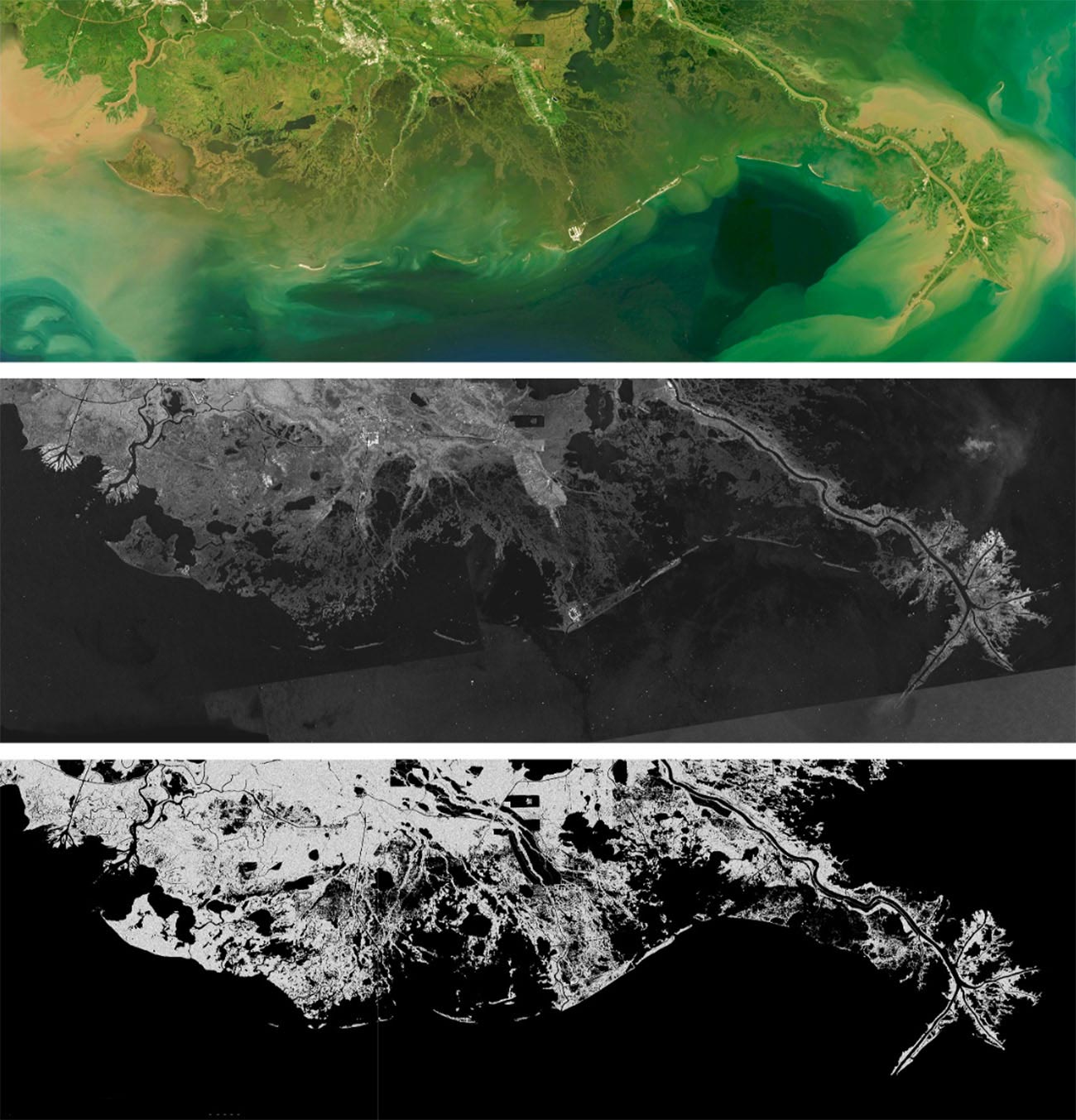
For the study, Birch developed a numerical model to simulate what Cassini’s SAR would see if it looked at a landscape scientists understand well: Earth. In the model, the water in Earth’s rivers and oceans was replaced by Titan’s methane liquid, which has different radar absorption properties compared to water.
“We basically made synthetic SAR images of Earth that assume properties of Titan’s liquid instead of Earth’s,” Birch said. “Once we see SAR images of a landscape we know very well, we can go back to Titan and understand a bit better what we’re looking at.”
Earth Simulations Clarify Titan Data
The research found that the synthetic SAR images of Earth clearly resolved large deltas and many other large coastal landscapes.
“If there are deltas the size of the one at the mouth of the Mississippi River, we should be able to see it,” Birch said. “If there are large barrier islands and similar coastal landscapes like those we see all along the U.S. Gulf Coast, we should be able to see those.”
Titan’s Delta Deficit Confirmed
But when Birch and his colleagues combed over the Titan images in light of their new analysis, they came up mostly empty. Aside from two probable deltas near Titan’s south pole, the rest of the moon’s rivers were entirely delta-free. The researchers found that only about 1.3% of Titan’s large rivers that terminate at coastlines have deltas. On Earth, in contrast, nearly every river of similar size has a delta.
It’s not entirely clear why Titan generally lacks deltas, Birch says. The fluid properties of Titan’s rivers should make them perfectly capable of carrying and depositing sediment. It could be, the researchers say, that sea levels on Titan rise and fall so rapidly that deltas are smeared across the landscape more quickly than they can be built up in a single spot. Winds and tidal currents along Titan’s coasts may also play an equally large role in preventing delta formation.
Unexpected Coastal Mysteries
And missing deltas aren’t the only mystery raised by the new research. The new analysis of Cassini SAR data of Titan’s coasts revealed pits of unknown origin deep within lakes and seas. The study also found deep channels on the floors of the seas that seem to have been carved by river flows, but it’s not clear how they got there.
All of these surprises will require more research to fully understand, Birch says.
“This is really not what we expected,” Birch said. “But Titan does this to us a lot. I think that’s what makes it such an engaging place to study.”
Reference: “Detectability of Coastal Landforms on Titan With the Cassini RADAR” by S. P. D. Birch, R. V. Palermo, U. G. Schneck, A. Ashton, A. G. Hayes, J. M. Soderblom, W. H. Mitchell and J. T. Perron, 20 March 2025, Journal of Geophysical Research: Planets.
DOI: 10.1029/2024JE008737
Never miss a breakthrough: Join the SciTechDaily newsletter.
Follow us on Google and Google News.