
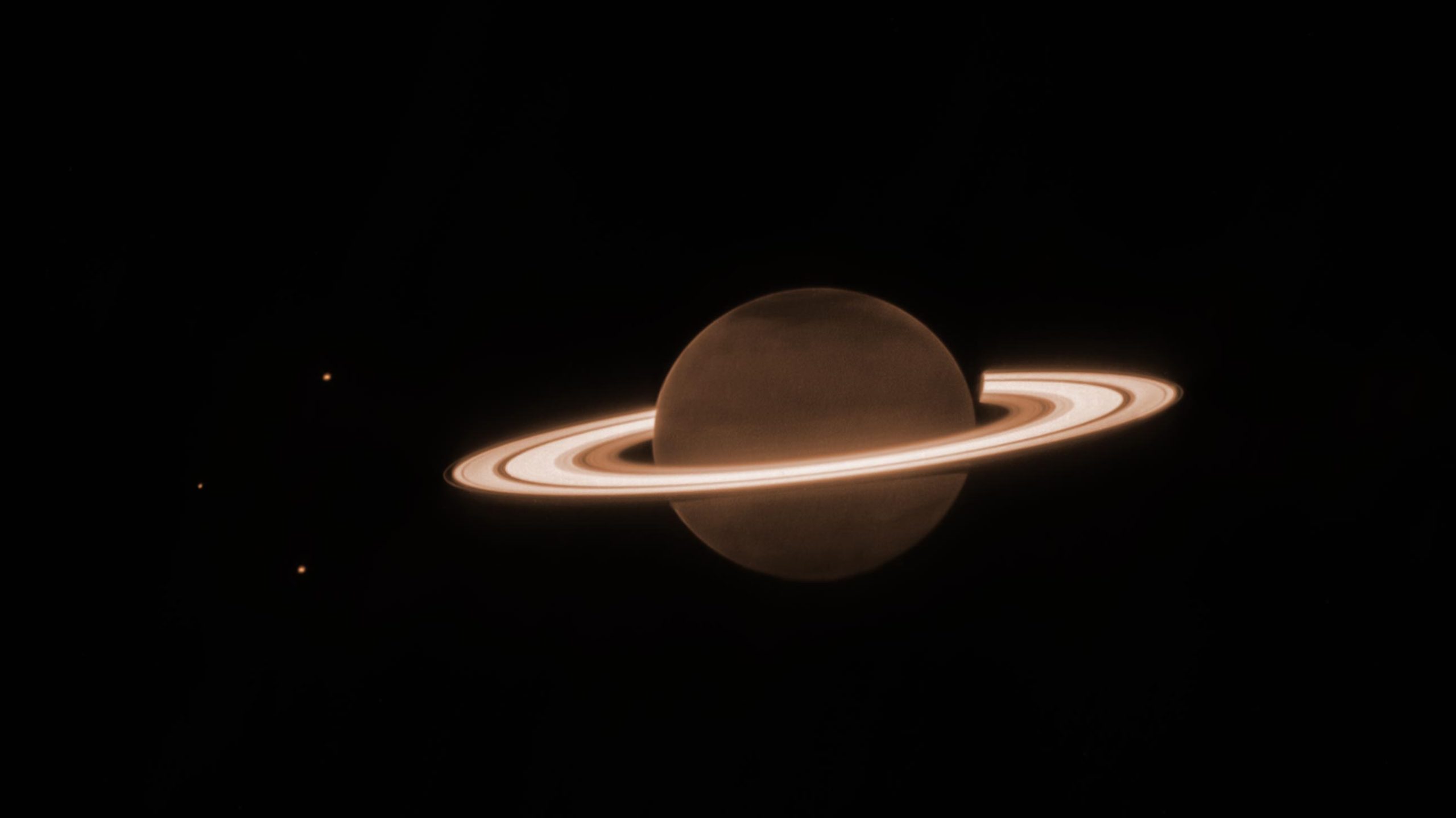
NASA’s James Webb Space Telescope provided unique near-infrared imagery of Saturn on June 25, 2023. The observations highlighted Saturn’s atmospheric characteristics, revealed intricate details of its ring system, and identified several moons. This imagery will help scientists understand the planet’s system more comprehensively, revealing both seasonal changes and potential faint moons, as well as the makeup of its atmosphere.
On June 25, 2023, NASA’s James Webb Space Telescope turned to famed ringed world Saturn for its first near-infrared observations of the planet. The initial imagery from Webb’s NIRCam (Near-Infrared Camera) is already fascinating researchers.
Saturn itself appears extremely dark at this infrared wavelength observed by the telescope, as methane gas absorbs almost all of the sunlight falling on the atmosphere. However, the icy rings stay relatively bright, leading to the unusual appearance of Saturn in the Webb image.
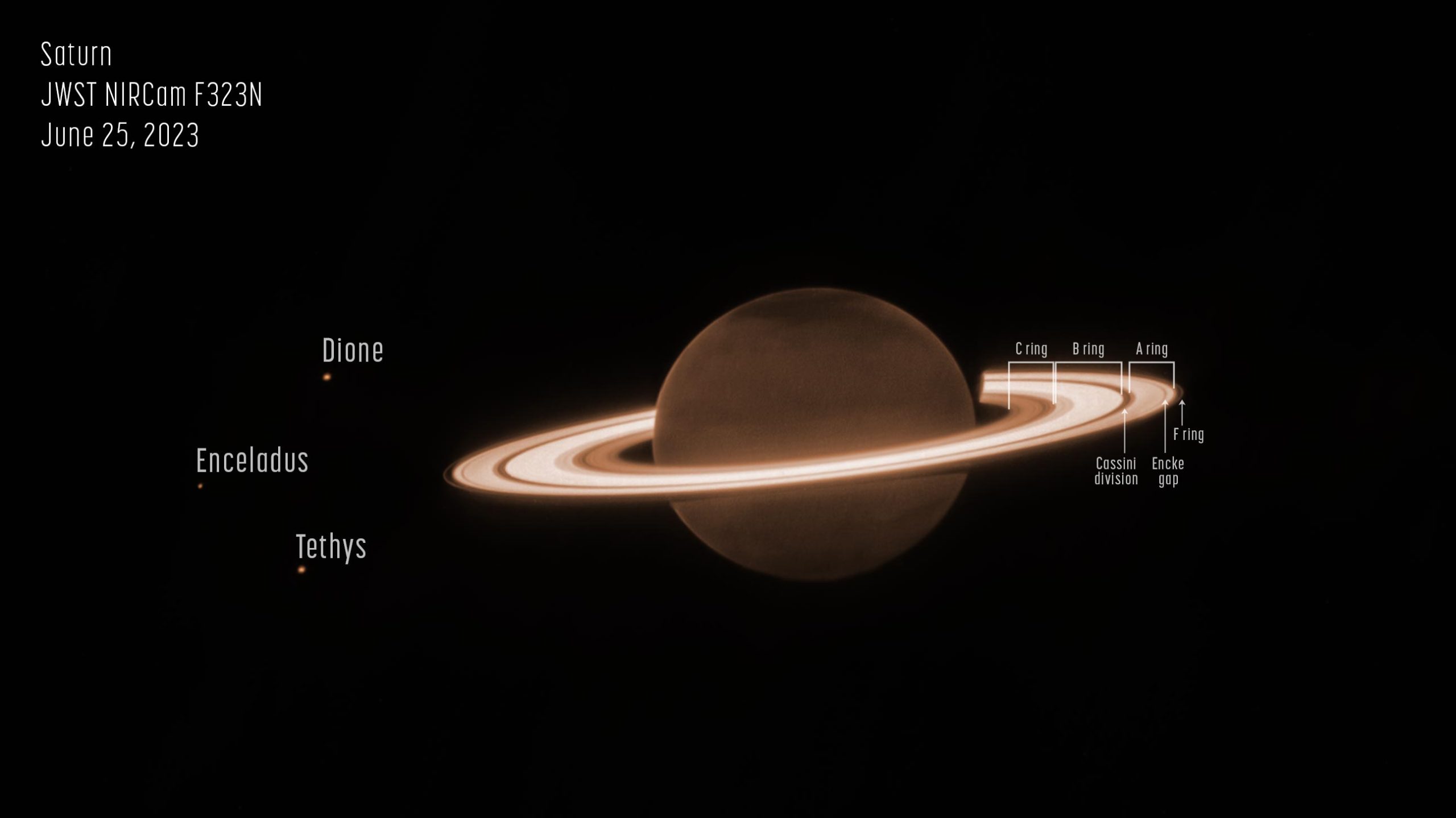
This image was taken as part of Webb Guaranteed Time Observation program 1247. The program included several very deep exposures of Saturn, which were designed to test the telescope’s capacity to detect faint moons around the planet and its bright rings. Any newly discovered moons could help scientists put together a more complete picture of the current system of Saturn, as well as its past.
Saturn, the sixth planet from the sun in our solar system, is known for its distinctive and striking ring system. This gas giant is the second-largest planet in the solar system after Jupiter and is composed primarily of hydrogen and helium. Its iconic rings are comprised of countless particles, ranging from tiny, grain-like pieces to massive chunks the size of mountains, primarily composed of ice and rock.
This new image of Saturn clearly shows details within the planet’s ring system, along with several of the planet’s moons – Dione, Enceladus, and Tethys. Additional deeper exposures (not shown here) will allow the team to probe some of the planet’s fainter rings, not visible in this image, including the thin G ring and the diffuse E ring.
Saturn’s rings are made up of an array of rocky and icy fragments – the particles range in size from smaller than a grain of sand to a few as large as mountains on Earth. Researchers recently used Webb to explore Enceladus, and found a large plume jetting from the southern pole of the moon that contains both particles and plentiful amounts of water vapor – this plume feeds Saturn’s E ring.
Saturn’s atmosphere also shows surprising and unexpected detail. Although the Cassini spacecraft observed the atmosphere at greater clarity, this is the first time that the planet’s atmosphere has been seen with this clarity at this particular wavelength (3.23 microns), which is unique to Webb.
The large, dark, diffuse structures in the northern hemisphere do not follow the planet’s lines of latitude, so this image is lacking the familiar striped appearance that is typically seen from Saturn’s deeper atmospheric layers. The patchiness is reminiscent of large-scale planetary waves in the stratospheric aerosols high above the main clouds, potentially similar to those seen in early Webb NIRCam observations of Jupiter.
Saturn has a fascinating system of over 80 moons, the most famous of which is Titan, larger than the planet Mercury and enveloped in a dense, nitrogen-rich atmosphere. The planet is also renowned for its beautiful but short-lived hexagonal storm at its north pole. The gas giant’s weather patterns include high-velocity winds, which can reach up to 1,800 kilometers per hour, and giant storms that periodically appear on its surface. Saturn’s yellowish hue is a result of ammonia crystals in its upper atmosphere. Its average distance from the sun is about 1.4 billion kilometers, and a single orbit takes approximately 29.5 Earth years.
When comparing the northern and southern poles of the planet in this image, the differences in appearance are typical with known seasonal changes on Saturn. For example, Saturn is currently experiencing northern summertime, with the southern hemisphere emerging from the darkness at the end of a winter. However, the northern pole is particularly dark, perhaps due to an unknown seasonal process affecting polar aerosols in particular. A tiny hint of brightening towards the edge of Saturn’s disk might be due to high-altitude methane fluorescence (the process of emitting light after absorbing light), emission from the trihydrogen ion (H3+) in the ionosphere, or both; spectroscopy from Webb could help confirm this.
Missions like NASA’s Pioneer 11, Voyagers 1 and 2, the Cassini spacecraft, and the Hubble Space Telescope have tracked Saturn’s atmosphere and rings for many decades. These observations from Webb are just a hint at what this observatory will add to Saturn’s story in the coming years as the science team delves deep into the data to prepare peer-reviewed results.
Science Credits: NASA, ESA, CSA, STScI, Matt Tiscareno (SETI Institute), Matt Hedman (University of Idaho), Maryame El Moutamid (Cornell University), Mark Showalter (SETI Institute), Leigh Fletcher (University of Leicester), Heidi Hammel (AURA).
About the Authors
- Heidi B. Hammel is a Webb interdisciplinary scientist leading Webb’s Cycle 1 Guaranteed Time Observations (GTO) of the solar system. She is the vice president for science at the Association of Universities for Research in Astronomy (AURA) in Washington, D.C.
- Leigh Fletcher is a professor of planetary science at the University of Leicester in England. Leigh is the principal investigator for several of Webb’s Guaranteed Time Observation Programs, including Program 1247 highlighted here.
- Matt Tiscareno is a Senior Research Scientist at the SETI Institute, California, where he studies the dynamics of planetary systems, including planetary rings. He is an integral member of the Webb Guaranteed Time Observation team for the study of Saturn.
Never miss a breakthrough: Join the SciTechDaily newsletter.
Follow us on Google and Google News.