
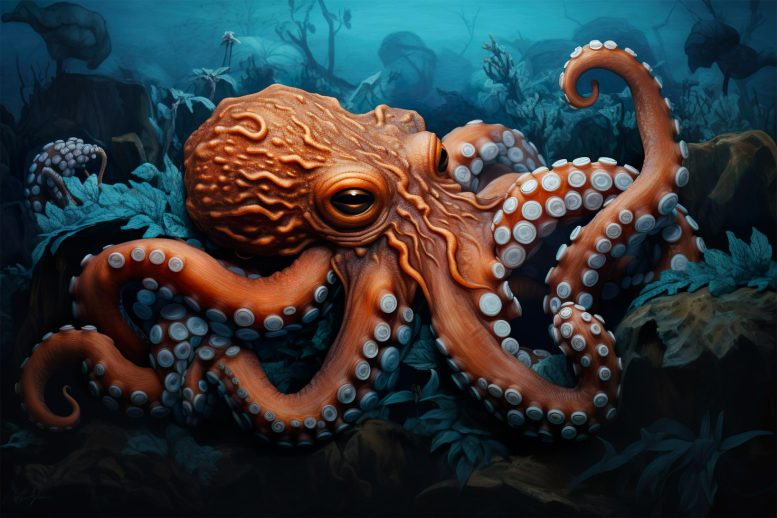
Like humans, octopuses transition between two sleep stages – a quiet stage and an active stage that resembles REM sleep in mammals. But could this mean that octopuses dream?
When octopuses sleep, their quiet periods of slumber are punctuated by short bursts of frenzied activity. Their arms and eyes twitch, their breathing rate quickens, and their skin flashes with vibrant colors.
Now, researchers from the Okinawa Institute of Science and Technology (OIST), in collaboration with the University of Washington, have closely examined the brain activity and skin patterning in octopuses (Octopus laqueus) during this active period of sleep and discovered that they closely resemble neural activity and skin patterning behavior seen when awake. Wake-like activity also occurs during rapid eye movement (REM) sleep in mammals – the phase in which most dreams occur.
A Link Between Octopus and Human Sleep Cycles
The study, published on June 28 in the journal Nature, highlights the remarkable similarities between the sleeping behavior of octopuses and humans and provides fascinating insights about the origin and function of sleep.
“All animals seem to show some form of sleep, even simple animals like jellyfish and fruit flies. But for a long time, only vertebrates were known to cycle between two different sleep stages,” said senior author, Professor Sam Reiter, who leads the Computational Neuroethology Unit at OIST.
These new revelations into how octopuses sleep came through a visit to OIST by Dr. Leenoy Meshulam, a statistical physicist at the University of Washington, who spent three months as a guest of the OIST Theoretical Sciences Visiting Program.
“The fact that two-stage sleep has independently evolved in distantly related creatures, like octopuses, which have large but completely different brain structures from vertebrates, suggests that possessing an active, wake-like stage may be a general feature of complex cognition,” said Dr. Meshulam.
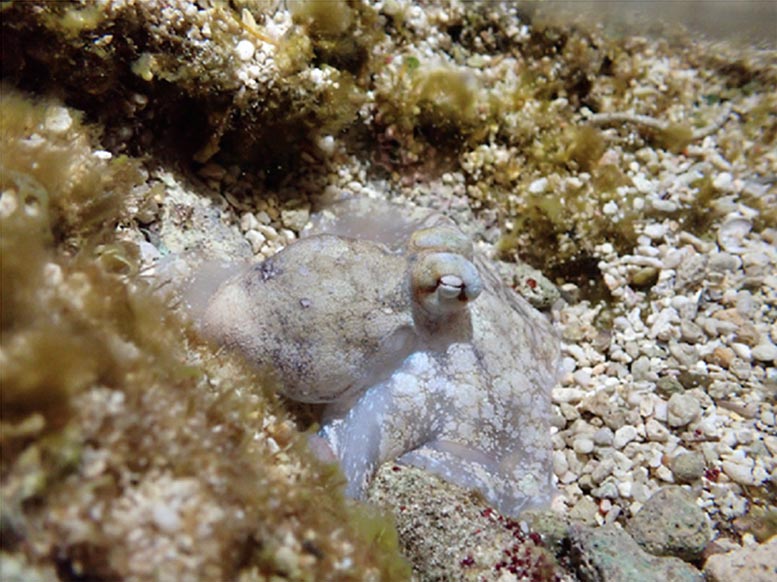
An octopus from the species Octopus laqueus changes its skin patterns during active sleep. Credit: OIST
To begin, the scientists checked whether the octopuses were truly asleep during this active period. They tested how the octopuses responded to a physical stimulus and found that when in both the quiet and active stage of sleep, the octopuses required stronger stimulation before reacting, compared to when they were awake. The team also discovered that if they prevented the octopuses from sleeping, or disrupted them during the active phase of sleep, the octopuses later entered active sleep sooner and more frequently.
“This compensatory behavior nails down the active stage as being an essential stage of sleep that is needed for octopuses to properly function,” said Aditi Pophale, co-first author of the study and PhD student at OIST.
Brain Activity Resembling Human Sleep Patterns
The researchers also delved into the brain activity of the octopuses when awake and asleep. During quiet sleep, the scientists saw characteristic brain waves that closely resemble certain waveforms seen during non-REM sleep in mammalian brains called sleep spindles. Although the exact function of these waveforms is unclear even within humans, scientists believe they aid in consolidating memories. Using a cutting-edge microscope built by co-first author Dr. Tomoyuki Mano, the researchers determined that these sleep spindle-like waves occur in regions of the octopuses’ brains associated with learning and memory, suggesting that these waves potentially serve a similar function to humans.
Roughly once an hour, the octopuses entered an active sleep phase for around a minute. During this stage, the octopuses’ brain activity very closely resembled their brain activity while awake, just like REM sleep does in humans.
The research group also captured and analyzed the changing skin patterns of the octopuses when awake and asleep in ultra-high 8K resolution.
“By filming in such high resolution, we can see how each individual pigmented cell behaves in order to create an overall skin pattern,” said Dr. Meshulam. “This could help us create simple skin pattern models to understand the general principles of waking and sleeping patterning behavior.”
When awake, octopuses control thousands of tiny, pigmented cells in their skin, creating a vast array of different skin patterns. They use these patterns to camouflage themselves in different environments, and in social or threat displays, such as warning off predators and communicating with each other. During active sleep, the scientists reported that the octopuses cycled through these same skin patterns.
Could Octopuses Be Dreaming?
The similarities between active sleep and awake states could be explained by a variety of reasons, said the scientists. One theory is that octopuses may be practicing their skin patterns to improve their waking camouflage behavior, or simply maintaining the pigment cells.
Another intriguing idea is that the octopuses could be re-living and learning from their waking experiences, such as hunting or hiding from a predator, and reactivating the skin pattern associated with each experience. In other words, they could be doing something similar to dreaming.
“In this sense, while humans can verbally report what kind of dreams they had only once they wake, the octopuses’ skin pattern acts as a visual readout of their brain activity during sleep,” said Prof. Reiter.
He added, “We currently don’t know which of these explanations, if any, could be correct. We are very interested in investigating further.”
Reference: “Wake-like skin patterning and neural activity during octopus sleep” by Aditi Pophale, Kazumichi Shimizu, Tomoyuki Mano, Teresa L. Iglesias, Kerry Martin, Makoto Hiroi, Keishu Asada, Paulette García Andaluz, Thi Thu Van Dinh, Leenoy Meshulam and Sam Reiter, 28 June 2023, Nature.
DOI: 10.1038/s41586-023-06203-4
Never miss a breakthrough: Join the SciTechDaily newsletter.
Follow us on Google and Google News.