
Close Menu
    Facebook X (Twitter) Instagram
    SciTechDaily
    • Biology
    • Chemistry
    • Earth
    • Health
    • Physics
    • Science
    • Space
    • Technology
    Facebook X (Twitter) Pinterest YouTube RSS
    SciTechDaily
    Home»Science»Scientist Have Uncovered the Mechanism Behind Mesmerizing “Whiskey Webs”
    Science

    Scientist Have Uncovered the Mechanism Behind Mesmerizing “Whiskey Webs”

    By American Chemical SocietyMarch 25, 2020No Comments2 Mins Read
    Facebook Twitter Pinterest Telegram LinkedIn WhatsApp Email Reddit
    Share
    Facebook Twitter LinkedIn Pinterest Telegram Email Reddit
    Evaporated Drop American Whiskey
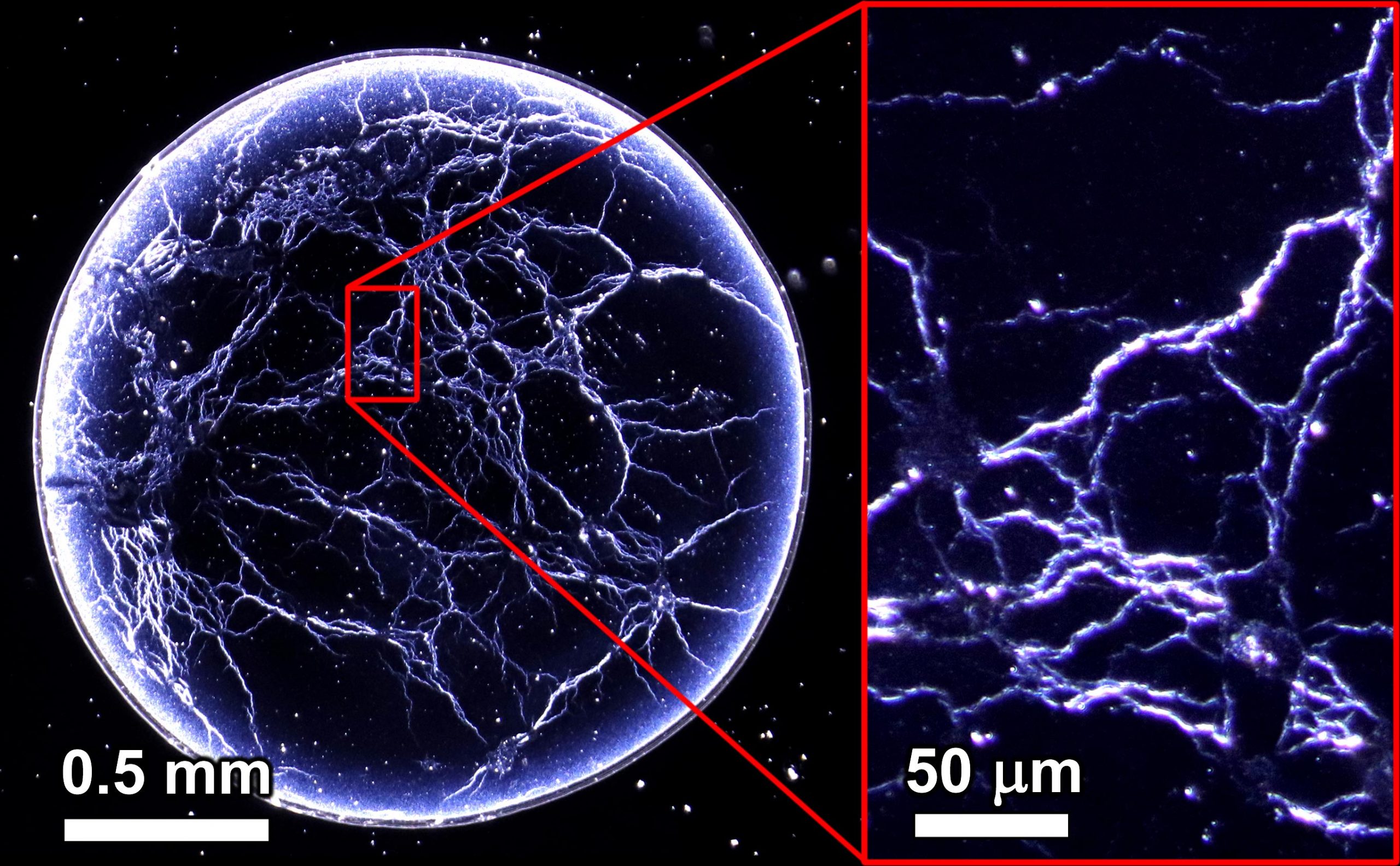
    A drop of American whiskey evaporated to form a distinctive web-like pattern of solutes. Credit: Adapted from ACS Nano 2020, DOI: 10.1021/acsnano.9b08984

    ‘Whiskey Webs’ Are the New ‘Coffee Ring Effect’

    Spilled coffee forms a ring as the liquid evaporates, depositing solids along the edge of the puddle. This “coffee ring effect” has fascinated scientists for decades, but now a team says they have uncovered the mechanism behind an even more striking, web-like pattern that forms when drops of American whiskey dry up. The results, reported in ACS Nano, suggest that these distinctive ‘whiskey webs’ could someday be used to identify counterfeit spirits.

    When a drop of liquid evaporates, solids are left behind in a pattern that depends on what the liquid is, what solids are in it, and the environmental conditions. Stuart Williams and colleagues previously found that drops of diluted American whiskeys — but not their Scotch or Canadian counterparts — formed webbed patterns when dried on a glass surface, and there were hints that the pattern was distinctive for different brands of whiskey. In the current study, the researchers wanted to see how the whiskey webs form in more detail, and whether they could serve as fingerprints of the spirits.

    The team used time-lapse microscopy to examine droplets of diluted American whiskey as the liquid evaporated. Non-volatile organic compounds, such as phenols, aromatics, and esters, clustered together and were driven to the surface of the droplet, where they formed monolayers. As the surface area of the droplet decreased, the monolayers collapsed, creating strands of the web. The researchers showed that different American whiskeys showed unique web patterns that could be correctly matched to unknown samples more than 90% of the time. The distinctive webs arise from the unique combination of solutes in each whiskey, the researchers say.

    Reference: “Multiscale Self-Assembly of Distinctive Weblike Structures from Evaporated Drops of Dilute American Whiskeys” by Adam D. Carrithers, Martin J. Brown, VI, Mohamed Z. Rashed, Sabina Islam, Orlin D. Velev, and Stuart J. Williams, 25 March 2020,  ACS Nano.
    DOI: 10.1021/acsnano.9b08984

    The authors do not acknowledge any funding sources for this paper.

    Never miss a breakthrough: Join the SciTechDaily newsletter.
    Follow us on Google and Google News.

    Alcohol American Chemical Society
    Share. Facebook Twitter Pinterest LinkedIn Email Reddit

    Related Articles

    COVID’s Lasting Legacy: How Pandemic Stress Fueled America’s Growing Alcohol Problem

    Nature’s Hidden Happy Hour: The Truth About Wild Animals and Alcohol

    Revolutionizing Refreshment: How Science is Redefining Beer Taste and Health

    Scientists Create Super-Strong Spider Silk That Heals Wounds

    Beer’s Best Friend: The Century-Old Experiment Boosting Barley’s Resilience

    Unlocking Yeast’s Killer Instinct to Save Craft Beer

    Concerning Findings: New Research Reveals That Washing Your Fruit Doesn’t Remove All Pesticides

    Alzheimer’s Imaging Breakthrough: Fluorescent Sensors Penetrate Blood-Brain Barrier

    Superfood in a Glass: The Surprising Health Benefits of Blueberry Wine

    Leave A Reply Cancel Reply

    • Facebook
    • Twitter
    • Pinterest
    • YouTube

    Don't Miss a Discovery

    Subscribe for the Latest in Science & Tech!

    Trending News

    1.4-Million-Year-Old Footprints Reveal a Giant Human Relative

    Astronomers May Have Found the First Moon Beyond Our Solar System

    Underwater Cameras Expose the Secret Lives of Whale Sharks

    Why Dreaming Leaves the Brain Running Low on Energy

    CERN Experiments Detect Signs of the Universe’s Primordial Matter

    Study Finds a Surprising Link Between Gut Microbes and Aging

    Frequent Cannabis Users Wake Up With More “Stress Hormone”

    Scientists Reveal Hidden DNA Traces in the Shroud of Turin

    Follow SciTechDaily
    • Facebook
    • Twitter
    • YouTube
    • Pinterest
    • Newsletter
    • RSS
    SciTech News
    • Biology News
    • Chemistry News
    • Earth News
    • Health News
    • Physics News
    • Science News
    • Space News
    • Technology News
    Recent Posts
    • World’s First Photonic Time Crystal Can Reshape Light in Trillionths of a Second
    • Meteorite That Smashed Through a New Jersey Roof Hid an Ancient Chemical Secret
    • Astronomers Find Ancient Black Holes Shining With the Power of a Trillion Suns
    • These “Good” Immune Cells Could Hold the Key to Spinal Cord Regeneration
    • New Research Questions Decades of Low-Fat Dairy Advice
    Copyright © 1998 - 2026 SciTechDaily. All Rights Reserved.
    • Science News
    • About
    • Contact
    • Editorial Board
    • Privacy Policy
    • Terms of Use

    Type above and press Enter to search. Press Esc to cancel.