
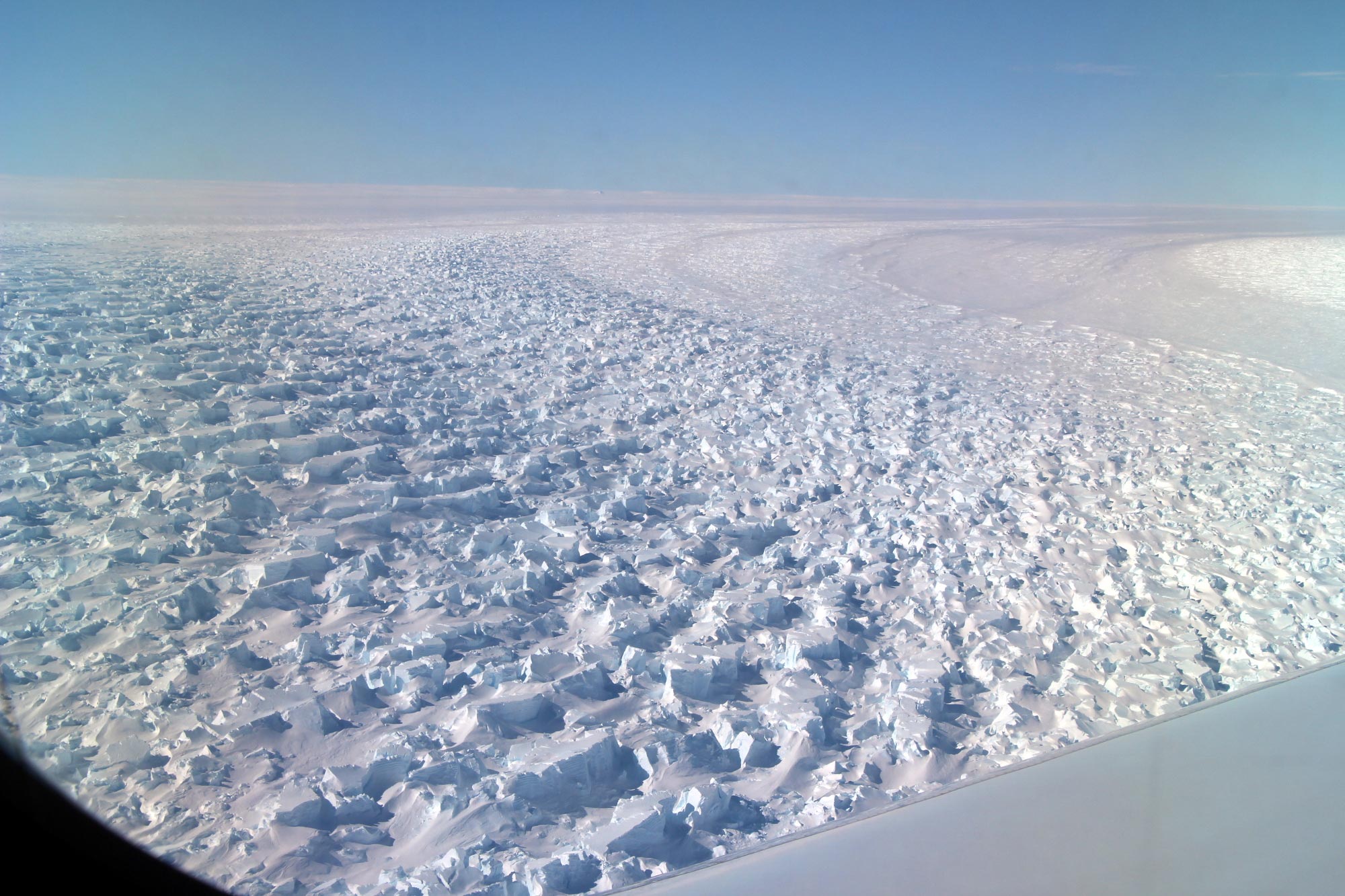
UCI, NASA scientists assess ice sheet with potential to raise global sea levels nearly 5 feet.
East Antarctica’s Denman Glacier has retreated 5 kilometers, nearly 3 miles, in the past 22 years, and researchers at the University of California, Irvine, and NASA’s Jet Propulsion Laboratory are concerned that the shape of the ground surface beneath the ice sheet could make it even more susceptible to climate-driven collapse.
If fully thawed, the ice in Denman would cause sea levels worldwide to rise about 1.5 meters, almost 5 feet. With this sobering fact in mind, the UCI and NASA JPL scientists have completed the most thorough examination yet of the glacier and surrounding area, uncovering alarming clues about its condition under further global warming.
The team’s assessment is the subject of a paper published today in the American Geophysical Union journal Geophysical Research Letters.
“East Antarctica has long been thought to be less threatened, but as glaciers such as Denman have come under closer scrutiny by the cryosphere science community, we are now beginning to see evidence of potential marine ice sheet instability in this region,” said co-author Eric Rignot, chair, Donald Bren Professor and Chancellor’s Professor of Earth system science at UCI.
“The ice in West Antarctica has been melting faster in recent years, but the sheer size of Denman Glacier means that its potential impact on long-term sea level rise is just as significant,” he added.
According to the study, Denman Glacier experienced a cumulative mass loss of 268 billion tons of ice between 1979 and 2017.
Using radar interferometer data from the Italian Space Agency’s COSMO-SkyMed satellite system, the researchers more precisely determined Denman’s grounding line, the point at which the ice leaves the land and begins to float in the ocean.
“Differential synthetic aperture radar interferometer data from 1996 to 2018 showed us a marked asymmetry in the grounding line retreat at the ice sheet’s land-sea interface,” said lead author Virginia Brancato, a postdoctoral fellow with NASA JPL who was a postdoctoral scholar at UCI when the study was conducted.
Denman’s eastern flank is protected from retreat by a subglacial ridge. But Brancato said that the western flank, which extends roughly 4 kilometers, is characterized by a deep and steep trough with a bed slope conducive to accelerated retreat.
“Because of the shape of the ground beneath Denman’s western side, there is potential for rapid and irreversible retreat, and that means substantial increases in global sea levels in the future,” she said.
In December, Nature Geoscience published a paper on the BedMachine Antarctica project led by Mathieu Morlighem, UCI associate professor of Earth system science, which revealed that the trough beneath Denman Glacier extends 3,500 meters below sea level, making it the deepest land canyon on Earth.
The UCI and NASA JPL scientists report in the Geophysical Research Letters paper that the bed configuration of Denman is unique in Antarctica’s eastern sector. Other major glaciers, such as Totten and Moscow University, feature prograde beds that slope down in the flow direction, providing some measure of stability, Rignot said.
Tracking the state of the floating extension of Denman Glacier, a 24,000-square-kilometer mass that includes the Shackleton Ice Shelf and Denman ice tongue, will be especially important, he added. The researchers used the German Aerospace Center’s TanDEM-X satellite in combination with data from COSMO-SkyMed to assess the melt rate of the floating sea ice, learning that the Denman ice tongue has shed mass at a rate of about 3 meters per year, above average compared to other East Antarctic ice shelves.
“We need to collect oceanographic data near Denman and keep an eye on its grounding line,” Rignot said. “The Italian COSMO-SkyMed satellite system is the only tool for us to monitor grounding line conditions in this sector of Antarctica, and we are fortunate to have on our team Dr. Brancato, who is skilled in extrapolating the data to give us the precise and up-to-date information we require.”
For more on this research, see Vulnerable to Climate Change: Huge Antarctic Glacier Melting From the Bottom Up.
References:
“Grounding line retreat of Denman Glacier, East Antarctica, measured with COSMO‐SkyMed radar interferometry data” by V. Brancato, E. Rignot, P. Milillo, M. Morlighem, J. Mouginot, L. An, B. Scheuchl, S. Jeong, P. Rizzoli, J.L. Bueso Bello and P. Prats‐Iraolaal, 23 March 2020, Geophysical Research Letters.
DOI: 10.1029/2019GL086291
“Deep glacial troughs and stabilizing ridges unveiled beneath the margins of the Antarctic ice sheet” by Mathieu Morlighem, Eric Rignot, Tobias Binder, Donald Blankenship, Reinhard Drews, Graeme Eagles, Olaf Eisen, Fausto Ferraccioli, René Forsberg, Peter Fretwell, Vikram Goel, Jamin S. Greenbaum, Hilmar Gudmundsson, Jingxue Guo, Veit Helm, Coen Hofstede, Ian Howat, Angelika Humbert, Wilfried Jokat, Nanna B. Karlsson, Won Sang Lee, Kenichi Matsuoka, Romain Millan, Jeremie Mouginot, John Paden, Frank Pattyn, Jason Roberts, Sebastian Rosier, Antonia Ruppel, Helene Seroussi, Emma C. Smith, Daniel Steinhage, Bo Sun, Michiel R. van den Broeke, Tas D. van Ommen, Melchior van Wessem & Duncan A. Young, 12 December 2019, Nature Geoscience.
DOI: 10.1038/s41561-019-0510-8
This project was funded by NASA’s Cryospheric Sciences Program and received support from the Italian Space Agency and the German Aerospace Center. Data and bed topography maps are publicly available at DOI: 10.15146/zf0j-5m50.
Never miss a breakthrough: Join the SciTechDaily newsletter.
Follow us on Google and Google News.
2 Comments
No surprise but thanks for the information. The scriptures do not lie. “… the elements shall melt with fervent heat …” So there will be more retreat of glaciers, not just in Antarctica but throughout the whole world.
The question is .
Do we burn, starve or drown
My thought is ALL OF THE ABOVE
WE are pushing power generation to the exclusion of what needs to be done
And increasing power use producing trash like a I sunglasses
For example using the military in many country’s to stop climate destroying practices
FOR EXAMPLE logging in then the amazon.