
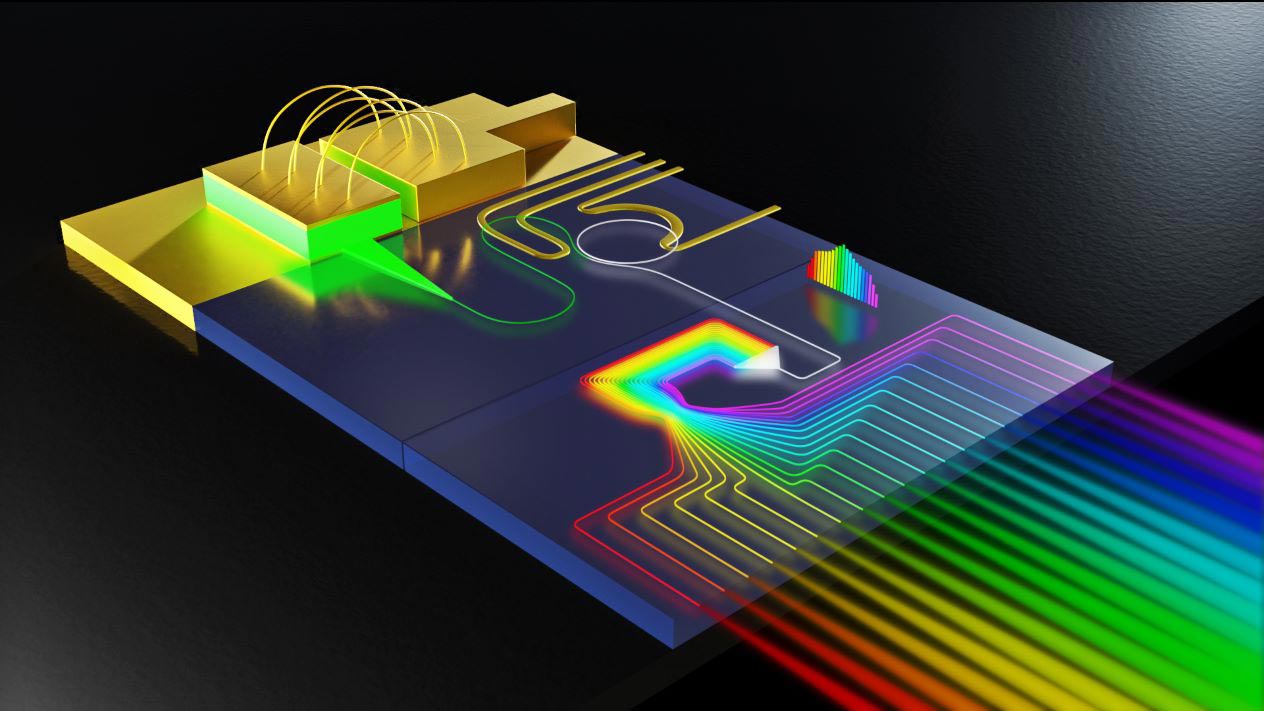
While developing LiDAR technology, scientists unexpectedly discovered how to generate multiple laser colors from a single chip.
Their innovation could transform data centers and communications by delivering faster, cleaner, and more efficient light sources.
Accidental Discovery in the Lab
A few years ago, researchers in Michal Lipson’s lab came across something unexpected.
Their work at the time focused on improving LiDAR, a technology that measures distance using lightwaves. The team was designing powerful chips capable of generating brighter, more intense beams of light.
“As we sent more and more power through the chip, we noticed that it was creating what we call a frequency comb,” explains Andres Gil-Molina, a former postdoctoral researcher in Lipson’s lab.
A frequency comb is a unique form of light made up of many distinct colors arranged in a precise, evenly spaced sequence, similar to the pattern of a rainbow. Each color, or frequency of light, appears bright, separated by dark gaps. When viewed on a spectrogram, these bright frequencies show up as sharp spikes resembling the teeth of a comb. This structure makes it possible to send multiple streams of information at once. Because the different colors do not interfere with one another, each “tooth” can function as its own independent data channel.
From Massive Lasers to a Single Chip
Until now, generating a strong frequency comb required bulky and costly lasers and amplifiers. In a new study published in Nature Photonics, Lipson, the Eugene Higgins Professor of Electrical Engineering and professor of Applied Physics, and her colleagues describe how to achieve the same result within a single microchip.
“Data centers have created tremendous demand for powerful and efficient sources of light that contain many wavelengths,” says Gil-Molina, who is now a principal engineer at Xscape Photonics. “The technology we’ve developed takes a very powerful laser and turns it into dozens of clean, high-power channels on a chip. That means you can replace racks of individual lasers with one compact device, cutting cost, saving space, and opening the door to much faster, more energy-efficient systems.”
“This research marks another milestone in our mission to advance silicon photonics,” Lipson said. “As this technology becomes increasingly central to critical infrastructure and our daily lives, this type of progress is essential to ensuring that data centers are as efficient as possible.”
Cleaning Up Messy Light
The breakthrough started with a simple question: What’s the most powerful laser we can put on a chip?
The team chose a type called a multimode laser diode, which is used widely in applications like medical devices and laser cutting tools. These lasers can produce enormous amounts of light, but the beam is “messy,” which makes it hard to use for precise applications.
Turning Chaos into Coherence
Integrating such a laser into a silicon photonics chip, where the light pathways are just a few microns — even hundreds of nanometers — wide, required careful engineering.
“We used something called a locking mechanism to purify this powerful but very noisy source of light,” Gil-Molina says. The method relies on silicon photonics to reshape and clean up the laser’s output, producing a much cleaner, more stable beam, a property scientists call high coherence.
Once the light is purified, the chip’s nonlinear optical properties take over, splitting that single powerful beam into dozens of evenly spaced colors, a defining feature of a frequency comb. The result is a compact, high-efficiency light source that combines the raw power of an industrial laser with the precision and stability needed for advanced communications and sensing.
Why It Matters Now
The timing for this breakthrough is no accident. With the explosive growth of artificial intelligence, the infrastructure inside data centers is straining to move information fast enough, for example, between processors and memory. State-of-the-art data centers are already using fiber optic links to transport data, but most of these still rely on single-wavelength lasers.
Frequency combs change that. Instead of one beam carrying one data stream, dozens of beams can run in parallel through the same fiber. That’s the principle behind wavelength-division multiplexing (WDM), the technology that turned the internet into a global high-speed network in the late 1990s.
By making high-power, multi-wavelength combs small enough to fit directly on a chip, Lipson’s team has made it possible to bring this capability into the most compact, cost-sensitive parts of modern computing systems. Beyond data centers, the same chips could enable portable spectrometers, ultra-precise optical clocks, compact quantum devices, and even advanced LiDAR systems.
The Future of Powerful Light
“This is about bringing lab-grade light sources into real-world devices,” says Gil-Molina. “If you can make them powerful, efficient, and small enough, you can put them almost anywhere.”
Reference: “High-power electrically pumped microcombs” by Andres Gil-Molina, Yair Antman, Ohad Westreich, Xingchen Ji, Min Chul Shin, Gaurang R. Bhatt, Ipshita Datta, Bok Young Kim, Yoshitomo Okawachi, Alexander L. Gaeta and Michal Lipson, 7 October 2025, Nature Photonics.
DOI: 10.1038/s41566-025-01769-z
Never miss a breakthrough: Join the SciTechDaily newsletter.
Follow us on Google and Google News.
6 Comments
Bone Marrow Carcinoma(Blue-463 A°) & Leukemia( 423 A°) on Progress.
Right?
Bone Marrow Carcinoma(Blue-463 A°) & Leukemia( 423 A°) on Progress.
Right?
The whole point of writing is to communicate ideas. If you fail to communicate, your effort is wasted.
Your new job is making rainbow lasers because I want one..
A mirco-chip credit card picture photograph sticker of a front credit card with the back credit card line both front sticker stick on a micro chip bracelet to avoid carrying wallets and purses and half a slide scanner at shopping stores just the back line slide scanner at shopping stores or a small credit card picture photograph sticker of front and back both on front credit card sticker stick it on a rubber bracelet (idea, invention) My name is Reymundo Lopez 1013 West Buchanan st Harlingen tx 78550 could I have a donation of free money 5,000 dollars for food and water thank you
Ipo