
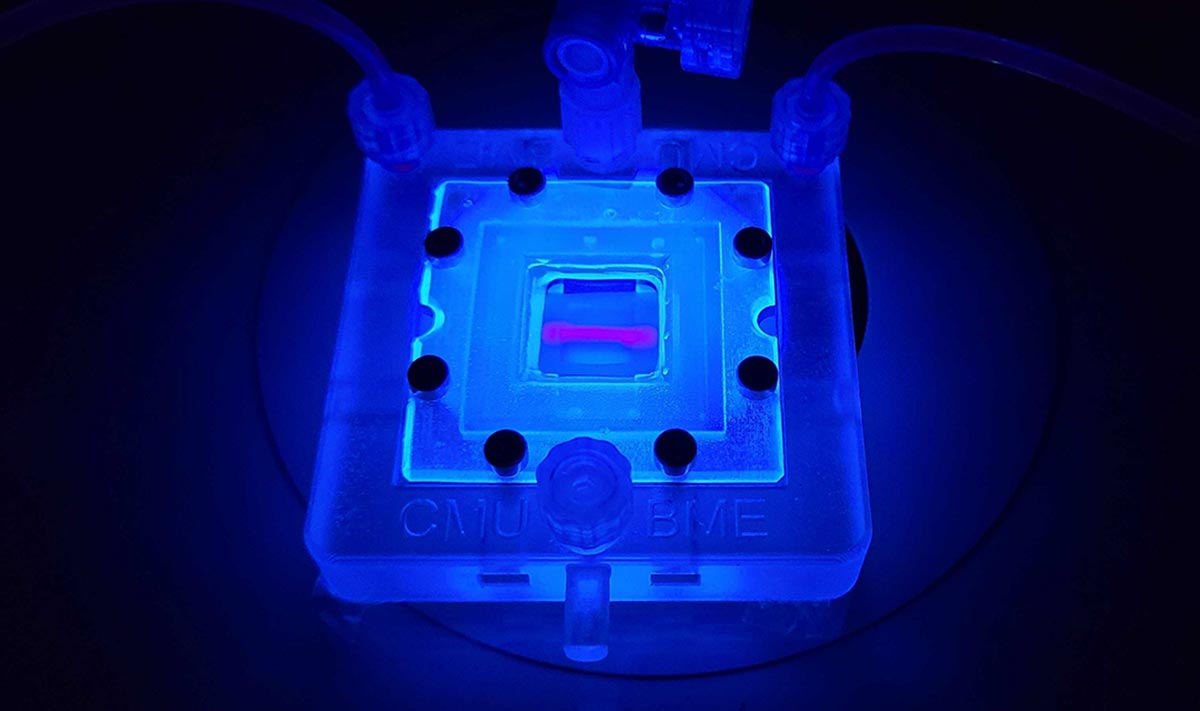
Carnegie Mellon researchers have used FRESH 3D bioprinting to create the first collagen-based microphysiologic systems, offering new hope for Type 1 diabetes treatment.
Collagen is widely recognized for its role in maintaining healthy skin, but its importance extends far beyond that. As the most abundant protein in the human body, collagen provides essential structure and support to nearly all tissues and organs.
Now, researchers at Carnegie Mellon’s Feinberg Lab have made a major breakthrough using their novel Freeform Reversible Embedding of Suspended Hydrogels (FRESH) 3D bioprinting technique. This method enables the precise printing of soft, living cells and tissues. Leveraging this technology, the team successfully created the first-ever microphysiologic system, also known as a tissue model, constructed entirely from collagen. This advancement opens new possibilities for studying disease and engineering tissue therapies, including potential treatments for conditions like Type 1 diabetes.
Traditionally, small-scale models of human tissue, referred to as microfluidics, organ-on-chip devices, or microphysiologic systems, have been fabricated using synthetic materials such as silicone rubber or plastics. These materials were necessary due to limitations in earlier manufacturing techniques. However, because they are not biologically native, they fail to fully replicate natural tissue environments, restricting their effectiveness in biomedical research and therapeutic development.
“Now, we can build microfluidic systems in the Petri dish entirely out of collagen, cells, and other proteins, with unprecedented structural resolution and fidelity,” explained Adam Feinberg, a professor of biomedical engineering and materials science & engineering at Carnegie Mellon University. “Most importantly, these models are fully biologic, which means cells function better.”
Building Complex Tissues with FRESH Bioprinting
In new research published in Science Advances, the group demonstrates the use of this FRESH bioprinting advancement, building more complex vascularized tissues out of fully biologic materials, to create a pancreatic-like tissue that could potentially be used in the future to treat Type 1 diabetes. This advancement in FRESH bioprinting builds on the team’s earlier work published in Science, by improving the resolution and quality to create fluidic channels that are like blood vessels down to about 100-micron diameter.
“There were several key technical developments to the FRESH printing technology that enabled this work,” described Daniel Shiwarski, assistant professor of bioengineering at the University of Pittsburgh and prior postdoctoral fellow in the Feinberg lab. “By implementing a single-step bioprinting fabrication process, we manufactured collagen-based perfusable CHIPS in a wide range of designs that exceed the resolution and printed fidelity of any other known bioprinting approach to date. Further, when combined with multi-material 3D bioprinting of ECM proteins, growth factors, and cell-laden bioinks and integration into a custom bioreactor platform, we were able to create a centimeter-scale pancreatic-like tissue construct capable of producing glucose-stimulated insulin release exceeding current organoid based approaches.”
This technology is currently being commercialized by FluidForm Bio, a Carnegie Mellon University spinout company where co-author Dr. Andrew Hudson, Director of Tissue Therapeutics, and his team have already demonstrated in an animal model that they can cure Type 1 diabetes in-vivo. FluidForm Bio plans to start clinical trials in human patients in the next few years.
The Importance of Collaboration and Future Directions
“It is paramount for everyone to understand the importance of team-based science in developing these technologies and the value that varied expertise, ranging from biology to materials science, brings both to the project, and our impact on society,” elaborated Feinberg.
“Going forward, the question is not, can we build it? It’s more of, what do we build? The work we’re doing today is taking this advanced fabrication capability and combining it with computational modeling and machine learning, so that we can hopefully better understand what we need to print. Ultimately, we want the tissue to better mimic the disease of interest or ultimately, have the right function, so when we implant it in the body as a therapy, it’ll do exactly what we want.”
Feinberg and his collaborators are committed to releasing open-source designs and other technologies that allow for broad adoption within the research community. “We’re hoping that very quickly, other labs in the world will adopt and expand this capability to other disease and tissue areas,” Feinberg added. “We see this as a base platform for building more complex and vascularized tissue systems.”
Reference: “3D bioprinting of collagen-based high-resolution internally perfusable scaffolds for engineering fully biologic tissue systems” by Daniel J. Shiwarski, Andrew R. Hudson, Joshua W. Tashman, Ezgi Bakirci, Samuel Moss, Brian D. Coffin and Adam W. Feinberg, 23 April 2025, Science Advances.
DOI: 10.1126/sciadv.adu5905
The study was funded by the National Institutes of Health.
Never miss a breakthrough: Join the SciTechDaily newsletter.
Follow us on Google and Google News.