
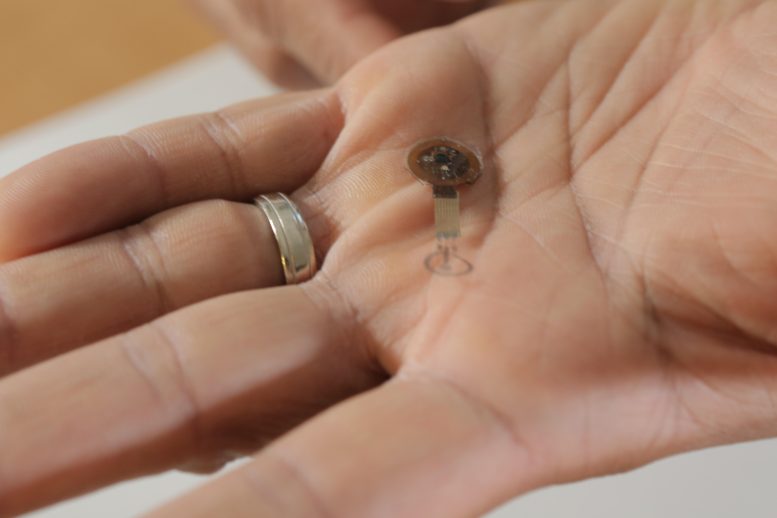
The bandage also keeps track of the healing process and informs healthcare professionals of any problems in real-time.
- Wireless, battery-free bandage delivers electrical signals to help wounds heal
- Bandage monitors healing, streaming data in real-time to a smartphone or tablet
- After healing is complete, bandage and electronics harmlessly absorb into the body
Northwestern University scientists have created a first-of-its-kind small, flexible, stretchable bandage that hastens the healing process by administering electrotherapy directly to the injury. In a trial on animals, the innovative bandage was found to heal diabetic sores 30% quicker in mice compared to those without the bandage.
In addition, the bandage continuously tracks the healing process and dissolves completely, including its electrodes, into the body once it is no longer required. This new invention could be a valuable asset for individuals with diabetes, whose wounds may lead to serious consequences such as limb amputation or death.
The research was published in the journal Science Advances. It marks the first bioresorbable bandage capable of delivering electrotherapy and the first example of a smart regenerative system.
“When a person develops a wound, the goal is always to close that wound as quickly as possible,” said Northwestern’s Guillermo A. Ameer, who co-led the study. “Otherwise, an open wound is susceptible to infection. And, for people with diabetes, infections are even harder to treat and more dangerous. For these patients, there is a major unmet need for cost-effective solutions that really work for them. Our new bandage is cost-effective, easy to apply, adaptable, comfortable, and efficient at closing wounds to prevent infections and further complications.”
“Although it’s an electronic device, the active components that interface with the wound bed are entirely resorbable,” said Northwestern’s John A. Rogers, who co-led the study. “As such, the materials disappear naturally after the healing process is complete, thereby avoiding any damage to the tissue that could otherwise be caused by physical extraction.”
An expert in regenerative engineering, Ameer is the Daniel Hale Williams Professor of Biomedical Engineering at Northwestern’s McCormick School of Engineering and professor of surgery at Northwestern University Feinberg School of Medicine. He also directs the Center for Advanced Regenerative Engineering (CARE) and the predoctoral Regenerative Engineering Training Program, funded by the National Institutes of Health. Rogers is the Louis Simpson and Kimberly Querrey Professor of Materials Science and Engineering, Biomedical Engineering and Neurological Surgery at McCormick and Feinberg. He also directs the Querrey Simpson Institute for Bioelectronics.
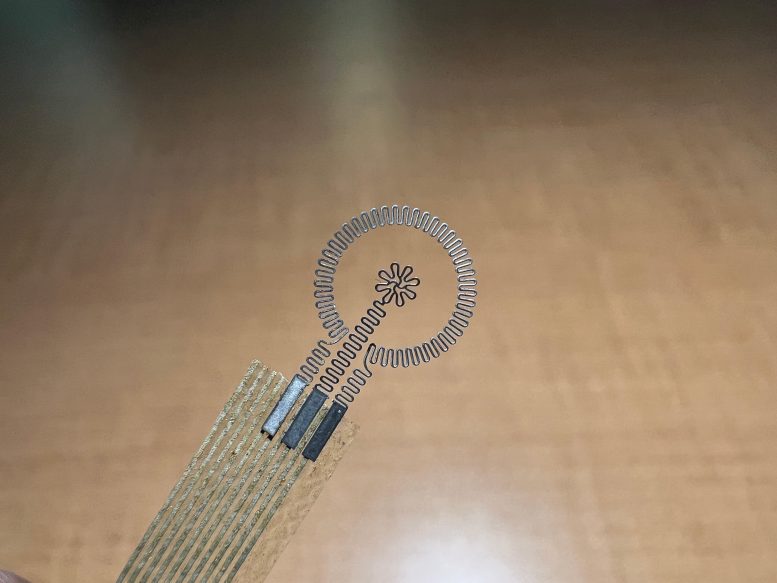
This artistic illustration shows the part of the device that harmlessly dissolves into the body. By making the electrode bioresorbable, the researchers were able to ensure that the device would not interfere with healing and new tissue growth. Credit: Northwestern University
Power of Electricity
Nearly 30 million people in the U.S. have diabetes, and about 15 to 25% of that population develops a diabetic foot ulcer at some point in their lives. Because diabetes can cause nerve damage that leads to numbness, people with diabetes might experience a simple blister or small scratch that goes unnoticed and untreated. As high glucose levels also thicken capillary walls, blood circulation slows, making it more difficult for these wounds to heal. It’s a perfect storm for a small injury to evolve into a dangerous wound.
The researchers were curious to see if electrical stimulation therapy could help close these stubborn wounds. According to Ameer, injuries can disrupt the body’s normal electrical signals. By applying electrical stimulation, it restores the body’s normal signals, attracting new cells to migrate to the wound bed.

“Our body relies on electrical signals to function,” Ameer said. “We tried to restore or promote a more normal electrical environment across the wound. We observed that cells rapidly migrated into the wound and regenerated skin tissue in the area. The new skin tissue included new blood vessels, and inflammation was subdued.”
Historically, clinicians have used electrotherapy for healing. But most of that equipment includes wired, bulky apparatuses that can only be used under supervision in a hospital setting. To design a more comfortable product that could be worn around the clock at home, Ameer partnered with Rogers, a bioelectronics pioneer who first introduced the concept of bioresorbable electronic medicine in 2018.
Remote Control
The two researchers and their teams ultimately developed a small, flexible bandage that softly wraps around the injury site. One side of the smart regenerative system contains two electrodes: A tiny flower-shaped electrode that sits right on top of the wound bed and a ring-shaped electrode that sits on healthy tissue to surround the entire wound. The other side of the device contains an energy-harvesting coil to power the system and a near-field communication (NFC) system to wirelessly transport data in real-time.
The team also included sensors that can assess how well the wound is healing. By measuring the resistance of the electrical current across the wound, physicians can monitor progress. A gradual decrease in current measurement relates directly to the healing process. So, if the current remains high, then physicians know something is wrong.
By building in these capabilities, the device can be operated remotely without wires. From afar, a physician can decide when to apply the electrical stimulation and can monitor the wound’s healing progress.
“As a wound tries to heal, it produces a moist environment,” Ameer said. “Then, as it heals, it should dry up. Moisture alters the current, so we are able to detect that by tracking electrical resistance in the wound. Then, we can collect that information and transmit it wirelessly. With wound care management, we ideally want the wound to close within a month. If it takes longer, that delay can raise concerns.”
In a small animal model study, the researchers applied electrical stimulation for just 30 minutes a day. Even this short amount of time accelerated the closure by 30%.
Disappearing Act
When the wound is healed, the flower-shaped electrode simply dissolves into the body, bypassing the need to retrieve it. The team made the electrodes from a metal called molybdenum, which is widely used in electronic and semiconductor applications. They discovered that when molybdenum is thin enough, it can biodegrade. Furthermore, it does not interfere with the healing process.
“We are the first to show that molybdenum can be used as a biodegradable electrode for wound healing,” Ameer said. “After about six months, most of it was gone. And we found there’s very little accumulation in the organs. Nothing out of the ordinary. But the amount of metal we use to make these electrodes is so minimal, we don’t expect it to cause any major issues.”
Next, the team plans to test their bandage for diabetic ulcers in a larger animal model. Then, they aim to test it on humans. Because the bandage leverages the body’s own healing power without releasing drugs or biologics, it faces fewer regulatory hurdles. This means patients potentially could see it on the market much sooner.
Reference: “Bioresorbable, wireless, and battery-free system for electrotherapy and impedance sensing at wound sites” by Joseph W. Song, Hanjun Ryu, Wubin Bai, Zhaoqian Xie, Abraham Vázquez-Guardado, Khizar Nandoliya, Raudel Avila, Geumbee Lee, Zhen Song, Jihye Kim, Min-Kyu Lee, Yugang Liu, Mirae Kim, Huifeng Wang, Yixin Wu, Hong-Joon Yoon, Sung Soo Kwak, Jaeho Shin, Kyeongha Kwon, Wei Lu, Xuexian Chen, Yonggang Huang, Guillermo A. Ameer and John A. Rogers, 22 February 2023, Science Advances.
DOI: 10.1126/sciadv.ade4687
The study was funded by the National Institute of Diabetes and Digestive and Kidney Diseases.
Never miss a breakthrough: Join the SciTechDaily newsletter.
Follow us on Google and Google News.