

Close Menu
    Facebook X (Twitter) Instagram
    SciTechDaily
    • Biology
    • Chemistry
    • Earth
    • Health
    • Physics
    • Science
    • Space
    • Technology
    Facebook X (Twitter) Pinterest YouTube RSS
    SciTechDaily
    Home»Health»Scientists Break 50-Year-Old Bottleneck To Supercharge Cancer Drug Production
    Health

    Scientists Break 50-Year-Old Bottleneck To Supercharge Cancer Drug Production

    By University of TurkuMarch 29, 2026No Comments3 Mins Read
    Facebook Twitter Pinterest Telegram LinkedIn WhatsApp Email Reddit
    Share
    Facebook Twitter LinkedIn Pinterest Telegram Email Reddit
    Scientist AI Biotechnology Medical Research
    A newly engineered bacterial strain produced substantially more doxorubicin than current industrial benchmarks. Credit: Shutterstock

    A long-standing challenge in cancer drug manufacturing may be shifting.

    An international team of scientists has reported a major advance in how doxorubicin, a widely used chemotherapy drug, can be produced. Their work pinpoints and overcomes key molecular “bottlenecks” that have restricted natural production of the drug for more than 50 years.

    First approved in the 1970s, doxorubicin remains a central treatment for cancers such as breast and bladder cancer, as well as lymphomas and carcinomas. More than one million patients receive it each year. Despite its importance, the bacteria that naturally make doxorubicin do so very inefficiently, forcing manufacturers to rely on costly, multi-step semi-synthetic methods.

    Identifying the barriers to production

    “We have uncovered several independent factors that limit the formation of doxorubicin,” says Researcher Keith Yamada, PhD, from the University of Turku in Finland, a lead scientist on the study. “By addressing these bottlenecks, we have harnessed rational strain engineering to pave the way for cost-effective manufacturing that can meet growing global demand”.

    The research brought together six laboratories across three countries, including the University of Turku in Finland, three groups in the United States, and two in Leiden, the Netherlands.

    Working together, the scientists identified three main factors that restrict high-yield production of doxorubicin.
    Doxorubicin Production Graphic
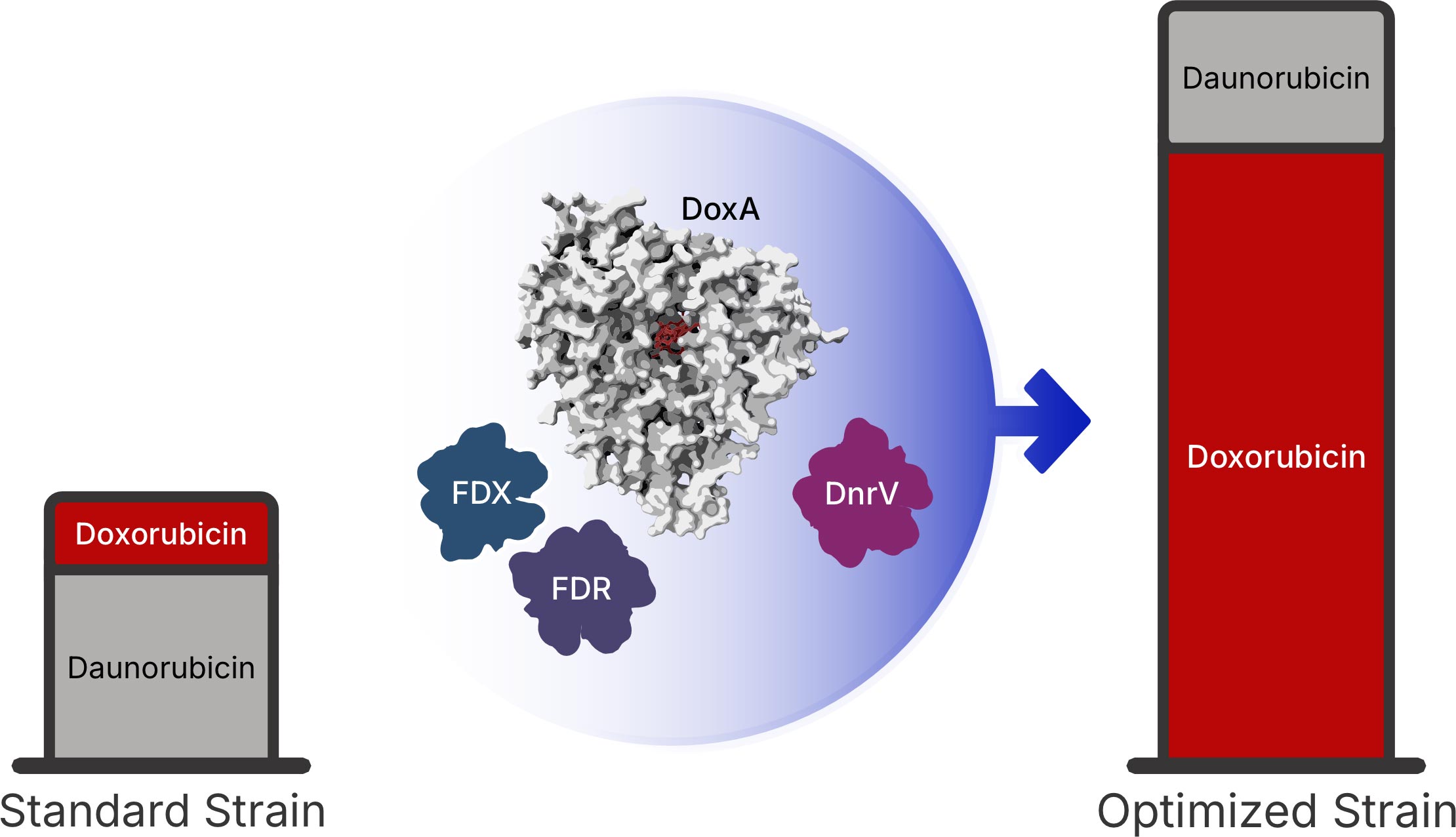
    The image shows how the new, optimised strain of bacteria produce an increased amount of doxorubicin. In the center, the primary production machinery (DoxA) is enhanced by a biological ‘power supply’ (FDX and FDR) and a ‘molecular sponge’ (DnrV). While the power supply keeps the process running at high speed, the sponge prevents the drug from clogging the system, allowing the engineered cells to produce the medicine with unprecedented purity and a 180% higher yield than standard industrial methods. Credit: Keith Yamada

    Three discoveries reshape the process

    The first finding revealed the enzyme’s required “biological power supply.” The team identified redox partners known as Fdx4 and FdR3, which deliver the electron flow needed to drive the reaction.

    Next, the researchers found that a protein called DnrV acts as a drug-binding “molecular sponge.” It sequesters (binds and holds) doxorubicin, preventing the compound from interfering with the enzyme responsible for producing it.

    Finally, using X-ray crystallography, the team mapped the enzyme’s structure for the first time. This showed that the drug binds in an unfavorable position inside the enzyme, helping explain why the reaction proceeds so slowly.

    From discovery to application

    By integrating these insights, the team engineered a bacterial strain capable of producing 180% more doxorubicin than current industrial standards.

    To move the technology toward real-world use, the researchers launched the spin-out company Meta-Cells Oy at the University of Turku last year. The company plans to develop these methods for the sustainable production of important antibiotics and anti-cancer drugs. This approach to fully biosynthetic manufacturing could lead to a cleaner and more dependable supply of essential medicines.

    Reference: “Metabolic engineering of doxorubicin biosynthesis through P450-redox partner optimization and structural analysis of DoxA” by Arina Koroleva, Erika Artukka, Keith Yamada, Sean A. Newmister, Ralph J. Harte, Hannah Boesger, Mikael Londen, Jacob N. Sanders, Heli Tirkkonen, Matti Kannisto, Rosan C. M. Kuin, Mandy Hulst, Rongbin Wang, Ester Leskinen, Morgane Barillec, Jarmo Niemi, Gilles P. van Wezel, Jacques Neefjes, S. Eric Nybo, Kendall N. Houk, David H. Sherman, Robbert Q. Kim and Mikko Metsä-Ketelä, 4 February 2026, Nature Communications.
    DOI: 10.1038/s41467-026-69194-6

    Never miss a breakthrough: Join the SciTechDaily newsletter.
    Follow us on Google and Google News.

    Cancer Chemotherapy Drugs Molecular Biology Pharmaceuticals Popular University of Turku
    Share. Facebook Twitter Pinterest LinkedIn Email Reddit

    Related Articles

    Cats May Hold the Key to Treating Human Cancer

    A Common Drug May Make Cancer Immunotherapy Work Better

    Sea Corals Found To Be a Source of an Elusive “Anti-Cancer” Compound

    Scientists Seek Innovative Cure for Cancer at the Molecular Level

    New Medication Shrinks Cancer in 80% of Patients

    Geneticists Reveal How Mutation Causes a Devastating Childhood Cancer – Use Drug To Reverse Its Effects

    Natural Painkiller: New Research Advances the Treatment of Chronic Pain

    Single Dose of Psychedelic Drug Produced Antianxiety and Antidepressant Effects That Last for Years

    Researchers Find a New Target to Treat a Wide Spectrum of Cancers

    Leave A Reply Cancel Reply

    • Facebook
    • Twitter
    • Pinterest
    • YouTube

    Don't Miss a Discovery

    Subscribe for the Latest in Science & Tech!

    Trending News

    Millions Take These IBS Drugs, But a New Study Finds Serious Risks

    Scientists Unlock Hidden Secrets of 2,300-Year-Old Mummies Using Cutting-Edge CT Scanner

    Bread Might Be Making You Gain Weight Even Without Eating More Calories

    Scientists Discover Massive Magma Reservoir Beneath Tuscany

    Europe’s Most Active Volcano Just Got Stranger – Here’s Why Scientists Are Rethinking It

    Alzheimer’s Symptoms May Start Outside the Brain, Study Finds

    Millions Take This Popular Supplement – Scientists Discover a Concerning Link to Heart Failure

    The Universe Is Expanding Too Fast and Scientists Can’t Explain Why

    Follow SciTechDaily
    • Facebook
    • Twitter
    • YouTube
    • Pinterest
    • Newsletter
    • RSS
    SciTech News
    • Biology News
    • Chemistry News
    • Earth News
    • Health News
    • Physics News
    • Science News
    • Space News
    • Technology News
    Recent Posts
    • Doctors Surprised by the Power of a Simple Drug Against Colon Cancer
    • Why Popular Diabetes Drugs Like Ozempic Don’t Work for Everyone: The “Genetic Glitch”
    • Scientists Create Improved Insulin Cells That Reverse Diabetes in Mice
    • Scientists Stunned After Finding Plant Thought Extinct for 60 Years
    • A Common Diabetes Drug May Hold the Key to Stopping HIV From Coming Back
    Copyright © 1998 - 2026 SciTechDaily. All Rights Reserved.
    • Science News
    • About
    • Contact
    • Editorial Board
    • Privacy Policy
    • Terms of Use

    Type above and press Enter to search. Press Esc to cancel.