
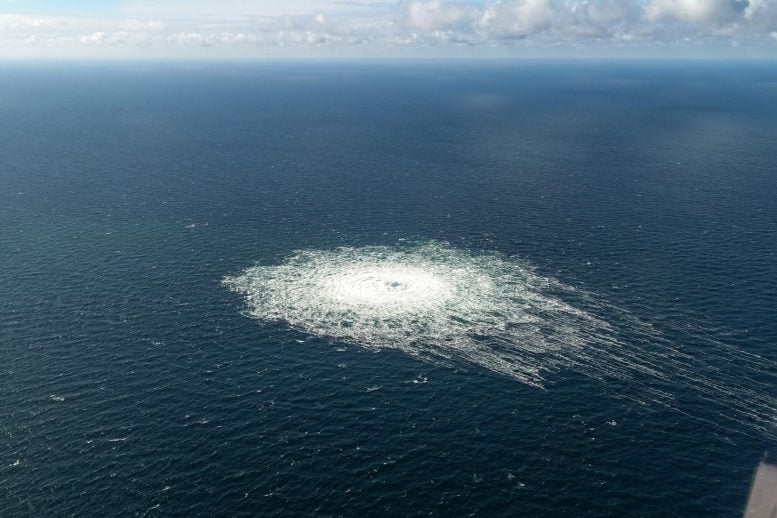
The Nord Stream methane leak, though significant, will cause minimal warming, equivalent to 20.6 Mt of CO2 over 20 years.
Nord Stream 1 and 2, two subsea pipelines for transferring natural gas from Russia to Germany, were both deliberately ruptured on September 26, 2022. Massive quantities of gases, primarily methane, escaped into the ocean and were then released into the atmosphere.
Methane is the second most abundant anthropogenic greenhouse gas after CO2 in terms of volume in the atmosphere, but it has a much stronger greenhouse effect. Therefore, whether negative climatic impacts would arise from this incident is a key concern worldwide. Although a news article published in the journal Nature commented on this issue, no quantitative conclusions were made.
This was the largest methane emission in a single event in human history.
Recently, scientists from the Institute of Atmospheric Physics, Chinese Academy of Sciences, estimated the possible climatic impact of the leaked methane by adopting the energy-conservation framework of the Intergovernmental Panel on Climate Change’s Sixth Assessment Report (IPCC AR6), released in 2021. Their findings were published today (November 11) in the journal Advances in Atmospheric Sciences.
First, the researchers collected all estimates of the total amount of leaked methane available in the world’s media after the incident. It was found that the earliest estimates (1–2 days after) reached up to 0.5 million tonnes (Mt). However, it later became clear that the quantity of methane that leaked was likely to be much lower than first estimated. In particular, a team from Nanjing University, China, provided a more accurate estimate of 0.22 ± 0.03 Mt by drawing upon multiple observations including those from high-resolution satellites.
This value established that this was the largest methane emission in a single event in human history—more than two times that of the Aliso Canyon accident in California in 2015. However, according to IPCC AR6, annual emissions of methane from the oil and gas sectors amounted to as much as 70 Mt during 2008–2017. This means that the leaked methane from the Nord Stream pipelines was equivalent to only 1 day of emissions from these sectors.
Short-Lived Methane’s Long-Term Climate Implications
IPCC AR6 also highlighted that methane in the atmosphere is gradually removed by reacting with certain radicals, such as hydroxyl radical, resulting in an approximate 10-year lifetime, which is short-lived compared to CO2. This means that the climatic impact of methane depends on the time horizon, which complicates matters when trying to calculate it directly.
Instead, the researchers made an indirect estimate with the help of the concept of “global warming potential.” Specifically, they determined that the quantity of heat accumulated per unit mass of methane in the next 20 years after its emission into the atmosphere is 82.5 times that of CO2. Then, armed with this information, they were able to calculate that, when considering a time horizon of 20 years, the climatic impact of the leaked methane is equivalent to that of 20.6 Mt of CO2, which would raise the atmospheric CO2 concentration by only 0.0026 ppm.
Based on the newest assessments in IPCC AR6 of the effective radiative forcing under doubled CO2, climate feedback, and ocean heat uptake efficiency, under the energy conservation framework, the global mean surface air temperature would in theory increase by 1.8×10⁻⁵ °C.
“Such a tiny warming cannot be perceived in ecosystems or human society,” explains Dr. Xiaolong Chen, first author of the study. “Still, anthropogenic methane has been the second largest driver of global warming, and is emitted from multiple sectors of agriculture and industry. If we are going to achieve the warming target of below 1.5°C or 2.7°F set out in the Paris Agreement, damage to infrastructure such as this should be avoided so that we can better control and reduce methane emissions.”
Reference: “Negligible Warming Caused by Nord Stream Methane Leaks” by Xiaolong Chen and Tianjun Zhou, 11 November 2022, Advances in Atmospheric Sciences.
DOI: 10.1007/s00376-022-2305-x
Never miss a breakthrough: Join the SciTechDaily newsletter.
Follow us on Google and Google News.
5 Comments
“Methane is the second most abundant anthropogenic greenhouse gas after CO2 in terms of volume in the atmosphere, …”
However, to put that into perspective, methane has an atmospheric concentration of about 2ppmv, while CO2 is about 420ppmv. Even the CO2 equivalent warming potential of methane is only about 5% of CO2, which is less than the uncertainty in the CO2 exchange in the oceans. The fossil fuel loss of methane is a fraction of the total (2ppmv) methane concentration. There are abrupt changes in the atmospheric methane that cannot be explained, but are probably related to weather. In other words, the Nord Stream release is in the noise of total atmospheric methane.
That’s because methane oxidizes when it reaches the atmosphere and turns into more CO2 through a simple chemical reaction.
A decade after the methane is released, almost all of it has been converted to CO2. That means, the annual flux of methane is equivalent to an annual increase of less than 0.02ppmv CO2, compared to a net annual increase of about 2.5ppmv of CO2. The CO2 equivalent of ALL methane additions is an order of magnitude less than the last uncertain digit in the annual CO2 increase. It isn’t just the Nord Stream release that is measurement noise, ALL methane is negligible compared to CO2.
The article itself explicitly said, “… the climatic impact of the leaked methane … would raise the atmospheric CO2 concentration by only 0.0026 ppm,” over a period of 20 years, or an average of 0.00013ppmv per year. Trying to reduce anthropogenic methane in the hopes of having a measurable impact is a Fools Errand — or at least the unfounded hope of innumerate politicians who want to give the impression of doing something useful.
It’s going to be a COLD winter for Europeans. Good thing China outputs more greenhouse gas vs the entire West!
It’s going to be a cold winter for Europeans, while China outputs more greenhouse gas vs the entire West.