
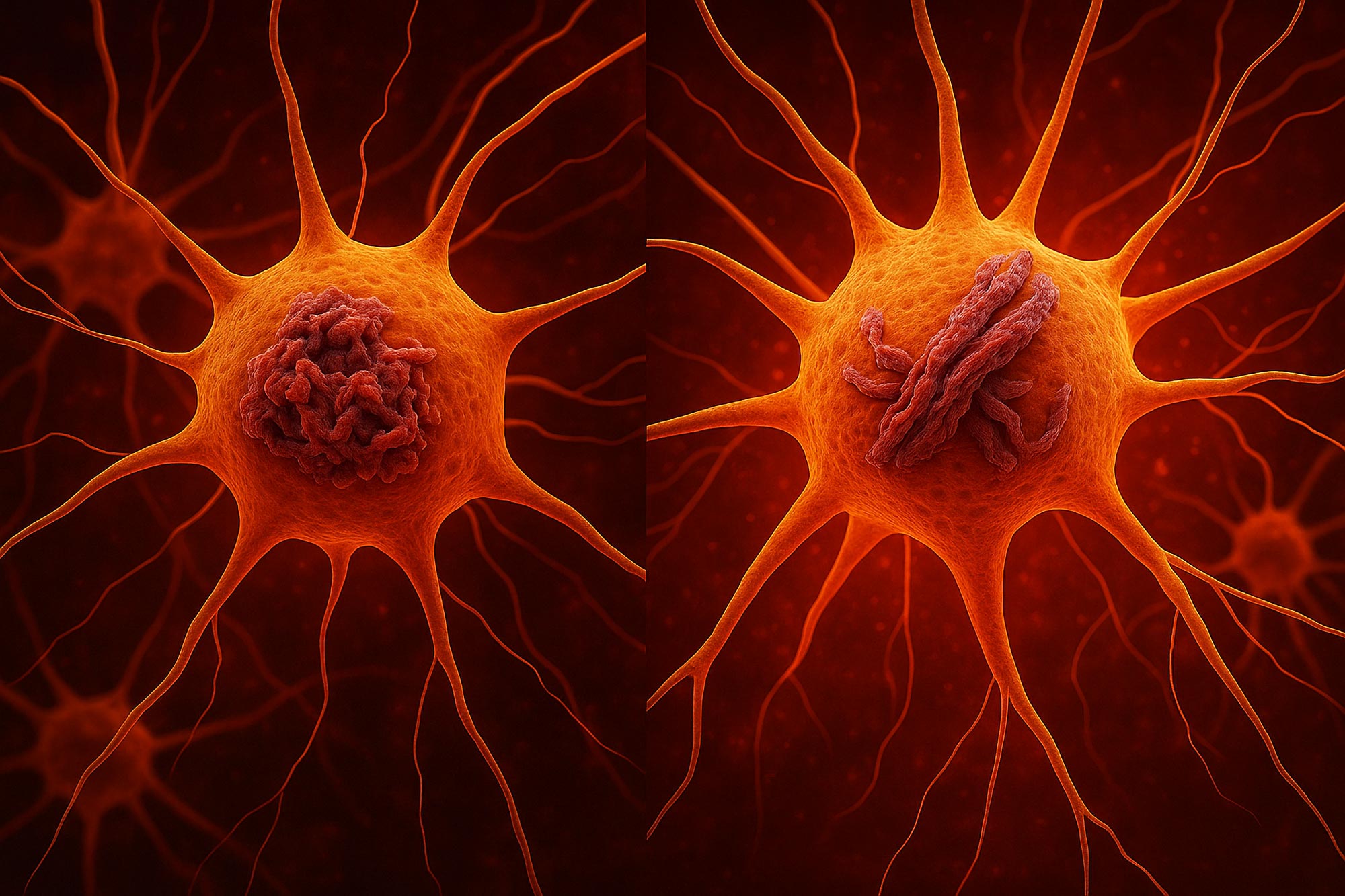
What if Alzheimer’s doesn’t begin with the visible plaques we’ve long blamed? Scientists have now pinpointed a stealthier culprit: tiny clumps of the tau protein that form before the classic brain damage appears.
This groundbreaking research reveals that subtle chemical changes in tau may quietly set off a chain reaction, spreading dysfunction across the brain. By identifying these early events, researchers may have unlocked a crucial window for treating Alzheimer’s before it takes hold, and it could lead to an entirely new class of drugs.
Uncovering Early Tau Changes in Alzheimer’s
Researchers from the University of Gothenburg in Sweden, in collaboration with the University of Pittsburgh, have published new findings in Nature Medicine.
Their study sheds light on one of the earliest stages of Alzheimer’s disease—the transformation of the tau protein into thread-like structures called fibrils inside nerve cells. This process occurs alongside the well-known buildup of amyloid plaques. In healthy brains, tau plays a stabilizing role by supporting microtubules, the structural components that help nerve cells maintain their shape and transport nutrients.
Tau Aggregation and Disease Spread
As Alzheimer’s disease progresses, tau undergoes harmful changes. Initially, it forms small, soluble clumps that are released from nerve cells. These clumps are believed to spread the disease by triggering similar changes in nearby cells. Over time, tau transforms into larger, fibrous strands that are toxic to neurons.
Tohidul Islam, a lead author of the study and researcher at the University of Gothenburg’s Sahlgrenska Academy, explains:
“In our study, we look at how tau is modified, which leads it to form its soluble clumps. We found that changes in two specific amino acids, serine-262 and serine-356, happen before these thread-like fibrils start to form in the nerve cells.”

New Hope for Drug Development
Alzheimer’s research has made significant advances around the world in recent years. Many countries – although not yet in the EU – have approved the Alzheimer’s drug lecanemab. An American drug donanemab is also being developed. Both drugs target the process that is deemed to be the most important in the progression of the disease: the accumulation of the protein beta-amyloid in the brain.
“Our hypothesis is that tau in its soluble form helps the disease process to spread in the brain,” says Kaj Blennow, a University of Gothenburg professor and one of the senior researchers behind the study. “If researchers want to develop drugs in the future to combat the tau pathology as a complement to drugs that target the amyloid plaque, we now know which regions are of interest to focus on.”
A New Biomarker for Measuring Treatment
The drug lecanemab was first introduced almost two years ago and has demonstrated good results in terms of reducing the amyloid plaque in the brain among patients at an early stage of Alzheimer’s disease. However, it is impossible to know with any degree of certainty what the long-term results will be. The findings regarding the soluble phosphorylated small aggregates of the protein tau also offer a new opportunity to demonstrate the protein changes before the larger fibrils form in the nerve cells. The study therefore provides a biomarker that can be directly linked to the amount of tau pathology in patients’ brains.
Reference: “Phospho-tau serine-262 and serine-356 as biomarkers of pre-tangle soluble tau assemblies in Alzheimer’s disease” by Tohidul Islam, Emily Hill, Eric E. Abrahamson, Stijn Servaes, Denis S. Smirnov, Xuemei Zeng, Anuradha Sehrawat, Yijun Chen, Przemysław R. Kac, Hlin Kvartsberg, Maria Olsson, Emma Sjons, Fernando Gonzalez-Ortiz, Joseph Therriault, Cécile Tissot, Ivana Del Popolo, Nesrine Rahmouni, Abbie Richardson, Victoria Mitchell, Henrik Zetterberg, Tharick A. Pascoal, Tammaryn Lashley, Mark J. Wall, Douglas Galasko, Pedro Rosa-Neto, Milos D. Ikonomovic, Kaj Blennow and Thomas K. Karikari, 10 February 2025, Nature Medicine.
DOI: 10.1038/s41591-024-03400-0
Never miss a breakthrough: Join the SciTechDaily newsletter.
Follow us on Google and Google News.
2 Comments
About time. The amyloid hypothesis has been an evident dead end for at least 20 years, yet has been the continued target of research and grant funding- to some extent, to the exclusion of other disease factors- despite failure after failure to explain the disease’s cause and progression as well as failing to provide an actionable treatment. Tau has been a more promising candidate for many years now, but amyloid was difficult to let go of because entire careers and research programs have been based upon it and the funding available.
It is not a true dead end. There are many amyloid diseases, and while it is obviously better to stop the disease before it starts, it may still be useful to remove the plaques at the appropriate time. It is likely to get at the tau, in a combination treatment, the amyloid may have to be stripped away.
There is a lot of research on Alzheimer’s other than just looking at amyloid. Someone motivated can likely prevent themselves from getting the disease, because of things we have learned.
We know now that quality sleep is absolutely critical. Sleeping pills can help, aroma therapy at night can help, insuring blood pressure at night does not fall too low can help, not elevating the head too high while sleeping can help, if low blood pressure is a risk. Regular zone 2 cardio, and HIIT, are helpful. Hibiscus tea, choline, green tea catechins and resveratrol, D-serine, Trigonelline, aspartate and glutamate, inulin and fructooligosaccharides all seem to help prevent Alzheimer’s.
The decline of Anti-inflammatory molecules in the brain suggests that increasing these could be of benefit in prevention. Associations with pathogens are substantial. Reducing dietary Advanced Glycation End-products may be big. The Bredesen Protocol combines some of these things, and has showed good results treating Alzheimer’s.