

Penn State scientists discovered seven new ceramics by simply removing oxygen—opening a path to materials once beyond reach.
Sometimes, less truly is more. By removing oxygen during the synthesis process, a team of materials scientists at Penn State successfully created seven new high-entropy oxides (HEOs)—a class of ceramics made from five or more metals that show promise for use in energy storage, electronics, and protective coatings.
During their experiments, the researchers also established a framework for designing future materials based on thermodynamic principles. Their findings were published in Nature Communications.
“By carefully removing oxygen from the atmosphere of the tube furnace during synthesis, we stabilized two metals, iron and manganese, into the ceramics that would not otherwise stabilize in the ambient atmosphere,” said corresponding and first author Saeed Almishal, research professor at Penn State working under Jon-Paul Maria, Dorothy Pate Enright Professor of Materials Science.
Machine learning expands material possibilities
Almishal first succeeded in stabilizing a manganese- and iron-containing compound by precisely controlling oxygen levels in a material he called J52, composed of magnesium, cobalt, nickel, manganese, and iron. Building on this, he used newly developed machine learning tools—an artificial intelligence technique capable of screening thousands of possible material combinations within seconds—to identify six additional metal combinations capable of forming stable HEOs.
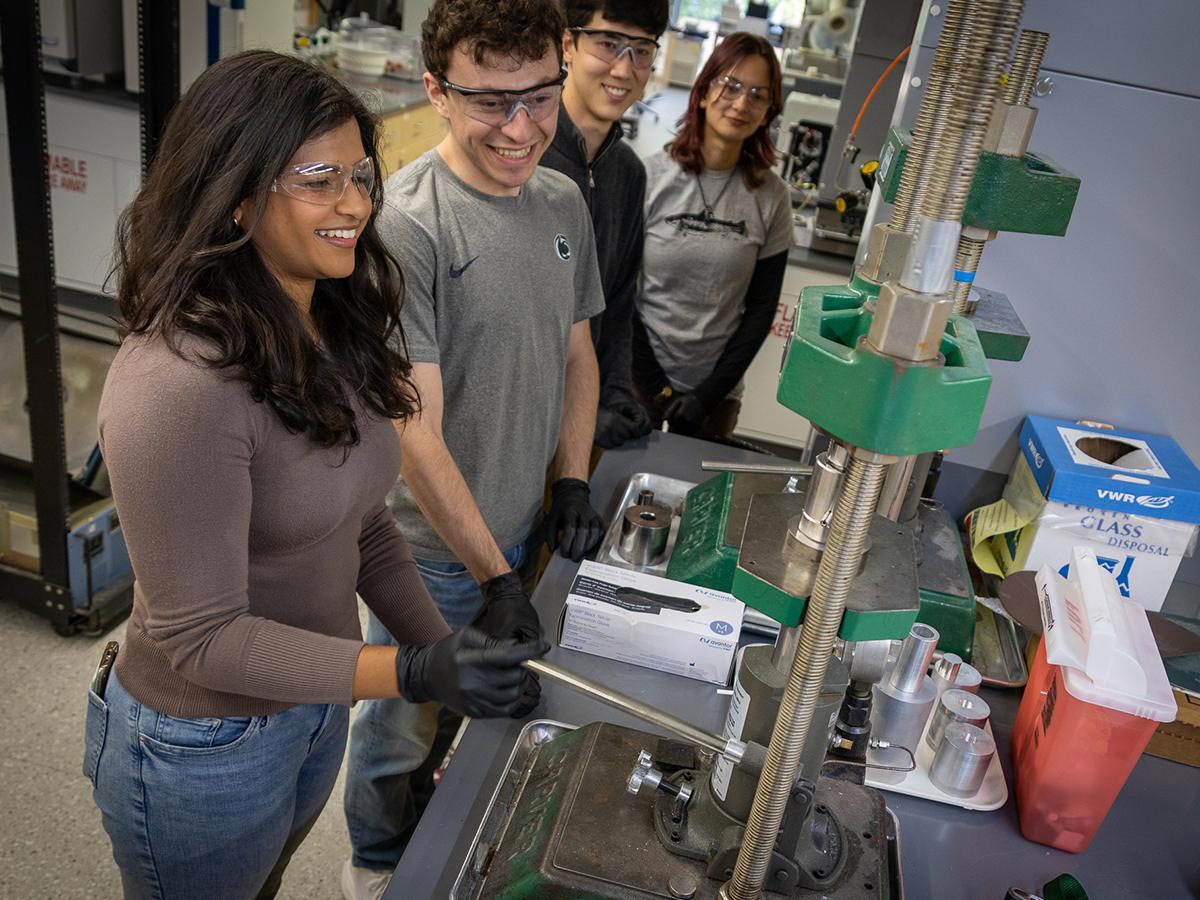
With the assistance of a team of undergraduate students who processed, fabricated, and characterized the samples, Almishal produced bulk ceramic pellets of all seven novel, stable, and potentially functional HEO compositions. The students’ work was supported by the Department of Materials Science and Engineering and Penn State’s Center for Nanoscale Science, a U.S. National Science Foundation–funded Materials Research Science and Engineering Center.
Thermodynamic principles behind stabilization
“In a single step, we stabilized all seven compositions that are possible given our current framework,” Almishal said. “Although this was previously treated this as a complex problem in the field of HEOs, the solution was simple in the end. With a careful understanding of the fundamentals of material and ceramic synthesis science — and particularly the principles of thermodynamics — we found the answer.”
Stabilizing these materials, Almishal explained, involves “coercing” the manganese and iron atoms to stay in the 2+ oxidation state, also known as the rock salt structure, where each atom bonds with only two oxygen atoms. Under normal oxygen levels, the materials would fail to stabilize because the manganese and iron atoms would keep binding with additional oxygen, shifting to a higher oxidation state. By reducing the amount of oxygen in the tube furnace, the researchers restricted how much oxygen the material could absorb, allowing it to form and remain in the stable rock salt structure.
“The main rule we followed in synthesizing these materials is the role that oxygen plays in stabilizing such ceramic materials,” Almishal said.
Confirming results and future directions
To make sure that manganese and iron in each new material were stable in the target oxidation state, Almishal collaborated with researchers from Virginia Tech. They performed an advanced imaging technique to measure how X-rays are absorbed by the atoms in the material. By analyzing the resulting data, researchers could determine the oxidation state of specific elements and confirm the stability of manganese and iron in the new materials.
In the next phase of research, the researchers said they will test all seven new materials for their magnetism. They also aim to apply their thermodynamic framework for controlling oxygen during synthesis to other material classes currently considered unstable and challenging to synthesize.
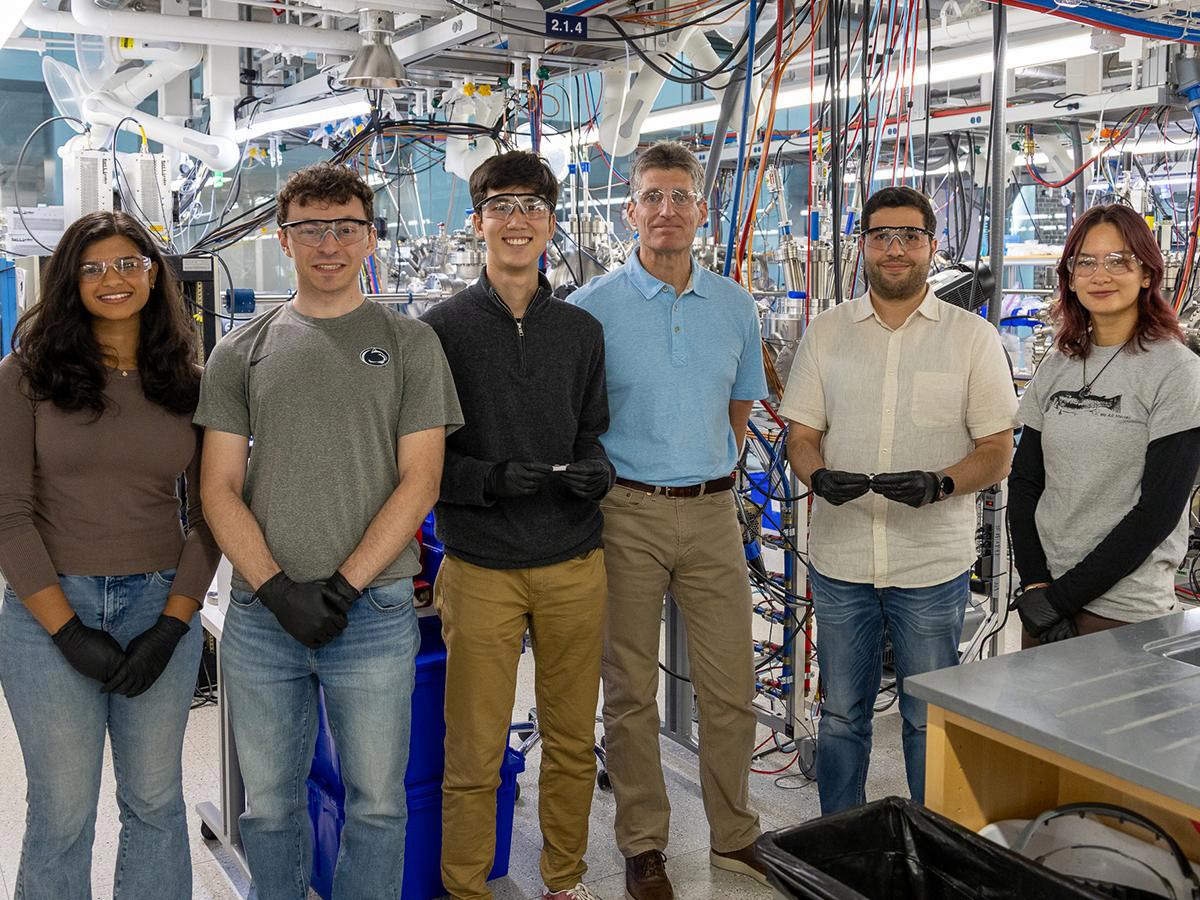
“This paper, which has already been accessed online thousands of times, seems to resonate with researchers because of its simplicity,” Almishal said. “Although we focus on rock salt HEOs, our methods provide a broad adaptable framework for enabling uncharted, promising chemically disordered complex oxides.”
As a result of his extensive lab work on the new materials, co-author and undergraduate materials science and engineering major Matthew Furst was invited to present the research at the American Ceramic Society’s (ACerS) Annual Meeting with Materials Science and Technology 2025 — an honor usually reserved for faculty or senior graduate students — which took place Sept. 28 through Oct. 1 in Columbus, Ohio.
“I am so grateful for the opportunities that I have had on this project and to be involved in every step of the research and publication process,” Furst said. “Being able to present this material to a broad audience as an invited talk reflects my involvement and the excellent guidance I have received from my mentors. It means a lot to me to develop important communication skills as an undergraduate student, and I look forward to pushing myself further in the future!”
Reference: “Thermodynamics-inspired high-entropy oxide synthesis” by Saeed S. I. Almishal, Matthew Furst, Yueze Tan, Jacob T. Sivak, Gerald Bejger, Joseph Petruska, Sai Venkata Gayathri Ayyagari, Dhiya Srikanth, Nasim Alem, Christina M. Rost, Susan B. Sinnott, Long-Qing Chen and Jon-Paul Maria, 2 September 2025, Nature Communications.
DOI: 10.1038/s41467-025-63567-z
Funding: The Penn State Center for Nanoscale Science, an U.S. National Science Foundation-funded Materials Research Science and Engineering Center, supported this research.
Never miss a breakthrough: Join the SciTechDaily newsletter.
Follow us on Google and Google News.
1 Comment
thanks for this