
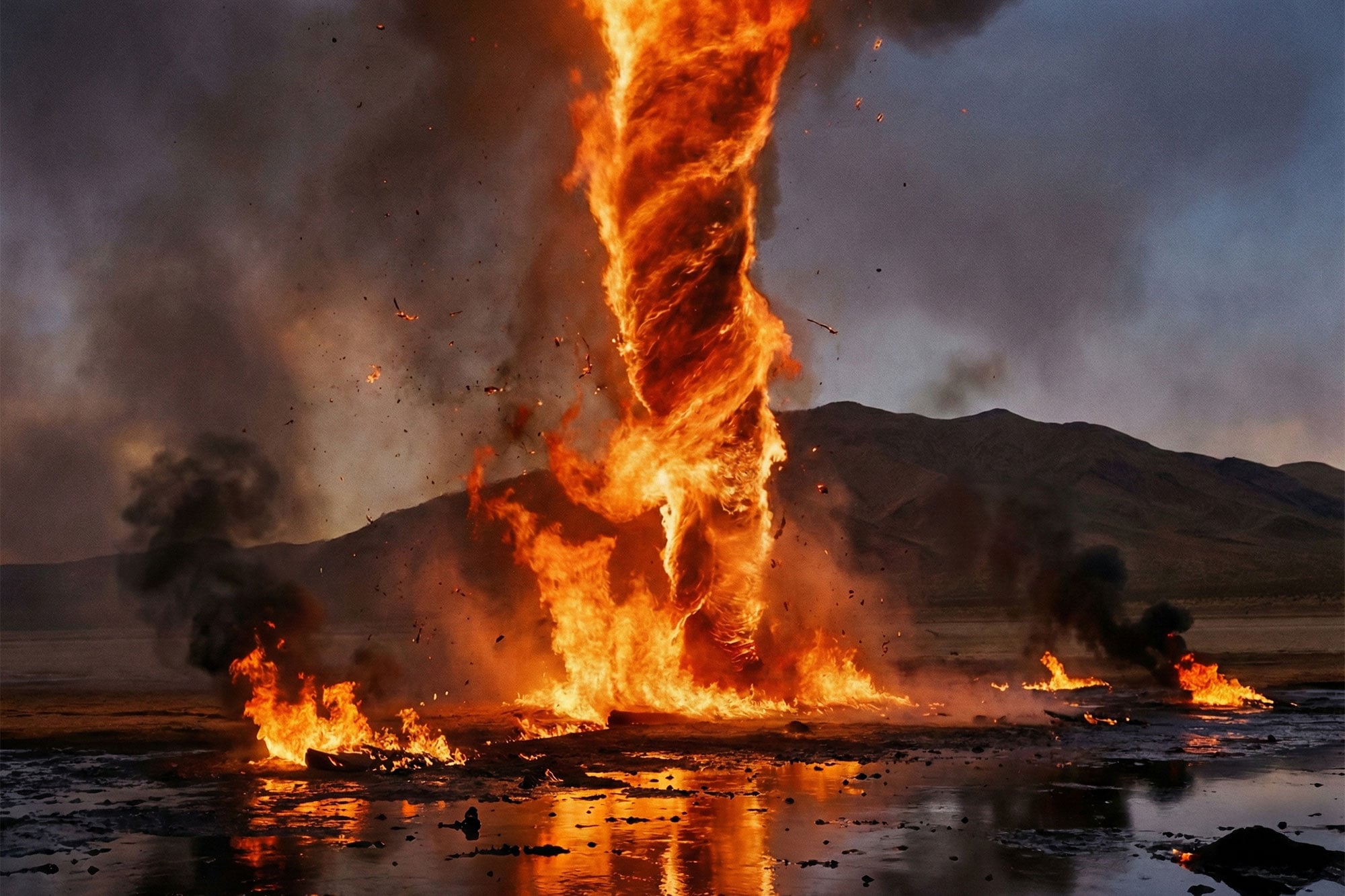
Scientists created 17-foot fire whirls that burn oil spills faster and cleaner than conventional methods, reducing soot by 40% and consuming nearly all the fuel. The technique shows promise for rapid, lower-emission spill response.
In the critical hours after an offshore oil spill, response teams must make a difficult choice: allow the slick to spread or set it on fire.
When responders ignite the oil, they create what is known as an ‘in-situ’ fire pool. This method can prevent oil from drifting and contaminating fragile marine ecosystems — but it comes at a heavy cost. Thick smoke rises into the air, soot and other pollutants spread through the atmosphere, and a layer of partially burned residue remains on the ocean surface.
In a first-of-its-kind large-scale experiment, scientists tested a different strategy: enormous fire whirls, spinning columns of flame that rise vertically like a tornado instead of spreading across the water.
Fire Whirls: A Cleaner, Faster Oil Spill Solution
This rotating column acts like a powerful engine. As it spins, it pulls in extra oxygen, which allows the flame to burn hotter and more efficiently than a traditional fire pool.
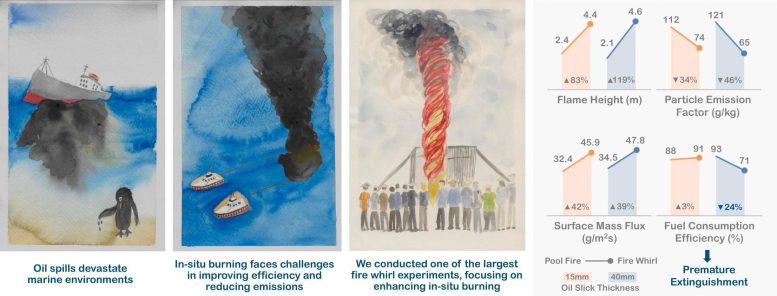
The improvement was dramatic. Compared with standard in-situ fires, the fire whirl generated 40 percent less soot and burned up to 95 percent of the oil, leaving behind far fewer hazardous particles and toxic remnants.
The research, funded by the Bureau of Safety and Environmental Enforcement (BSEE), is led by Dr. Elaine Oran and Dr. Qingsheng Wang of Texas A&M University, along with Dr. Michael Gollner of the University of California, Berkeley.
“This the first time anyone has conceived using fire whirls for oil spill remediation, and it’s really just the beginning,” said Oran, professor of aerospace engineering in the College of Engineering. “Our goal is to harness the chaotic nature of fire whirls as a powerful, precise restoration tool to protect coastlines, marine ecosystems, and the environment as a whole.”

A New Era of Rapid, Greener Oil Spill Response
By learning how to generate and control large fire whirls, the team is advancing an unconventional yet potentially transformative tool for tackling oil spill disasters.
The 2010 Deepwater Horizon disaster—the largest offshore oil spill in U.S. history that claimed the lives of 11 workers, killed thousands of marine animals, and devastated oceanic habitats—illustrates how quickly such events can escalate into environmental crises.
“We are looking at environmental disasters like oil spills and identifying ways to remediate them in faster, greener, and more sustainable ways,” Oran said.
Faster Burn Rates and Reduced Emissions
One of the clearest advantages of fire whirls is speed.
Because they burn crude oil nearly twice as fast as in-situ fire pools, they could give emergency crews a crucial time advantage, helping them eliminate slicks before they drift into protected or sensitive coastal areas.
“Fire whirls burn through crude oil spills nearly twice as fast as in-situ fire pools, potentially giving cleanup crews faster operational and response times to eliminating the oils from spreading,” Oran said.
The findings also suggest meaningful improvements in air quality during spill response operations.
Cleaner Air and Broader Combustion Applications
“One of the biggest challenges of burning oil spills is the sheer volume of smoke emitted,” Oran said. “Our results show that fire whirls, compared to in-situ fires, dramatically reduce overall emissions.”
Functioning much like an industrial incinerator, the spinning flame breaks down the particles that normally create dense smoke clouds. This reduces the environmental tradeoff of emergency burning while vaporizing almost all the oil before it can harden into a sticky tar layer on the water.
The insights gained from studying fire whirls may extend well beyond marine spills. A more in-depth understanding of their physics could influence the design of high-efficiency combustion systems and improve strategies for anticipating and managing wildfires on land.
“Our study has universal applications,” Oran said. “By understanding the physical laws that govern fire whirls, we can harness their power beyond oil spill remediation.”
Scaling Up: Creating a 17-Foot Fire Whirlpool
Much of the existing knowledge about fire whirls, including the spinning columns seen in wildfires, has come from small laboratory experiments.
To realistically model conditions similar to those of a large ocean spill, the researchers built a much larger experimental setup.
“The scale of our experiment is one of the reasons why our investigation is so unique, and what sets it apart as a first-of-its-kind,” Oran said.
Inside the Large-Scale Fire Whirl Experiment
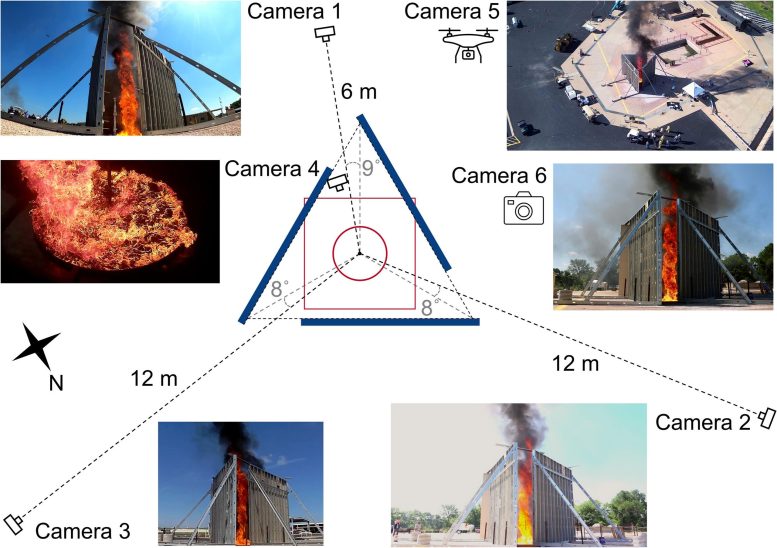
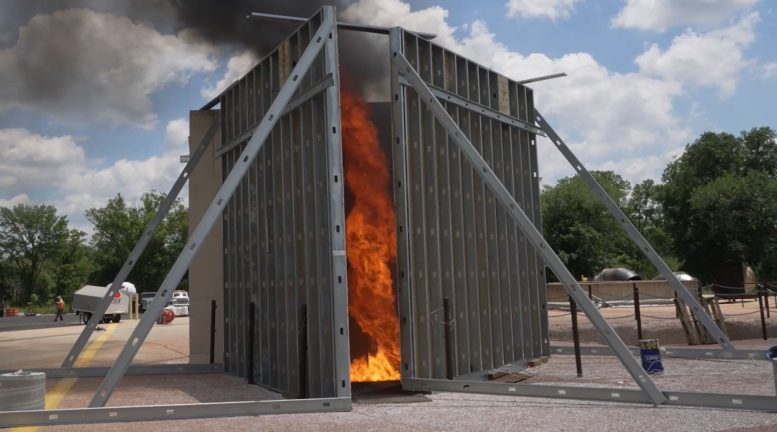
The team constructed a 16-foot-tall triangular structure with three walls to carefully direct airflow. At its center, they placed a 1.5-meter-wide pool of crude oil floating on water.
When the oil was ignited at the Texas A&M Engineering Extension Service (TEEX) Brayton Fire Training Field, the setup produced a roaring fire whirl that reached nearly 17 feet in height.
Results published in Fuel showed clear gains in performance, including stronger combustion, cleaner exhaust, and near-complete fuel consumption.
“The fire whirls burned the oil about 40 percent faster, cut soot emissions by 40 percent, and achieved up to 95 percent fuel consumption efficiency compared to in-situ fire tests,” Oran said.
The ‘Goldilocks’ Zone: Balancing Power and Stability
Despite their potential, the researchers caution that fire whirls are highly sensitive to their surroundings.
“Fire whirls are incredibly powerful and can be incredibly beneficial,” Oran said. “But they’re also sensitive and only reach high efficiency when the conditions are just right.”
If winds are too strong, the spinning column can break apart. If airflow is not carefully managed, the flame reverts to a standard fire pool. The thickness of the oil layer also plays a role. When the slick became too deep, the fire whirl went out earlier than expected.
This delicate balance—the ‘Goldilocks’ zone—underscores both the opportunity and the engineering challenges involved in applying the technology outside controlled experiments.
Future Deployment: Fire Whirls on the Horizon
With additional research and further technological advances, the scientists envision portable systems that could be positioned over burning oil slicks, converting ordinary flames into efficient fire whirls.
“This study is more than just an experiment, it’s a glimpse into a future where fire isn’t a force of destruction, but a tool to protect our oceans and planet,” Oran said.
For now, the successfully generated and controlled fire whirls stand as a significant scientific milestone.
The work shows that unconventional ideas can lead to major breakthroughs, and that even intense, destructive forces can be redirected to address urgent environmental challenges.
Reference: “Large-scale field experiments on enhancing In-Situ burning with fire whirls” by Wuquan Cui, Joseph L. Dowling, Mohammadhadi Hajilou, Mitchell Huffman, Bhushan Pawar, Johanna Aurell, Qingsheng Wang, Elaine Oran, Karen N. Stone and Michael J. Gollner, 30 June 2025, Fuel.
DOI: 10.1016/j.fuel.2025.136093
Never miss a breakthrough: Join the SciTechDaily newsletter.
Follow us on Google and Google News.
2 Comments
So, yeah. Just disperse all of the particles and pollutants to a higher altitude over a wider area? Sounds more like a cop out to spend less on cleanup and ultimately save money on trying to prevent spills to begin with. Works out great for big oil doesn’t it? We need to convert away from oil and coil. Ultimately we’re going to need all of those hydrocarbons as a food resource.
“Just disperse all of the particles and pollutants to a higher altitude over a wider area?”
What in the article supports that claim? If there is any criticism of the approach, I think it is in trading CO2 for soot. However, personally, I think that the concern about CO2 is over-rated.