
Study finds that fire-prone areas and downwind regions have seen an increase in premature deaths.
You need only to remember last summer’s wildfires in the United States and Canada, which fouled the air from coast to coast, to know the effects these blazes can have on the environment and human health.
Rising Air Pollution Due to Wildfires
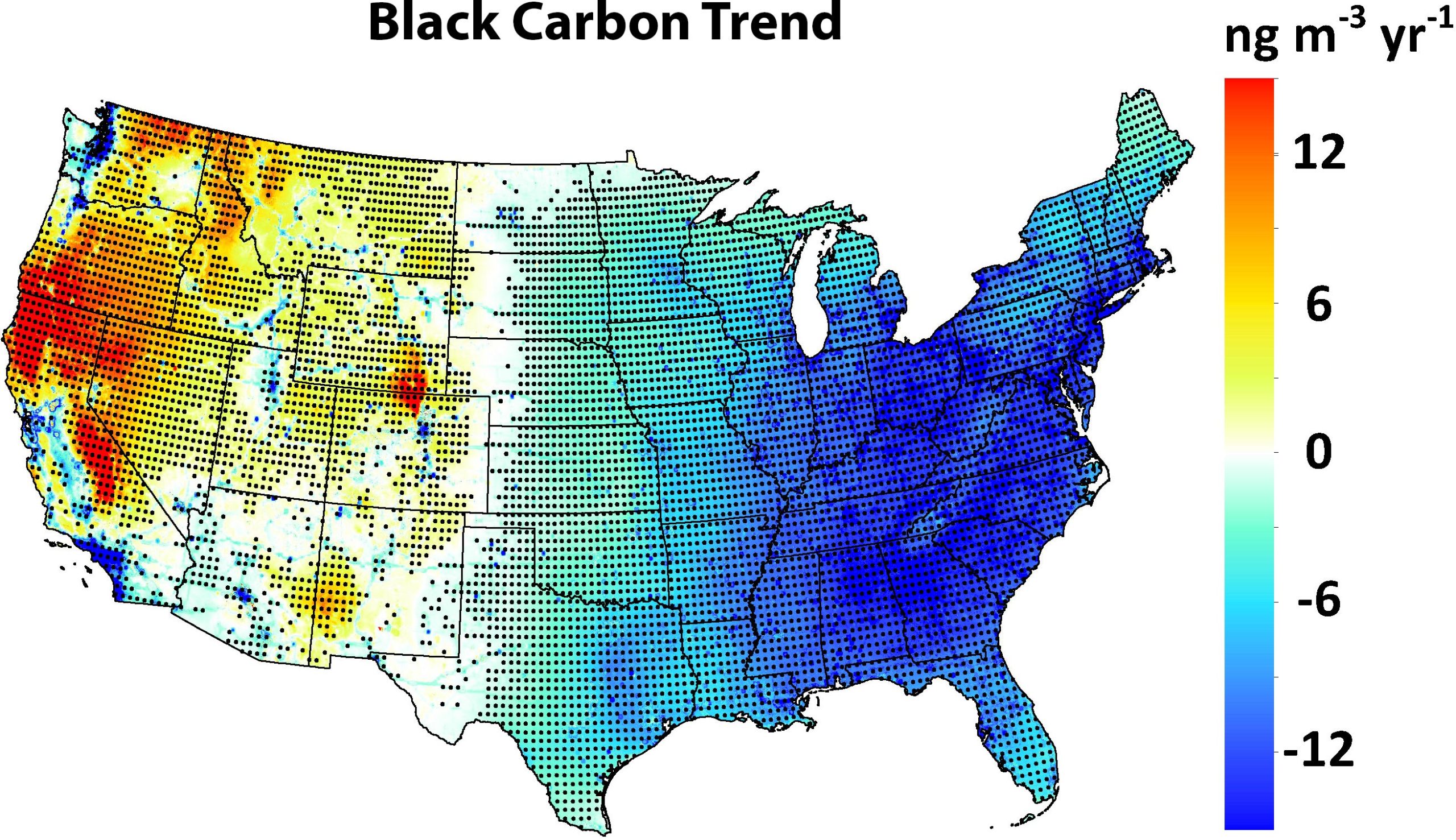
A new study has tabulated the toll from two decades of wildfires on air quality and human health in the continental U.S. The authors report that from 2000 to 2020, the air has worsened in the western U.S., mainly due to the increase in frequency and ferocity of wildfires causing an increase of 670 premature deaths per year in the region during that time period. Overall, the study’s authors report fires have undercut successful federal efforts to improve air quality primarily through reductions in automobile emissions.
“Our air is supposed to be cleaner and cleaner due mostly to EPA regulations on emissions, but the fires have limited or erased these air-quality gains,” says Jun Wang, James E. Ashton professor and chair in the Department of Chemical and Biochemical Engineering, assistant director of the Iowa Technology Institute at the University of Iowa, and the lead corresponding author on the study. “In other words, all the efforts for the past 20 years by the EPA to make our air cleaner basically have been lost in fire-prone areas and downwind regions. We are losing ground.”
Deteriorating Air Quality and Health Risks
The researchers calculated the concentration of black carbon, a fine-particle air pollutant that has been linked to respiratory and heart disease, on a kilometer-by-kilometer (0.6 miles) grid for the continental U.S.
In the western U.S., the researchers report black carbon concentrations have risen 55%, on an annual basis, mostly due to wildfires.
Not surprisingly, the highest premature mortality rates were in the western U.S., the region where the wildfires originated or that was most affected by smoke from wildfires in Canada. The authors say the increase of 670 premature deaths per year is a conservative estimate, as black carbon’s effects on human health are not fully understood.
“Wildfires have become increasingly intensive and frequent in the western U.S., resulting in a significant increase in smoke-related emissions in populated areas,” Wang and his team write. “This has likely contributed to a decline in air quality and an increase in attributable mortality.”
Midwest and Eastern U.S. Air Quality
The fires also have affected the Midwest. Smoke transported in the atmosphere affects air quality, though direct effects on health appear, for now, to be minimal. But, Wang says, “we are on the borderline. If fires increase or become more frequent, our air quality will get worse.”
The eastern U.S. had no major declines in air quality during the 2000-20 time period.
Methodology and Significance of the Study
The researchers derived black carbon concentrations and premature deaths estimates from satellite data and 500 ground-based stations that monitor air quality. The data from surface stations can be extensive, but it does not give complete spatial coverage and can be lacking in rural areas. So, the researchers employed “deep learning,” which enables computer systems to cluster data and produce accurate predictions, to calculate the black carbon concentrations. They calculated premature deaths through a formula that incorporated average life span, black carbon exposure, and population density.
“This is the first time to look at black carbon concentrations everywhere, and at one-kilometer resolution,” Wang says.
Jing Wei, the study’s lead author, led the collection of satellite data of fine particulates and the analysis of these pollutants on public health when he was a postdoctoral research scholar in Wang’s research group at Iowa.
“The increasing number and intensity of wildfires in the U.S. counteract or even overshadow the reduction in anthropogenic emissions, exacerbating air pollution and heightening the risks of both morbidity and mortality,” says Wei, now assistant research scientist at the University of Maryland’s Earth System Science Interdisciplinary Center.
Reference: “Long-term mortality burden trends attributed to black carbon and PM2·5 from wildfire emissions across the continental USA from 2000 to 2020: a deep learning modelling study” by Jing Wei, Jun Wang, Zhanqing Li, Shobha Kondragunta, Susan Anenberg, Yi Wang, Huanxin Zhang, David Diner, Jenny Hand, Alexei Lyapustin, Ralph Kahn, Peter Colarco, Arlindo da Silva and Charles Ichoku, 4 December 2023, The Lancet Planetary Health.
DOI: 10.1016/S2542-5196(23)00235-8
Zhanqing Li, from the University of Maryland’s Earth System Science Interdisciplinary Center, who supervises Wei, is a co-corresponding author. Contributing authors include Shobha Kondragunta, from the National Oceanic and Atmospheric Administration’s STAR Center for Satellite Applications and Research; Susan Anenberg, from George Washington University; Yi Wang and Huanxin Zhang, from Iowa; David Diner, from the California Institute of Technology and NASA Jet Propulsion Lab; Jenny Hand, from Colorado State University; Alexei Lyapustin, Ralph Kahn, Peter Colarco, and Arlindo da Silva, from NASA Goddard Space Flight Center; and Charles Ichoku, from the University of Maryland-Baltimore County.
NASA and NOAA funded the research.
Never miss a breakthrough: Join the SciTechDaily newsletter.
Follow us on Google and Google News.
2 Comments
Please avoid phrasing it like this. If decades of very expensive progress were always to be wiped out by wildfires anyway, then why did anybody bother? Why bother in the future, or even read about it again? Carbon black is soot, and there’s more to air quality than just soot, but this kind of phrasing encourages the reader to give up as if air quality efforts are a pointless scam. It’s great that we can now quantify the soot in the atmosphere now by satellite, and a study doing that is productive, but turning it into a narrative like this is not.
There are a number of reasons that hold with wildfires, a reduction of plant growth,methane from melting poles,increases in population,chemicals burning in accidents,increases in travel and how about oil well fires that had started this huge mess the ones in Iraq that burned for months. If we humans don’t get a handle on pollution our children will live a life of neglect with no future.