
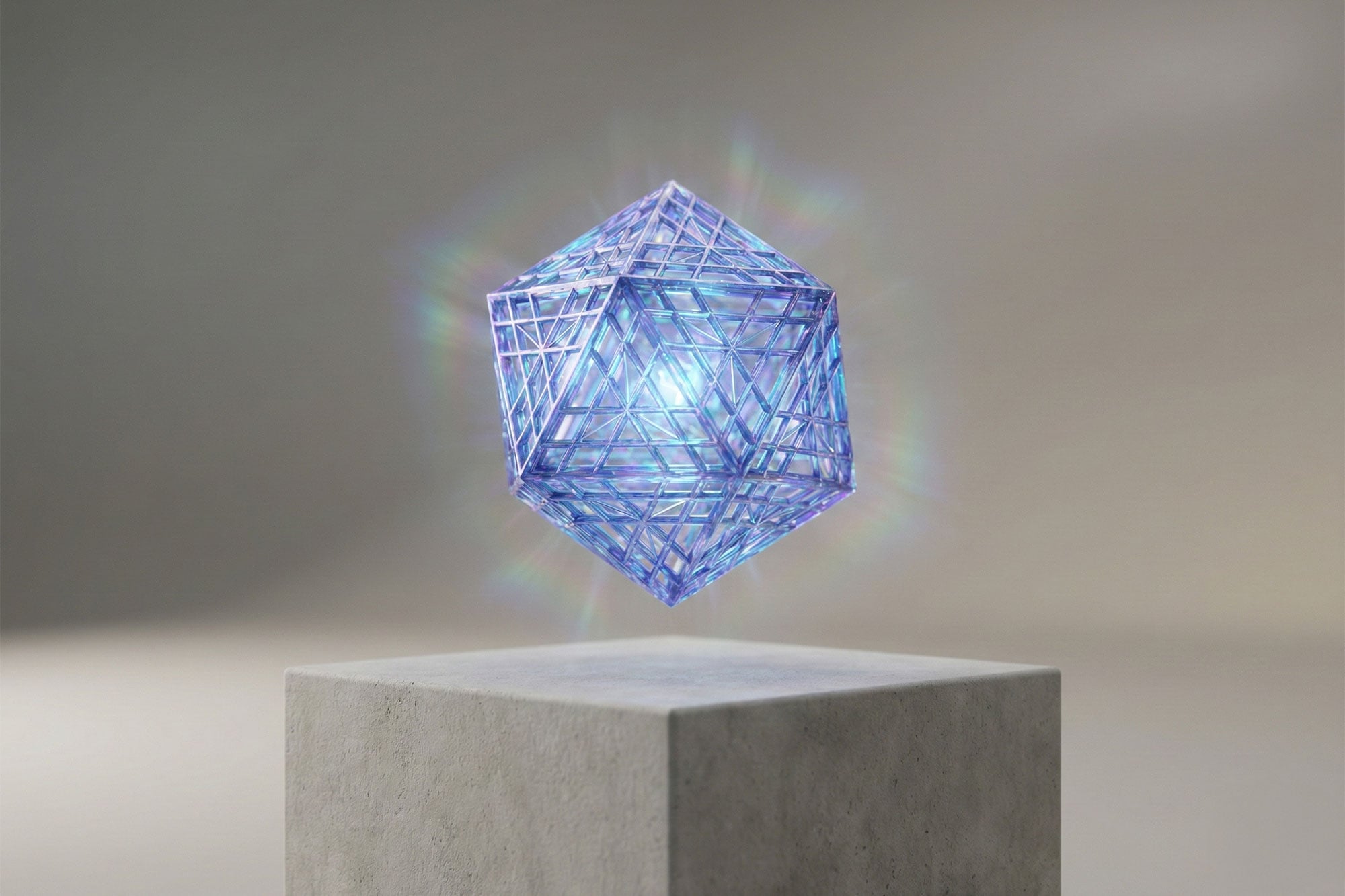
A newly observed acoustic time crystal uses sound waves to levitate particles that oscillate through nonreciprocal interactions. The discovery challenges classical physics and hints at applications in technology and biology.
Time crystals are systems made up of particles that repeat a steady back-and-forth motion, often described as “ticking.” They were first proposed theoretically and then confirmed experimentally roughly ten years ago. Although no commercial or industrial uses exist yet, researchers see strong potential for applications such as quantum computing and advanced data storage.
Since their discovery, scientists have created and studied multiple forms of time crystals. Each version behaves differently, opening up various possible future uses.
Now, physicists at New York University have observed a previously unknown type of time crystal in which particles float on sound and interact by sending sound waves back and forth. These interactions violate Newton’s Third Law of Motion, which states that every action has an equal and opposite reaction, meaning forces normally come in matched pairs (i.e., equal in magnitude and opposite in direction). In the NYU system, however, the particles, described as beads, influence one another unevenly rather than symmetrically, resulting in what scientists call nonreciprocal motion.
Visible Acoustic Time Crystals and Biological Links
The results, published in the journal Physical Review Letters, broaden the potential relevance of time crystals for practical applications. Unlike many quantum systems, this one is visible to the naked eye. The crystal forms on a device about one foot tall that can be easily held in a person’s hand.
“Time crystals are fascinating not only because of the possibilities, but also because they seem so exotic and complicated,” says Physics Professor David Grier, director of NYU’s Center for Soft Matter Research and the paper’s senior author. “Our system is remarkable because it’s incredibly simple.”
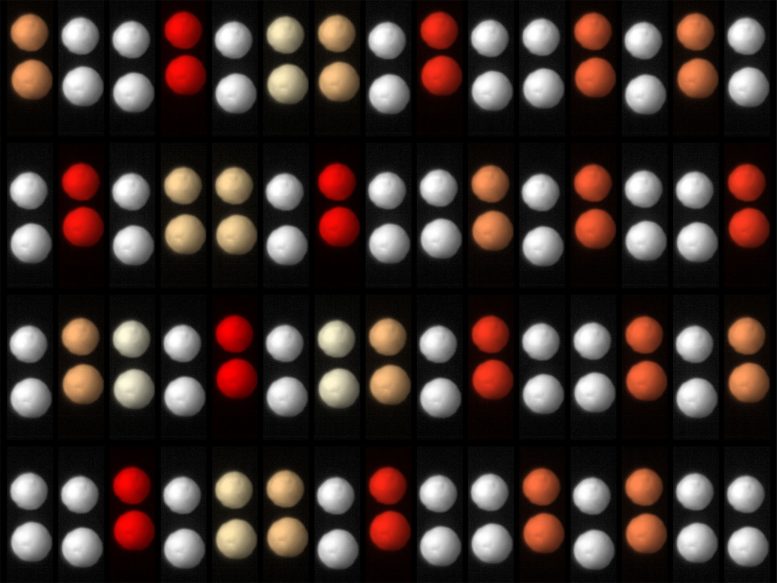
In addition to Grier, the study involved Mia Morrell, an NYU graduate student, and Leela Elliott, an NYU undergraduate. Their work also has implications for understanding biological timekeeping, such as circadian rhythms. This connection arises because some biochemical systems, including processes involved in digestion, also rely on nonreciprocal interactions similar to those seen in the new time crystal.
Acoustic Levitation and Sound-Mediated Interactions
The time crystal itself is made of small styrofoam beads, similar to packing material, that are held in place by sound waves. These waves act as an “acoustic levitator,” allowing the beads to remain suspended and initially motionless in mid-air.
“Sound waves exert forces on particles—just like waves on the surface of a pond can exert forces on a floating leaf,” explains Morrell. “We can levitate objects against gravity by immersing them in a sound field called a standing wave.”
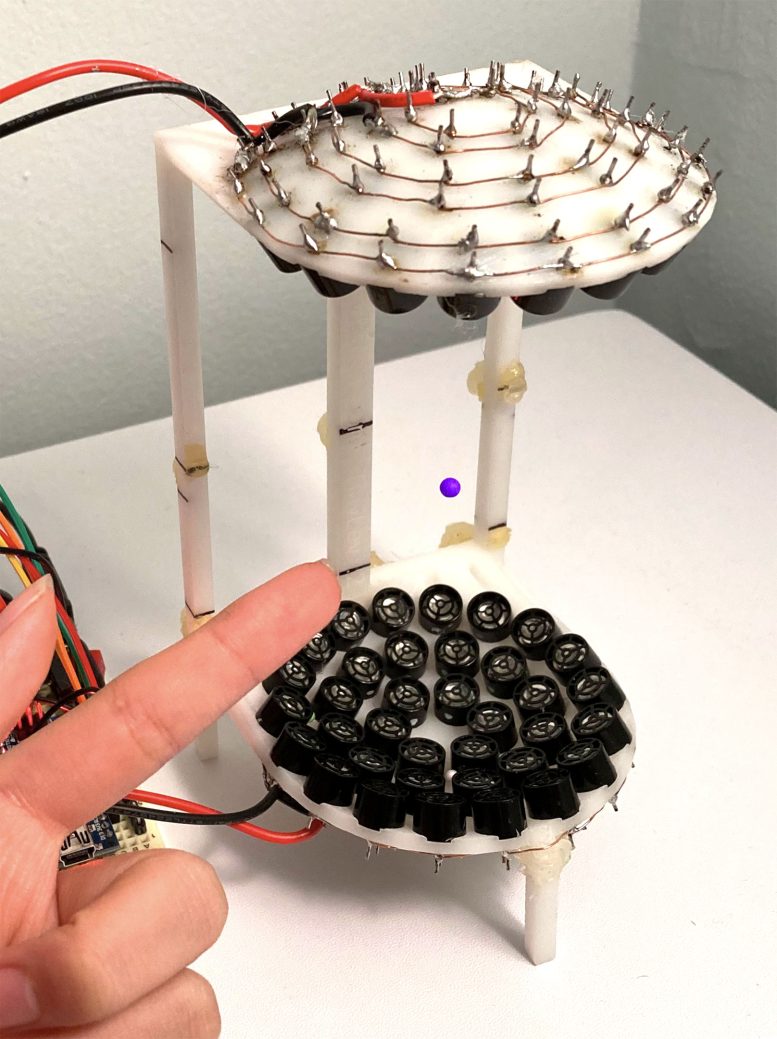
Once suspended, the particles begin interacting with one another by scattering sound waves between them. These exchanges are central to the unusual behavior of the system.
Nonreciprocal Forces Defy Newton’s Third Law
The key detail is that larger particles scatter more sound than smaller ones. As a result, a larger bead has a stronger effect on a smaller bead than the smaller bead has in return. This imbalance means the interaction between differently sized particles is inherently uneven.
“Think of two ferries of different sizes approaching a dock,” says Morrell. “Each one makes water waves that pushes the other one around—but to different degrees, depending on their size.”
Because these sound-based interactions are not bound by Newton’s Third Law, the beads are free to begin oscillating on their own while floating in place. Together, they settle into a steady rhythm that balances the unusual forces acting on them, creating a visible and sustained time crystal motion.
Reference: “Nonreciprocal Wave-Mediated Interactions Power a Classical Time Crystal” by Mia C. Morrell, Leela Elliott and David G. Grier, 6 February 2026, Physical Review Letters.
DOI: 10.1103/zjzk-t81n
The research was supported by grants from the National Science Foundation (DMR-21043837, DMR-2428983).
Never miss a breakthrough: Join the SciTechDaily newsletter.
Follow us on Google and Google News.
10 Comments
Newton’s third law is never violated. What time crystals defy is the present particle theory based on QM.
Consider the possibility that motion is a fundamental property of a particle. Then it moves on its own, and the reaction manifests as gravity. QM is not science. There is no wave – particle duality. It is just particles moving along helical paths due to reaction to motion.
The probably equations of QM give good results. But that does not mean that uncertainty is fundamental. The world is deterministic as viewed by Newtonian Physics.
Based on the Topological Vortex Theory (TVT), what is determined is the formation of vortices and anticyclones, but what cannot be determined is the interaction mode between the two vortices.
Way to reproof and confirm in a scientific way everything I do for work in spirit and in dance much 🙏 that is excellent 👌 finally a new merkaba to tap into because my original merkaba has been busy running repairs in an uncooperative psychologists’ chakras
Way to reproof and confirm in a scientific way everything I do for work in spirit and in dance much 🙏 that is excellent 👌 finally a new merkaba to tap into because my original merkaba has been busy running repairs in an uncooperative psychologists’ chakras
Don’t worry though it works from were ever it’s already within me I can tap into it from anywhere
Please do your best to keep that thing running 💨 cause it keeps the earths abomin from being in pain
Please do your best to keep that thing running 💨 cause it keeps the earths abdomen from being in pain
it keeps the earths abdomen from being in pain
And do not listen to paranoid guys that tell you to shut it down‽
At last a way to have a real hoverboard.