
Close Menu
    Facebook X (Twitter) Instagram
    SciTechDaily
    • Biology
    • Chemistry
    • Earth
    • Health
    • Physics
    • Science
    • Space
    • Technology
    Facebook X (Twitter) Pinterest YouTube RSS
    SciTechDaily
    Home»Science»Scientists Defy Nature: Making Diamonds in Minutes at Room Temperature
    Science

    Scientists Defy Nature: Making Diamonds in Minutes at Room Temperature

    By Australian National UniversityNovember 20, 20203 Comments4 Mins Read
    Facebook Twitter Pinterest Telegram LinkedIn WhatsApp Email Reddit
    Share
    Facebook Twitter LinkedIn Pinterest Telegram Email Reddit
    River of Diamond
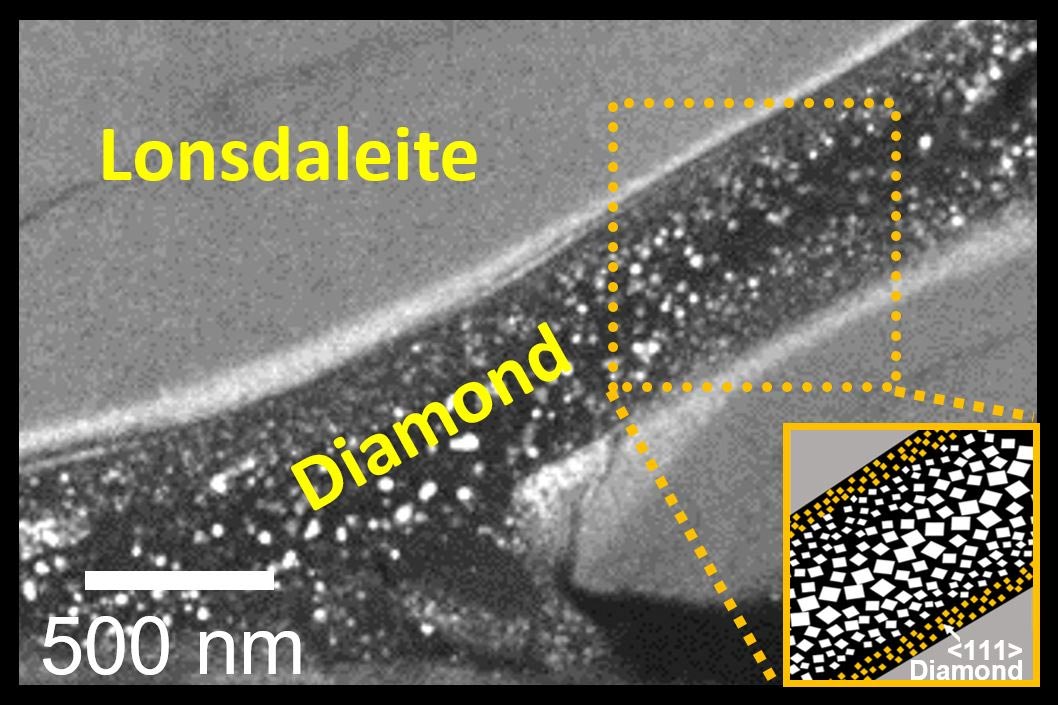
    The RMIT team’s pictures showed that the regular diamonds only form in the middle of these Lonsdaleite veins under this new method developed by the cross-institutional team. Credit: RMIT

    An international team of scientists has defied nature to make diamonds in minutes in a laboratory at room temperature — a process that normally requires billions of years, huge amounts of pressure and super-hot temperatures.

    The team, led by The Australian National University (ANU) and RMIT University, made two types of diamonds: the kind found on an engagement ring and another type of diamond called Lonsdaleite, which is found in nature at the site of meteorite impacts such as Canyon Diablo in the US.

    One of the lead researchers, ANU Professor Jodie Bradby, said their breakthrough shows that Superman may have had a similar trick up his sleeve when he crushed coal into a diamond, without using his heat ray.

    “Natural diamonds are usually formed over billions of years, about 150 kilometers (93 miles) deep in the Earth where there are high pressures and temperatures above 1,000 degrees Celsius (1,800 degrees Fahrenheit),” said Professor Bradby from the ANU Research School of Physics.

    Professor Jodie Bradby
    ANU Professor Jodie Bradby holds the diamond anvil that the team used to make the diamonds in the lab. Credit: Jamie Kidston, ANU

    The team, including former ANU PhD scholar Tom Shiell now at Carnegie Institution for Science, previously created Lonsdaleite in the lab only at high temperatures.

    This new unexpected discovery shows both Lonsdaleite and regular diamond can also form at normal room temperatures by just applying high pressures — equivalent to 640 African elephants on the tip of a ballet shoe.

    “The twist in the story is how we apply the pressure. As well as very high pressures, we allow the carbon to also experience something called ‘shear’ — which is like a twisting or sliding force. We think this allows the carbon atoms to move into place and form Lonsdaleite and regular diamond,” Professor Bradby said.

    Co-lead researcher Professor Dougal McCulloch and his team at RMIT used advanced electron microscopy techniques to capture solid and intact slices from the experimental samples to create snapshots of how the two types of diamonds formed.

    “Our pictures showed that the regular diamonds only form in the middle of these Lonsdaleite veins under this new method developed by our cross-institutional team,” Professor McCulloch said.
    Brenton Cook and Dougal McCulloch
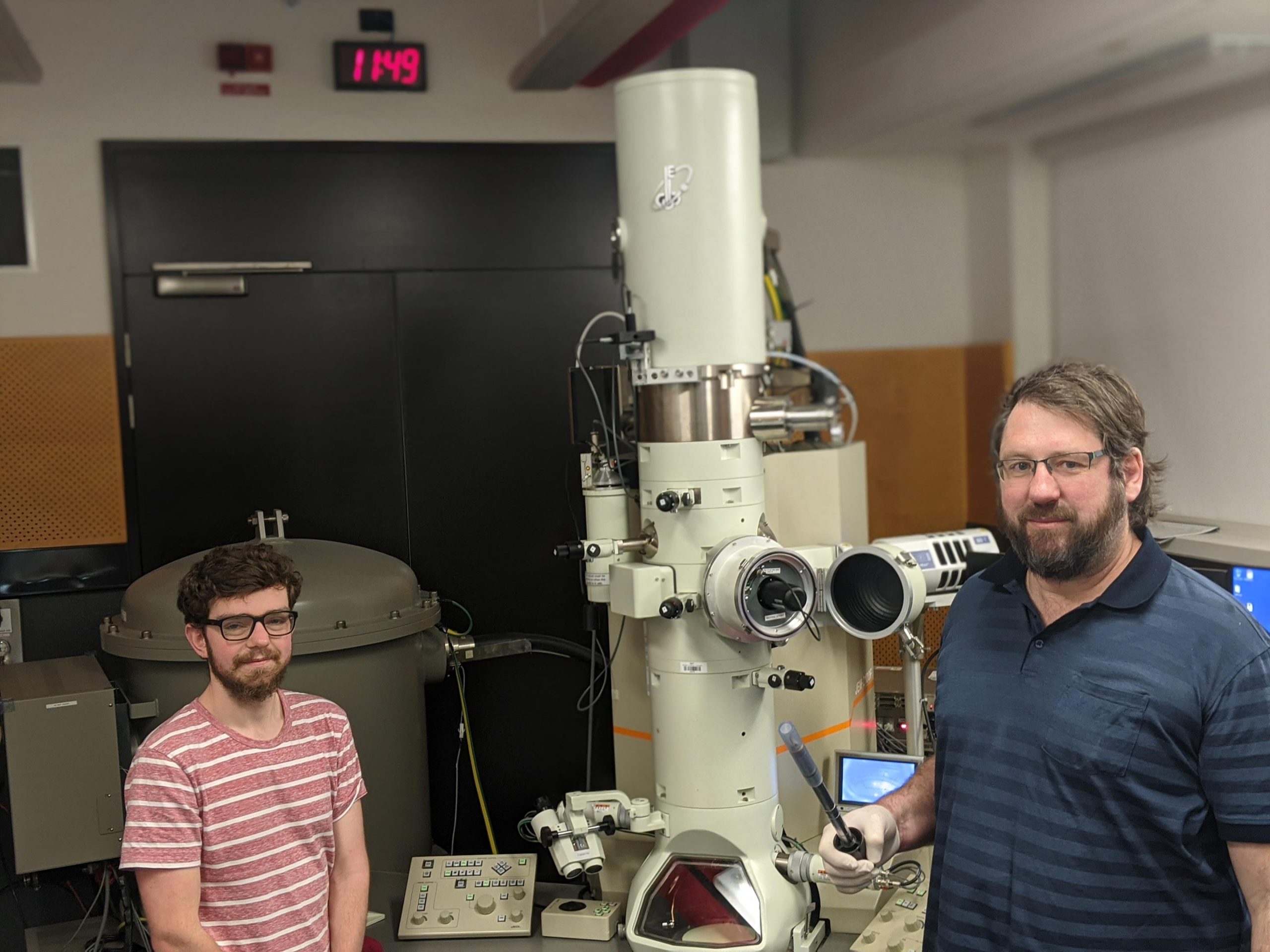
    PhD scholar Brenton Cook (left) and Prof Dougal McCulloch with one of the electron microscopes used in the research. Credit: RMIT

    “Seeing these little ‘rivers’ of Lonsdaleite and regular diamond for the first time was just amazing and really helps us understand how they might form.”

    Lonsdaleite, named after the crystallographer Dame Kathleen Lonsdale, the first woman elected as a Fellow to the Royal Society, has a different crystal structure to a regular diamond. It is predicted to be 58 percent harder.

    “Lonsdaleite has the potential to be used for cutting through ultra-solid materials on mining sites,” Professor Bradby said.

    “Creating more of this rare but super useful diamond is the long-term aim of this work.”

    Ms. Xingshuo Huang is an ANU PhD scholar working in Professor Bradby’s lab.

    “Being able to make two types of diamonds at room temperature was exciting to achieve for the first time in our lab,” Ms. Huang said.

    The team, which involved University of Sydney and Oak Ridge National Laboratory in the US, have published the research findings in the journal Small.

    Reference: “Investigation of Room Temperature Formation of the Ultra‐Hard Nanocarbons Diamond and Lonsdaleite” by Dougal G. McCulloch, Sherman Wong, Thomas B. Shiell, Bianca Haberl, Brenton A. Cook, Xingshuo Huang, Reinhard Boehler, David R. McKenzie and Jodie E. Bradby, 4 November 2020, Small.
    DOI: 10.1002/smll.202004695

    Never miss a breakthrough: Join the SciTechDaily newsletter.
    Follow us on Google and Google News.

    Australian National University Diamonds Materials Science Popular
    Share. Facebook Twitter Pinterest LinkedIn Email Reddit

    Related Articles

    20-Year Dream Comes True: Chemists Grow Diamonds With an Electron Beam

    Puzzle Solved: New Near Unbreakable Material Rivals Diamond in Hardness

    Modern Alchemy: Stanford Finds Fast, Easy Way to Make Diamonds – “Cheating the Thermodynamics”

    Researchers Control Light Emission by Pairing Exotic 2D Materials

    Experimental Evidence Shows New Boron Nanomaterial is Possible

    Defects in Graphene Will Reduce its Strength

    Russian Impact Crater Might Contain Trillions of Carats of Diamonds

    Hybrid Crystalline/Amorphous Material Capable of Indenting Diamonds

    Scientists Make 3D Objects Invisible to Microwave Wavelengths

    3 Comments

    1. Elliot Lin on November 20, 2020 11:20 am

      Does this mean that diamonds can be mass produced? If so, the cost of diamonds is going WAY down…

      Reply
    2. Rene on November 20, 2020 1:28 pm

      SO Superman movie was right…

      Reply
    3. Chris on November 22, 2020 6:49 pm

      I can see it already.. she has a 0.1 Bitcoin Ring! The rarest most impossible thing known to man to create or find.. diamonds are like shoe laces now, even homeless people have them.

      Reply
    Leave A Reply Cancel Reply

    • Facebook
    • Twitter
    • Pinterest
    • YouTube

    Don't Miss a Discovery

    Subscribe for the Latest in Science & Tech!

    Trending News

    Scientists Warn That This Common Pet Fish Can Wreck Entire Ecosystems

    Scientists Make Breakthrough in Turning Plastic Trash Into Clean Fuel Using Sunlight

    This Popular Supplement May Interfere With Cancer Treatment, Scientists Warn

    Scientists Finally Solved One of Water’s Biggest Mysteries

    Could This New Weight-Loss Pill Disrupt the Entire Market? Here’s What You Should Know About Orforglipron

    Earth’s Crust Is Tearing Open in Africa, and It Could Form a New Ocean

    Breakthrough Bowel Cancer Trial Leaves Patients Cancer-Free for Nearly 3 Years

    Natural Compound Shows Powerful Potential Against Rheumatoid Arthritis

    Follow SciTechDaily
    • Facebook
    • Twitter
    • YouTube
    • Pinterest
    • Newsletter
    • RSS
    SciTech News
    • Biology News
    • Chemistry News
    • Earth News
    • Health News
    • Physics News
    • Science News
    • Space News
    • Technology News
    Recent Posts
    • Kratom Use Explodes in the US, With Life-Changing Consequences
    • Scientists Uncover Fatal Weakness in “Zombie Cells” Linked to Cancer
    • World-First Study Reveals Human Hearts Can Regenerate After a Heart Attack
    • Why Your Dreams Feel So Real Sometimes and So Strange Other Times
    • Scientists Debunk 100-Year-Old Belief About Brain Cells, Rewriting Textbooks
    Copyright © 1998 - 2026 SciTechDaily. All Rights Reserved.
    • Science News
    • About
    • Contact
    • Editorial Board
    • Privacy Policy
    • Terms of Use

    Type above and press Enter to search. Press Esc to cancel.