

A new seaborgium isotope may unlock the path to discovering even shorter-lived superheavy nuclei through K-isomer states.
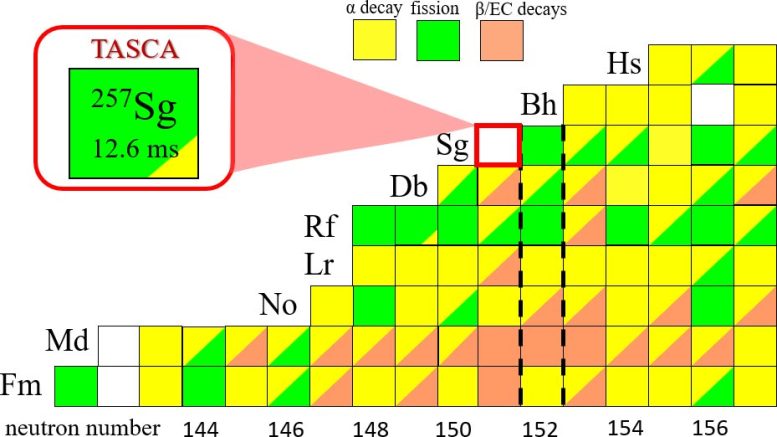
An international team of researchers from GSI/FAIR, Johannes Gutenberg University Mainz (JGU), and the Helmholtz Institute Mainz (HIM) has successfully produced a new isotope of the element seaborgium. During experiments at the GSI/FAIR accelerator facilities, scientists detected 22 nuclei of seaborgium-257. The findings were published in Physical Review Letters and selected as an “Editor’s Suggestion.”
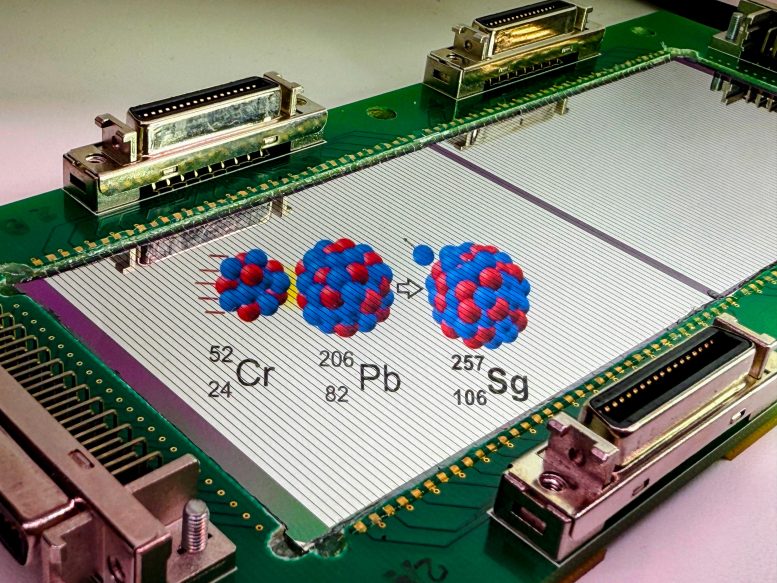
This discovery brings the total number of known seaborgium isotopes, an artificial superheavy element with atomic number 106, to 14. To create seaborgium-257, the team used a high-intensity beam of chromium-52 from the UNILAC linear accelerator to bombard high-purity lead-206 targets.
The gas-filled recoil separator TASCA (TransActinide Separator and Chemistry Apparatus) enabled the detection of 22 decay events: 21 fission reactions and one alpha decay. The new isotope has a half-life of 12.6 milliseconds and is located near the enhanced neutron shell gap at neutron number 152.
Fission properties and shell effects
“Our findings on seaborgium-257 provide exciting hints on the impact of shell effects on the fission properties of superheavy nuclei. As one consequence, it is possible that the next lighter, still unknown isotope — seaborgium-256 — may undergo fission in a very short time range of one nanosecond to six microseconds,” says Dr. Pavol Mosat, the first author of the publication from GSI/FAIR’s research department for the chemistry of superheavy elements (SHE Chemistry).
The upper limit of the expected half-life range is close to or even slightly below what current experiments can detect, unless a so-called K-isomeric state is present. These excited states, which are stabilized by quantum effects, can have longer fission lifetimes and provide an indirect way to study otherwise short-lived nuclei.
A recent breakthrough in this area was the discovery of rutherfordium-252, which has a 60-nanosecond half-life due to a longer-lived K-isomeric state. Exploring the isotopic boundary of seaborgium continues this line of research, helping to chart the edges of the so-called island of stability for superheavy elements.
Evidence of a K-isomeric state in seaborgium-259
So far, no K-isomeric state has been observed in seaborgium isotopes. In the present experiment, however, the research team also irradiated a lead-208 target and observed strong evidence for the presence of a K-isomeric state in seaborgium-259.
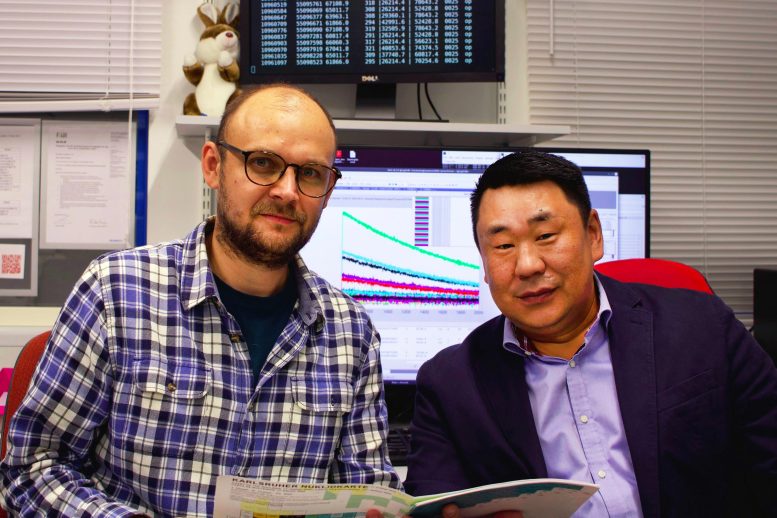
“Our results on a K-isomeric state in seaborgium–259 open a doorway to explore the K-isomer phenomenon in other seaborgium isotopes and to enable the synthesis of the short-lived isotope seaborgium-256 isotope, if a long-lived K-isomeric state exists also in this nucleus,” says Dr. Khuyagbaatar Jadambaa, leader of the corresponding experimental program of GSI/FAIR.
“The present work is a great example of the collaborative efforts of different GSI/FAIR departments — besides SHE Chemistry, the Experiment Electronics and Target Laboratory departments were involved — with our international partner institutes,” says Professor Christoph E. Düllmann, head of the SHE Chemistry department at GSI/FAIR, professor at JGU and director of HIM. “The further exploration of the stability and the properties of superheavy nuclei jointly with our national and international partners will continue to be an important area of research for our research team.”
Reference: “Probing the Shell Effects on Fission: The New Superheavy Nucleus Sg257” by P. Mosat, J. Khuyagbaatar, J. Ballof, R. A. Cantemir, D. Dietzel, Ch. E. Düllmann, K. Hermainski, F. P. Heßberger, E. Jäger, B. Kindler, J. Krier, N. Kurz, B. Lommel, S. Löchner, M. Maiti, T. K. Sato, B. Schausten, J. Uusitalo, P. Wieczorek and A. Yakushev, 11 June 2025, Physical Review Letters.
DOI: 10.1103/s7hr-y7zq
Besides GSI/FAIR, JGU and HIM, also the University of Jyväskylä, Finland, the Advanced Science Research Center of the Japan Atomic Energy Agency, Japan, and the Indian Institute of Technology Roorkee, India, are collaborators of the experiment.
Never miss a breakthrough: Join the SciTechDaily newsletter.
Follow us on Google and Google News.
1 Comment
5.9 of Miskal Ku, undrideur Nu 6.59 and dukisod 2.113 Ul