
Close Menu
    Facebook X (Twitter) Instagram
    SciTechDaily
    • Biology
    • Chemistry
    • Earth
    • Health
    • Physics
    • Science
    • Space
    • Technology
    Facebook X (Twitter) Pinterest YouTube RSS
    SciTechDaily
    Home»Biology»Scientists Detect Silent “Scream” of Skin Cells for the First Time
    Biology

    Scientists Detect Silent “Scream” of Skin Cells for the First Time

    By University of Massachusetts AmherstMarch 19, 2025No Comments3 Mins Read
    Facebook Twitter Pinterest Telegram LinkedIn WhatsApp Email Reddit
    Share
    Facebook Twitter LinkedIn Pinterest Telegram Email Reddit
    Purple Immune Cells
    Researchers from the University of Massachusetts Amherst have discovered that epithelial cells communicate using slow electrical signals, a previously unknown ability. Their study, published in PNAS, shows that these cells “scream” to their neighbors when injured, transmitting signals using calcium ion flows. This discovery could lead to advancements in bioelectric sensors and wound healing. Credit: SciTechDaily.com

    Scientists discover “electric spiking” communication in previously thought to be mute cells, paving the way for bioelectric innovations.

    For years, scientists believed that only nerve and heart cells relied on electrical impulses for communication, while epithelial cells, which form the linings of the skin, organs, and body cavities, were thought to be passive barriers, primarily absorbing and secreting substances. However, researchers from the University of Massachusetts Amherst have challenged this assumption, demonstrating that epithelial cells do, in fact, communicate through slow electrical signals.

    The study, led by Steve Granick, Robert K. Barrett Professor of Polymer Science and Engineering, and postdoctoral fellow Sun-Min Yu, was recently published in the Proceedings of the National Academy of Sciences. Their findings could pave the way for advancements in wearable bioelectric sensors, wound healing, and other biomedical applications.

    “Epithelial cells do things that no one has ever thought to look for,” says Granick. “When injured, they ‘scream’ to their neighbors, slowly, persistently, and over surprising distances. It’s like a nerve’s impulse, but 1,000 times slower.” His team’s curiosity-driven approach, blending polymer science and biology, unveiled this hidden cellular signaling.
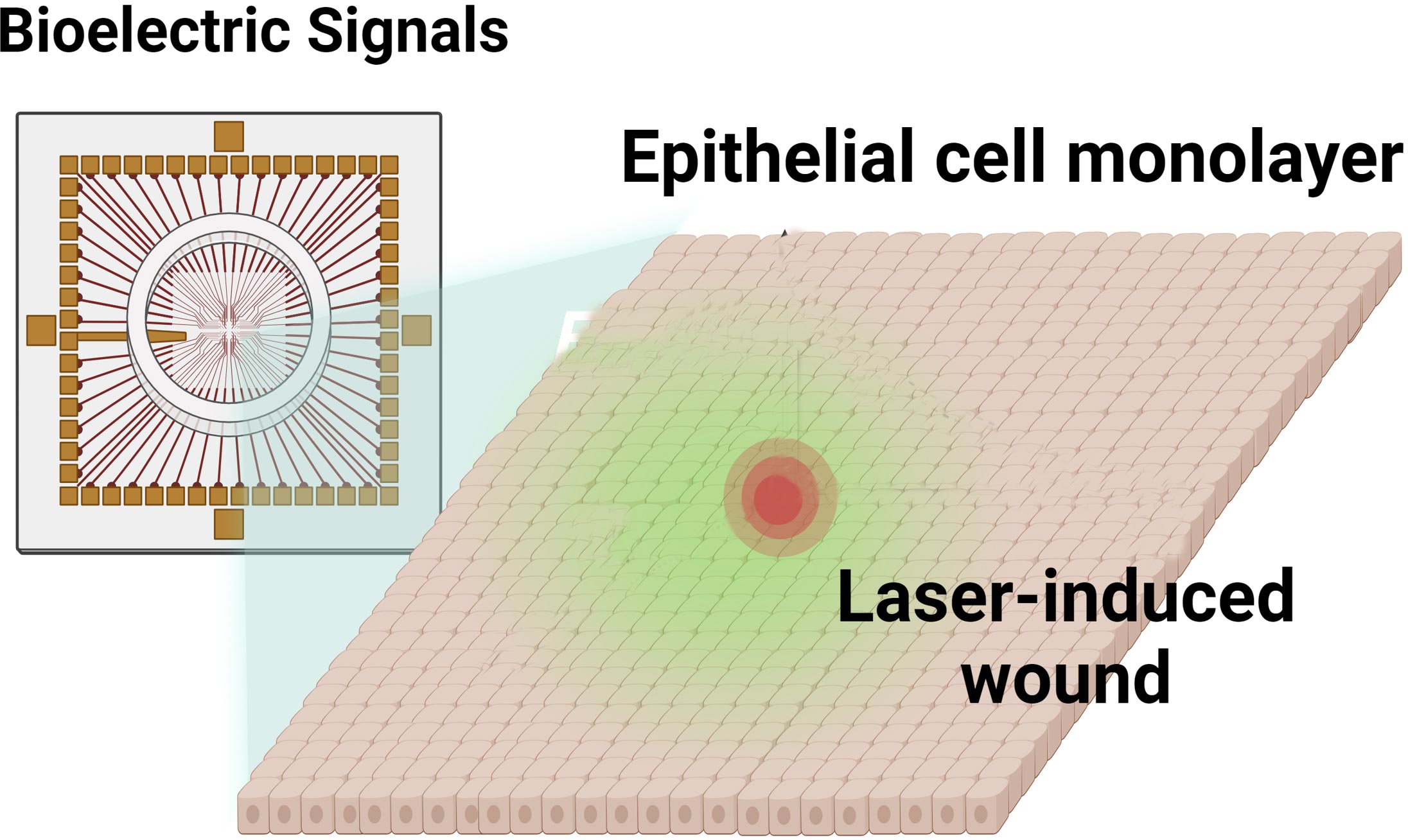
    Epithelial Cell Coated Chip Graphic
    Granick and Yu used an epithelial-cell-coated chip with 60 precisely placed electrodes that could detect minute electric shifts. Credit: UMass Amherst

    Granick and Yu used an epithelial-cell-coated chip with 60 precisely placed electrodes to eavesdrop. Yu, a cell-culture expert, grew a single layer of human epithelial cells on the chip, which detected minute electric shifts.

    Observing Cellular Communication in Action

    Using a precise laser to produce “sting” patterns of individual cells, they watched as signals rippled outward. “We tracked how cells coordinated their response,” Yu explained. “It’s a slow-motion, excited conversation.”

    Unlike the swift neurotransmitter bursts of nerve cells, epithelial cells rely on ion flows — of calcium, especially — that produce signals that are far slower than those in nerve cells, but with similar voltages. These signals can be long-lived: Granick and Yu observed cells that “talked” for over five hours across distances nearly 40 times their own length.

    Though Granick and Yu showed that calcium ions are necessary for epithelial conversation, they have yet to test what else might contribute to the conversation. And though the immediate applications of their new discovery remain to be seen, the implications are vast.

    “Wearable sensors, implantable devices, and faster wound healing could grow from this,” Granick noted. “Understanding these screams between wounded cells opens doors we didn’t know existed,” Yu added.

    Reference: “Electric spiking activity in epithelial cells” by Sun-Min Yu and Steve Granick, 17 March 2025, Proceedings of the National Academy of Sciences.
    DOI: 10.1073/pnas.2427123122

    Never miss a breakthrough: Join the SciTechDaily newsletter.
    Follow us on Google and Google News.

    Biotechnology Cell Biology Popular University of Massachusetts Amherst
    Share. Facebook Twitter Pinterest LinkedIn Email Reddit

    Related Articles

    Researchers Find COVID-19 Virus Was “Highly Human Adapted” – Exact Origins Still a Mystery

    Breakthrough Understanding of Limb and Organ Regeneration – Closer to the Development of Regenerative Medicine Therapies

    Genetic Copycatchers Detect Efficient and Precise CRISPR Editing in a Living Organism

    Apples May Boost Brain Function, Stimulate the Production of New Brain Cells

    Cure for Blindness in Sight: Retinal Stem Cell Transplant Clears Experimental Hurdle

    “Symphony of Cellular Activities” Revealed by Fluorescent Imaging Technique

    Two Major Microbial Groups Discovered That Can’t Breathe – May Predate the Evolution of Respiration

    Video Shows Single-Cell Organism Making Complex Decisions – Resolves Century-Old Scientific Debate

    MIT Develops a Synthetic Gene Circuit to Trigger Immune System Attack on Cancer

    Leave A Reply Cancel Reply

    • Facebook
    • Twitter
    • Pinterest
    • YouTube

    Don't Miss a Discovery

    Subscribe for the Latest in Science & Tech!

    Trending News

    Largest-Ever Study Finds Medicinal Cannabis Ineffective for Anxiety, Depression, PTSD

    250-Million-Year-Old Egg Solves One of Evolution’s Biggest Mysteries

    Living With Roommates Might Be Changing Your Gut Microbiome Without You Knowing

    Century-Old Cleaning Chemical Linked to 500% Increased Risk of Parkinson’s Disease

    What if Your Memories Never Happened? Physicists Take a New Look at the Boltzmann Brain Paradox

    One of the Universe’s Largest Stars May Be Getting Ready To Explode

    Scientists Discover Enzyme That Could Supercharge Ozempic-Like Weight Loss Drugs

    Popular Sweetener Linked to DNA Damage – “It’s Something You Should Not Be Eating”

    Follow SciTechDaily
    • Facebook
    • Twitter
    • YouTube
    • Pinterest
    • Newsletter
    • RSS
    SciTech News
    • Biology News
    • Chemistry News
    • Earth News
    • Health News
    • Physics News
    • Science News
    • Space News
    • Technology News
    Recent Posts
    • Black Hole Jets Pack Power of 10,000 Suns, Stunning New Study Reveals
    • A Cosmic Crash Turned This Nearby Galaxy Into Chaos
    • This Alien Solar System Doesn’t Follow the Rules – and Scientists Are Intrigued
    • What Did Prehistoric Europeans Eat? Scientists Uncover Surprising Answers
    • Scientists Say This Overlooked Organ Could Hold the Key to Longer Life
    Copyright © 1998 - 2026 SciTechDaily. All Rights Reserved.
    • Science News
    • About
    • Contact
    • Editorial Board
    • Privacy Policy
    • Terms of Use

    Type above and press Enter to search. Press Esc to cancel.