
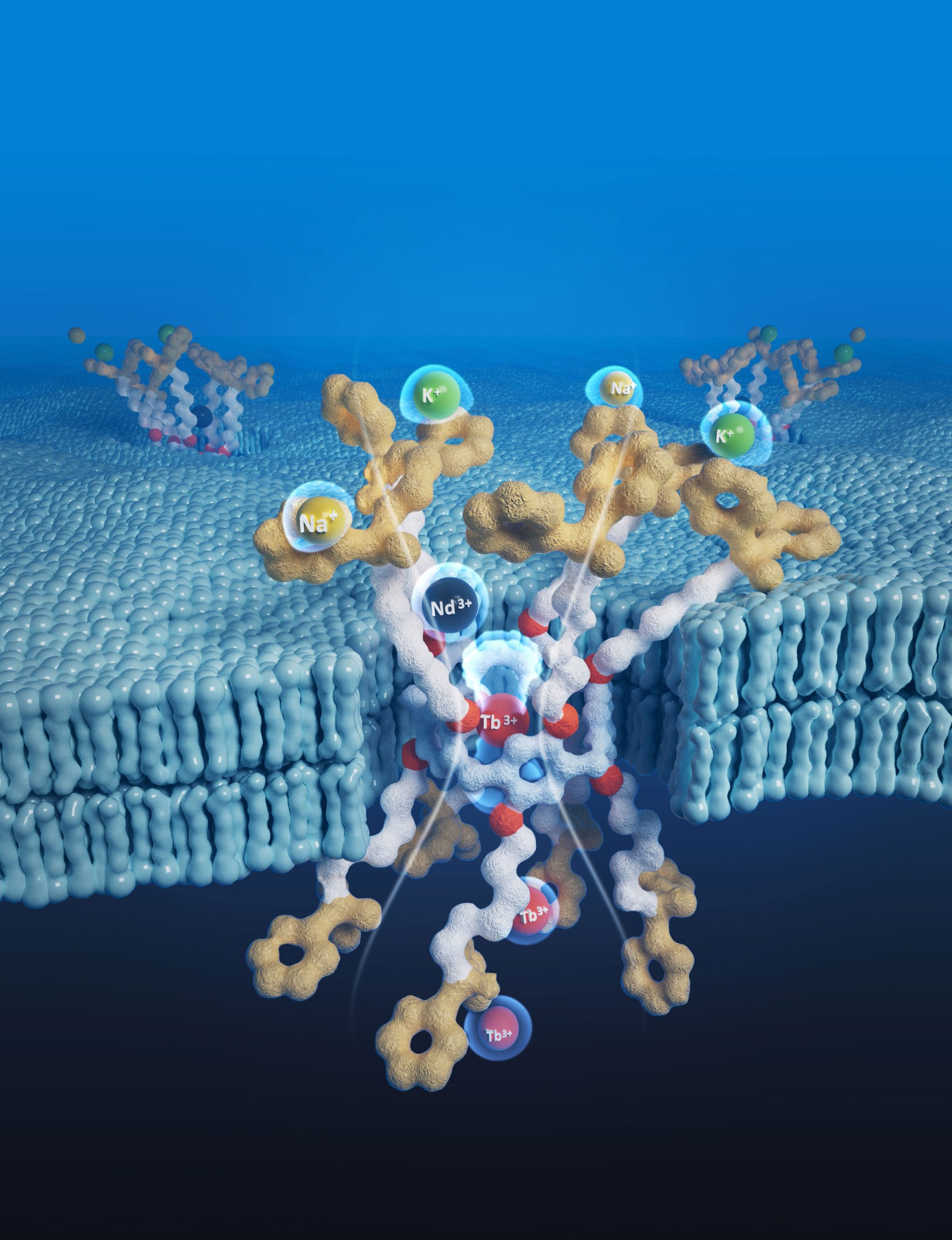
Researchers at UT Austin have created artificial membrane channels that mimic nature’s precision to selectively extract key rare earth elements.
A team of scientists at The University of Texas at Austin has created a cleaner and more efficient way to extract rare earth elements, which are vital for technologies such as electric vehicle batteries and smartphones. The technique could strengthen domestic production and lessen dependence on expensive imports.
The new process makes it possible to separate and collect rare earth elements from sources that were previously too difficult or inefficient to use, offering a potential solution to supply challenges heightened by global trade tensions.
“Rare earth elements are the backbone of advanced technologies, but their extraction and purification are energy intensive and extremely difficult to implement at the scales required,” said Manish Kumar, professor in the Cockrell School of Engineering’s Fariborz Maseeh Department of Civil, Architectural and Environmental Engineering and the McKetta Department of Chemical Engineering. “Our work aims to change that, inspired by the natural world.”
The study, recently published in ACS Nano, describes how the team engineered artificial membrane channels, tiny pores within membranes, that imitate the highly selective transport systems of natural proteins in living organisms. In biology, such channels guide ions as they move between cells.
Each channel has unique properties that allow only ions with specific traits to pass through while blocking others. This fine-tuned selectivity is essential for many biological functions, including the way the human brain processes information.
Designing Artificial Gatekeepers
The researchers’ artificial channels use a modified version of a structure called pillararene to enhance their ability to bind and block specific common ions while transporting specific rare earth ions. The result is a system that can selectively transport middle rare earth elements, such as europium (Eu³⁺) and terbium (Tb³⁺), while excluding other ions like potassium, sodium, and calcium.
“Nature has perfected the art of selective transport through biological membranes,” said Venkat Ganesan, professor in the McKetta Department of Chemical Engineering and one of the research leaders. “These artificial channels are like tiny gatekeepers, allowing only the desired ions to pass through.”
Rare earth elements are split into several classes (light, middle and heavy), each with different properties that make them ideal for specific applications. Middle elements are used in lighting and displays, including TVs, and as magnets in green energy technologies, such as wind turbines and electric vehicle batteries.
The U.S. Department of Energy and the European Commission have identified several middle elements, including europium and terbium, as critical materials at risk of supply disruption. With demand for these elements expected to grow by over 2,600% by 2035, finding sustainable ways to extract and recycle them is more urgent than ever.
Remarkable Selectivity and Efficiency
In experiments, the artificial channels showed a 40-fold preference for europium over lanthanum (a light rare earth element) and a 30-fold preference for europium over ytterbium (a heavy rare earth element). These selectivity levels are significantly higher than those achieved by traditional solvent-based methods that require dozens of stages to achieve similar results.
Using advanced computer simulations, they discovered that the channels’ selectivity is driven by unique water-mediated interactions between the rare earth ions and the channel. These interactions allow the channels to differentiate between ions based on their hydration dynamics—how water molecules surround and interact with ions.
Kumar and his team have been working on this research for more than five years. He is an expert in membrane-based separations, applying that knowledge to clean water generation as well.
The researchers envision their technology being integrated into scalable membrane systems for industrial use. The goal is to make it easier to conduct ion separations in the U.S., using clean energy.
They’re working on a platform for these channels that allows users to select a variety of ions to gather. This could include other critical minerals like lithium, cobalt, gallium, and nickel.
This is a first step towards translating nature’s sophisticated molecular recognition and transport strategies into robust industrial processes, thus bringing high selectivity to settings where current methods fall short,” said Harekrushna Behera, a research associate in Kumar’s lab who worked on the project.
Reference: “Lanthanide-Selective Artificial Channels” by Harekrushna Behera, Tyler J. Duncan, Laxmicharan Samineni, Hyeonji Oh, Ankit Jogdand, Arnav Karnik, Raman Dhiman, Aida Fica, Tzu-Yun Hsieh, Venkat Ganesan and Manish Kumar, 4 April 2025, ACS Nano.
DOI: 10.1021/acsnano.4c17675
Never miss a breakthrough: Join the SciTechDaily newsletter.
Follow us on Google and Google News.
1 Comment
I’m the owner of Alaska Rare Earth LLC and would be interested in partnering with you on this new refining technology.