
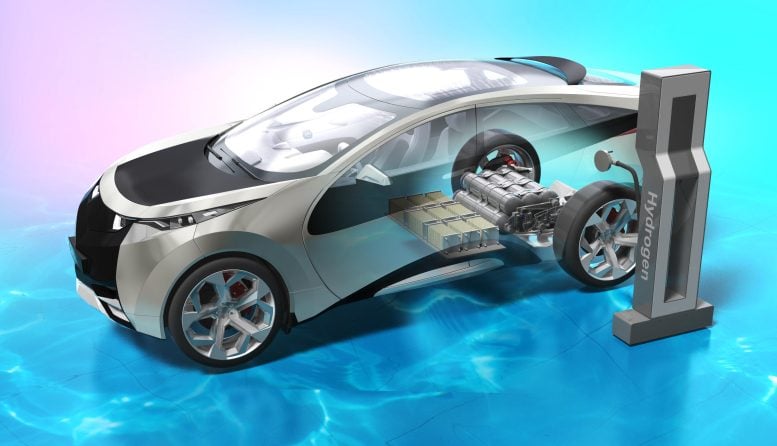
Nagoya University researchers have created a high-performance PEM with exceptional conductivity and sulfonic acid density, revolutionizing fuel cell technology for a carbon-neutral future.
Researchers at Nagoya University in Japan, under a project commissioned by the New Energy and Industrial Technology Development Organization (NEDO), have created poly(styrenesulfonic acid)-based PEMs with a high density of sulfonic acid groups.
A crucial element in eco-friendly polymer electrolyte fuel cells is a polymer electrolyte membrane (PEM), which produces electrical energy through the interaction of hydrogen and oxygen gases. Practical applications of fuel cells include fuel cell vehicles (FCVs) and fuel cell combined heat and power (CHP) systems.
The best-known PEM is a membrane based on a perfluorosulfonic acid polymer, such as Nafion, which was developed by DuPont in the 1960s. It has a good proton conductivity of 0.1 S/cm at 70-90 °C (158-194 °F) under humidified conditions. Under these conditions, protons can be released from sulfonic acid groups.
Proton conduction in such membranes typically depends on the proton transport mechanism between protons, sulfonic acid groups, and water molecules.
Typically, the higher the density of the sulfonic acid groups in the membrane, the higher the density of protons that can be released from the sulfonic acid groups; therefore, the higher density of the sulfonic acid groups usually results in higher proton conductivities.
However, using a conventional synthesis process, it is difficult to synthesize PEMs with a high density of sulfonic acid groups. For instance, to increase the density of sulfonic acid groups in a poly(styrenesulfonic acid)-based PEM, the sulfonation reaction must be carried out over long hours or under severe conditions. It usually uses highly oxidizing substances, such as fuming sulfuric acid and chlorosulfonic acid.
Unfortunately, this leads to undesirable side reactions, such as cleavage of the backbone chains of the polymer. Therefore, to avoid unwanted side reactions during polymer synthesis, commercially available PEMs are usually synthesized to have a low density of sulfonic acid groups.
For commercially available Nafion or poly(styrenesulfonic acid)-based PEMs such as Selemion by AGC, the ion exchange capacity (IEC), an index of the density of acid groups, is typically less than 1.0 meq./g.
Breakthrough in PEM Development
In the paper, Atsushi Noro and colleagues at the Graduate School of Engineering, Nagoya University, and from the Institutes of Innovation for Future Society also Nagoya University, have developed poly(styrenesulfonic acid)-based PEM with an ultrahigh density of sulfonic acid groups.
The IEC of the PEM was 5.0 mequiv./g. This is five times higher than the IEC of typical commercially available PEMs such as Nafion or Selemion. Its proton conductivity at 80°C under 90%RH (a common operating condition for polymer electrolyte fuel cells) was 0.93 S/cm. This is six times higher than the conductivity of Nafion (0.15 S/cm) or Selemion (0.091 S/cm) under the same measurement conditions.
Future fuel cells must be operated under more severe operating conditions such as higher temperatures and lower humidities.
This study will contribute to the synthesis and development of next-generation higher-performance PEMs exhibiting a good conductivity of 0.1 S/cm or higher under such severe conditions. The study will also contribute to the goal of reaching a net-zero carbon society.
Reference: “Synthesis of a Cross-Linked Polymer Electrolyte Membrane with an Ultra-High Density of Sulfonic Acid Groups” by Katsumi Sato, Takato Kajita and Atsushi Noro, 19 April 2023, ACS Applied Polymer Materials.
DOI: 10.1021/acsapm.3c00150
Never miss a breakthrough: Join the SciTechDaily newsletter.
Follow us on Google and Google News.
2 Comments
No one wants to ride around with a potential Hindenburg strapped to their car but what about for a electric power plant? I thought that is what was supposed to happen to make FCEL stock valuable but it has gone backwards really bad.
As we all know the problems of the conversion of water to oxygen and hydrogen was solved in the fifties or earlier , the inclusion of those gases into a usable fuel was also solved and shelved , hidden ,suppressed, all to solve the problem of making the use of energy a chargeable commodity , people we will never have FREE ENERGY , there is to much money to be made