
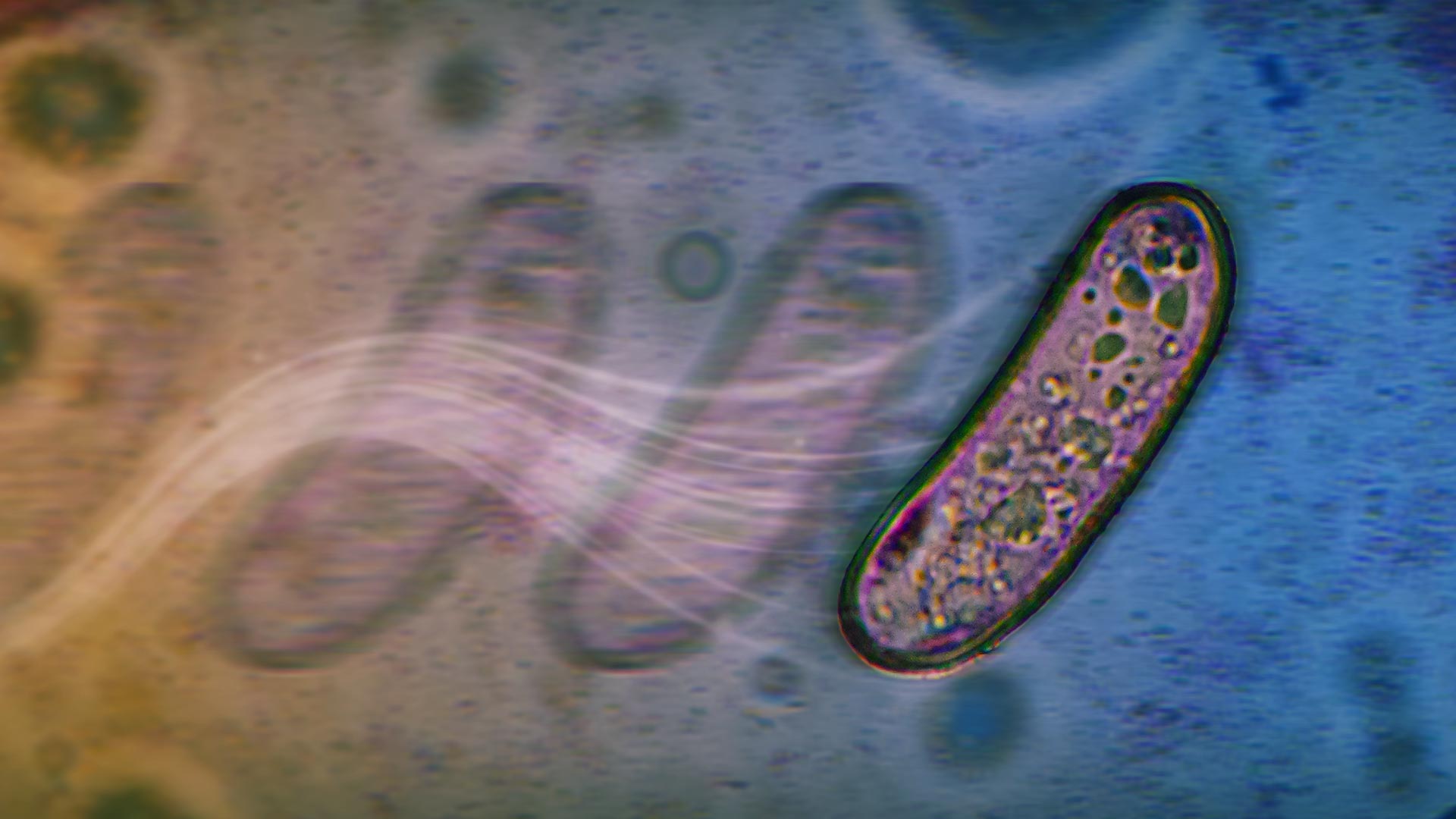
Two new studies uncover unexpected ways that microbes move, offering insights that could impact our understanding of human health and disease.
New research from Arizona State University has uncovered unexpected strategies bacteria use to move even when their flagella, the thin whip-like structures that normally propel them, are not functioning.
Being able to travel across surfaces is important for bacteria because it allows them to build communities, reach new environments, or avoid harmful conditions. Learning how these microbes accomplish this can guide new approaches for preventing and treating infections.
Discovery of “swashing” mobility
In the first study, Navish Wadhwa and his team found that salmonella and E. coli can still spread across moist surfaces after their flagella are disabled. While digesting sugars, the microbes produce acidic by-products that pull water outward on the surface. This creates gentle fluid currents that push the bacteria forward, similar to leaves floating along a shallow stream.

The researchers refer to this movement as “swashing.” This mechanism may clarify how harmful microbes manage to take hold on medical implants, open wounds, or equipment used in food production. Because this form of movement is powered by metabolism, adjusting factors such as local pH or the amount of sugar available could offer new ways to reduce bacterial spread.
“We were amazed by the ability of these bacteria to migrate across surfaces without functional flagella. In fact, our collaborators originally designed this experiment as a ‘negative control,’ meaning that we expected (once rendered) flagella-less, the cells to not move,” Wadhwa says. “But the bacteria migrated with abandon, as if nothing were amiss, setting us off on a multiyear quest to understand how they were doing it.
“It just goes to show that even when we think we’ve got something figured out, there are often surprises waiting just under the surface, or in this case, above it.”
Wadhwa is a researcher with the Biodesign Center for Mechanisms of Evolution and assistant professor with the Department of Physics at ASU.
The study appears in the Journal of Bacteriology. The paper has been selected by the journal as an Editor’s Pick, highlighting the importance of the research.
Implications of sugar-driven movement
When bacteria break down sugars such as glucose, maltose or xylose, they release acidic by-products like acetate and formate. These substances pull moisture from the surface and create small flows of water that carry the bacteria outward. This type of motion depends completely on fermentable sugars. If the sugars are absent, the microbes cannot move using this method. Environments in the body that contain a lot of sugar, including mucus, may therefore make it easier for harmful bacteria to spread and trigger infections.
Researchers also tested how detergent-like compounds called surfactants affect this motion. When surfactants were added to the colonies, the bacteria stopped swashing. However, the same compounds had no effect on swarming, a fast, coordinated type of movement powered by flagella that allows bacteria to travel quickly across wet surfaces. These results indicate that swashing and swarming rely on different physical processes and that surfactants could potentially be used to specifically reduce (or increase) bacterial movement depending on which mode they are using.

The fact that bacteria can colonize surfaces even when their normal swimming machinery is impaired has important implications for human health. Some microbes may spread by swashing across medical catheters, implants, and hospital equipment. Blocking flagella alone may not be enough to stop them. Instead, we may need to interfere with the chemical processes they use to power this movement.
Both E. coli and salmonella can cause foodborne illness. Knowing they can spread on surfaces through passive fluid flows may help improve how food processing plants design cleaning protocols. And because swashing depends on fermentation and acidic by-products, strategies that alter surface pH or sugar availability could reduce bacterial colonization. The study showed that simple changes in acidity were enough to alter how the bacteria moved.
Something similar may also occur inside the body, where moist surfaces like gut mucus, wound fluids or the urinary tract create favorable conditions for bacteria. In these places, bacteria could use swashing to spread even when their flagella don’t work well.
Molecular “gear shifting” in flavobacteria
In a second study, corresponding author Abhishek Shrivastava and his colleagues looked at a type of bacteria known as flavobacteria. Unlike E. coli, these bacteria don’t swim; rather, they navigate environmental and host-associated surfaces using a machine called the type 9 secretion system, or T9SS, which propels a molecular conveyor belt.
Normally, the T9SS helps these bacteria glide across surfaces. It does this by moving an adhesive-coated belt around the cell body, pulling the bacterium forward like a microscopic snowmobile. The researchers discovered that a conveyor-belt protein called GldJ acts like a gear-shifter, controlling the direction of this rotary motor.
If a small part of GldJ is deleted, the motor flips its spin from counterclockwise to clockwise, changing how the bacteria move. The study describes this molecular gearset in detail and shows how it allows bacteria to fine-tune their direction of movement, giving them an evolutionary edge in navigating complex environments.
Beyond enabling bacterial movement, the T9SS also has major implications for human health — serving both harmful and beneficial roles depending on the microbial community. In the human oral microbiome, T9SS-containing bacteria are linked to gum disease, where their secreted proteins promote inflammation in the mouth and brain, contributing to disorders such as heart disease and Alzheimer’s. Conversely, in the gut microbiome, T9SS-secreted proteins can protect antibodies from degradation, thereby strengthening immunity and improving the efficacy of oral vaccines.
Linking movement mechanics to microbiome effects
Understanding how this gearbox works could help scientists design ways to block bacteria from forming slimy bacterial communities known as biofilms, causing infections and contaminating medical devices, but also harness its beneficial properties to promote health and develop targeted microbiome therapies.
“We are very excited to have discovered an extraordinary dual-role nanogear system that integrates a feedback mechanism, revealing a controllable biological snowmobile and showing how bacteria precisely tune motility and secretion in dynamic environments,” Shrivastava says. “Building on this breakthrough, we now aim to determine high-resolution structures of this remarkable molecular conveyor to visualize, at atomic precision, how its moving parts interlock, transmit force, and respond to mechanical feedback. Unraveling this intricate design will not only deepen our understanding of microbial evolution but also inspire the development of next-generation bioengineered nanomachines and therapeutic technologies.”
Shrivastava is a researcher with the Biodesign Center for Fundamental and Applied Microbiomics, the Biodesign Center for Mechanisms of Evolution, and assistant professor with ASU’s School of Life Sciences. The research appears in the journal mBio.
How the two discoveries connect
At first glance, the two discoveries — fluid surfing and molecular gear-shifting, seem worlds apart. But they share a common theme: bacteria have evolved multiple, surprising ways to spread. The more strategies bacteria have, the harder they are to contain.
The new findings also underscore the need for fresh thinking in combating bacterial disease. Many traditional approaches have often focused on targeting flagella. But as these studies show, bacteria can get around that limitation.
The research suggests that controlling the bacterial environment, including factors like sugar levels, pH and surface chemistry, may be just as important as targeting bacterial genes. And disrupting key molecular machines like the T9SS gearbox could prevent bacteria not only from moving but also from secreting the proteins that make them dangerous.
References:
“Swashing: a propulsion-independent form of bacterial surface migration” by Justin Panich, Eric M. Dudebout, David F. Blair and Navish Wadhwa, 3 November 2025, Journal of Bacteriology.
DOI: 10.1128/jb.00323-25
“A molecular conveyor belt-associated protein controls the rotational direction of the bacterial type 9 secretion system” by Abhishek Trivedi, Jacob A. Miratsky, Emma C. Henderson, Abhishek Singharoy and Abhishek Shrivastava, 13 June 2025, mBio.
DOI: 10.1128/mbio.01125-25
N.W. is supported by the National Institute of General Medical Sciences of the NIH (grant R00GM134124) and by a New Investigator Award from the Arizona Biomedical Research Centre (grant RFGA2023-008-14). The work was also supported by funding obtained by D.B. (from intramural sources).
Never miss a breakthrough: Join the SciTechDaily newsletter.
Follow us on Google and Google News.