
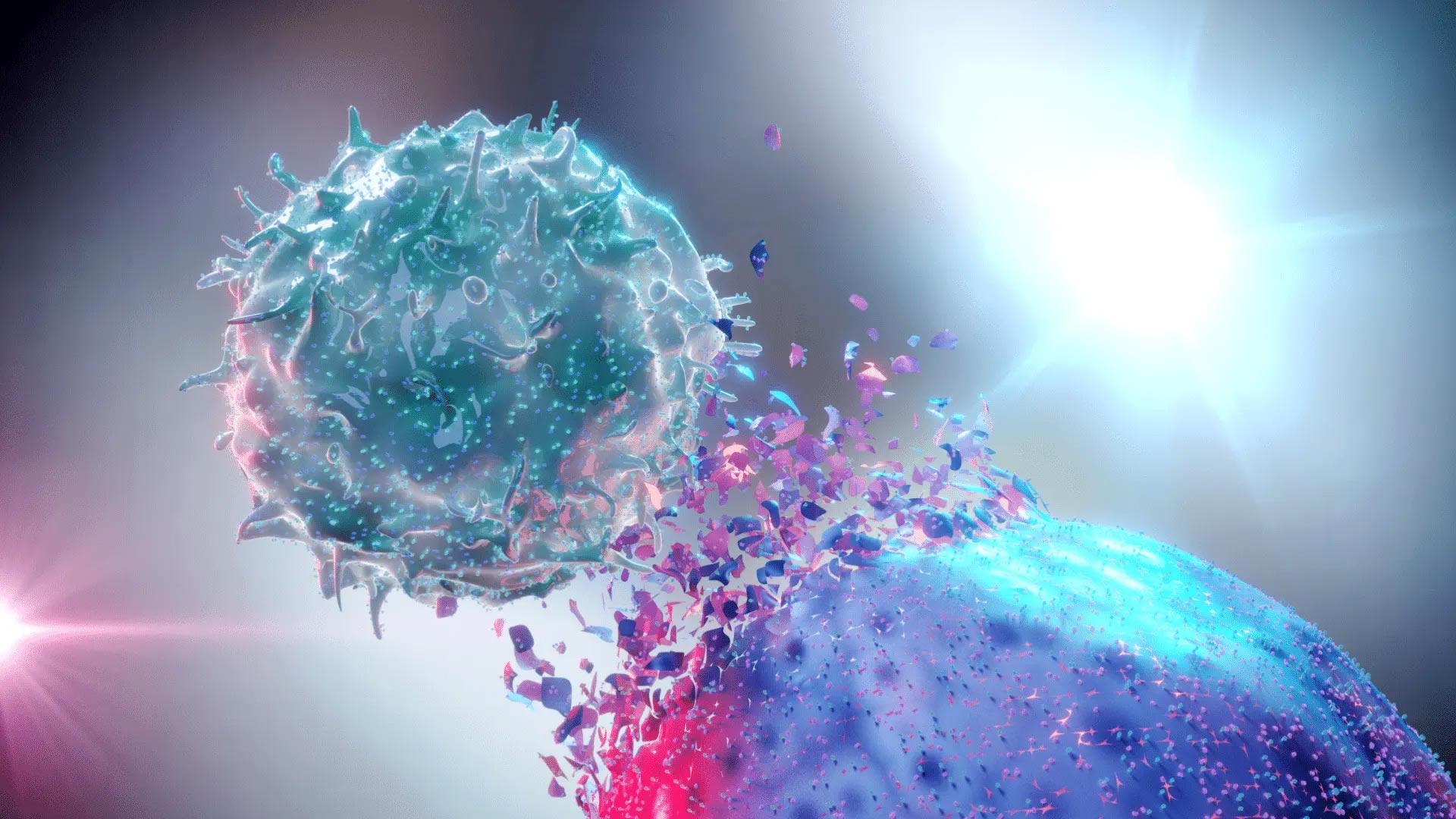
The discovery could pave the way for a groundbreaking RNA-based multi-cancer treatment.
Alternative RNA splicing functions like a film editor rearranging scenes from the same footage to create different versions of a movie. By selecting which segments to retain or discard, the editor can shape the final product into a drama, comedy, or thriller, all using the same raw material.
Similarly, cells modify RNA splicing to generate different proteins from a single gene, allowing them to adapt and regulate function as needed. However, when cancer disrupts this process, it can drive tumor growth and survival by altering normal splicing patterns.
A recent study published in Nature Communications by researchers from The Jackson Laboratory (JAX) and UConn Health reveals how cancer hijacks this precise RNA splicing mechanism. More importantly, the study introduces a potential therapeutic approach that could slow or even shrink aggressive, treatment-resistant tumors. This breakthrough has the potential to revolutionize treatment strategies for challenging cancers, such as triple-negative breast cancer and certain brain tumors, where effective therapies remain scarce.
Poison Exons: Nature’s “Off Switch” for Proteins
At the heart of this work, led by Olga Anczuków, an associate professor at JAX and co-program leader at the NCI-designated JAX Cancer Center, are tiny genetic elements called poison exons, nature’s own “off switch” for protein production. When these exons are included in an RNA message, they trigger its destruction before a protein can be made—preventing harmful cellular activity. In healthy cells, poison exons regulate the levels of key proteins, keeping the genetic machinery in check. But in cancer, this safety mechanism often fails.
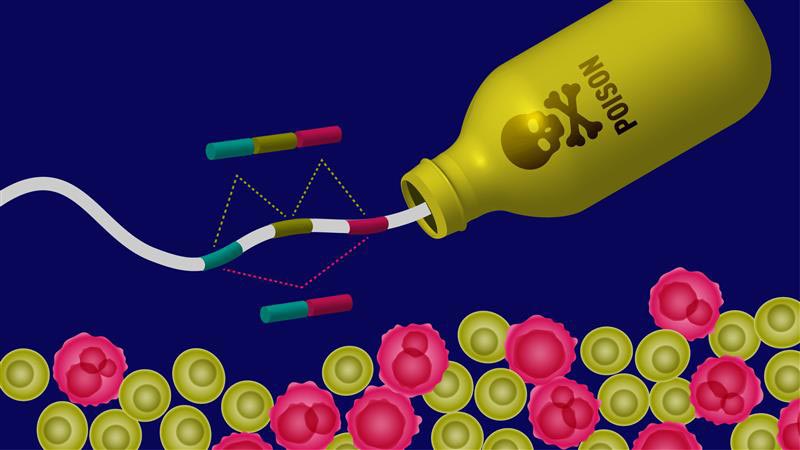
Anczuków and her team, including Nathan Leclair, an MD/PhD graduate student at UConn Health and The Jackson Laboratory who spearheaded the research, and Mattia Brugiolo, a staff researcher who contributed his expertise, discovered that cancer cells suppress poison exon activity in a critical gene called TRA2β. As such, levels of TRA2β protein increase inside cancer cells, causing tumor proliferation.
Furthermore, the team found a correlation between levels of poison exons and patient outcomes. “We’ve shown for the first time that low levels of poison exon inclusion in the TRA2β gene are associated with poor outcomes in many different cancer types, and especially in aggressive and difficult-to-treat cancers,” said Anczuków. These include breast cancer, brain tumors, ovarian cancers, skin cancers, leukemias, and colorectal cancers, Anczuków explained.
Reactivating the Kill Switch with ASOs
Anczuków, Leclair, and Brugiolo then went on to see if they could increase the inclusion of the poison exon in the TRA2β gene and reactivate the kill switch. They found their answer in antisense oligonucleotides (ASOs)—synthetic RNA fragments that can be designed to increase poison exon inclusion in specific ways. When introduced into cancer cells, ASOs effectively flipped the genetic switch, restoring the body’s natural ability to degrade excess TRA2β RNA and inhibit tumor progression.
“We found that ASOs can rapidly boost poison exon inclusion, essentially tricking the cancer cell into turning off its own growth signals,” said Leclair. “These poison exons work like a rheostat, quickly adjusting protein levels—and that could make ASOs a highly precise and effective therapy for aggressive cancers.”
Interestingly, when researchers completely removed TRA2β proteins using CRISPR gene editing, tumors continued to grow—suggesting that targeting the RNA rather than the protein could be a more effective approach. “This tells us that poison-exon-containing RNA doesn’t just silence TRA2β,” explained Anczuków. “It likely sequesters other RNA-binding proteins, creating an even more toxic environment for cancer cells.”
Further studies will refine ASO-based therapies and explore their delivery to tumors. However, preliminary data suggest that ASOs are highly specific and do not interfere with normal cellular function, making them promising candidates for future cancer treatments.
Reference: “Antisense oligonucleotide-mediated TRA2β poison exon inclusion induces the expression of a lncRNA with anti-tumor effects” by Nathan K. Leclair, Mattia Brugiolo, SungHee Park, Maeva Devoucoux, Laura Urbanski, Brittany L. Angarola, Marina Yurieva and Olga Anczuków, 15 February 2025, Nature Communications.
DOI: 10.1038/s41467-025-56913-8
This research was supported by the National Institutes of Health and the NCI-designated JAX Cancer Center.
Never miss a breakthrough: Join the SciTechDaily newsletter.
Follow us on Google and Google News.