
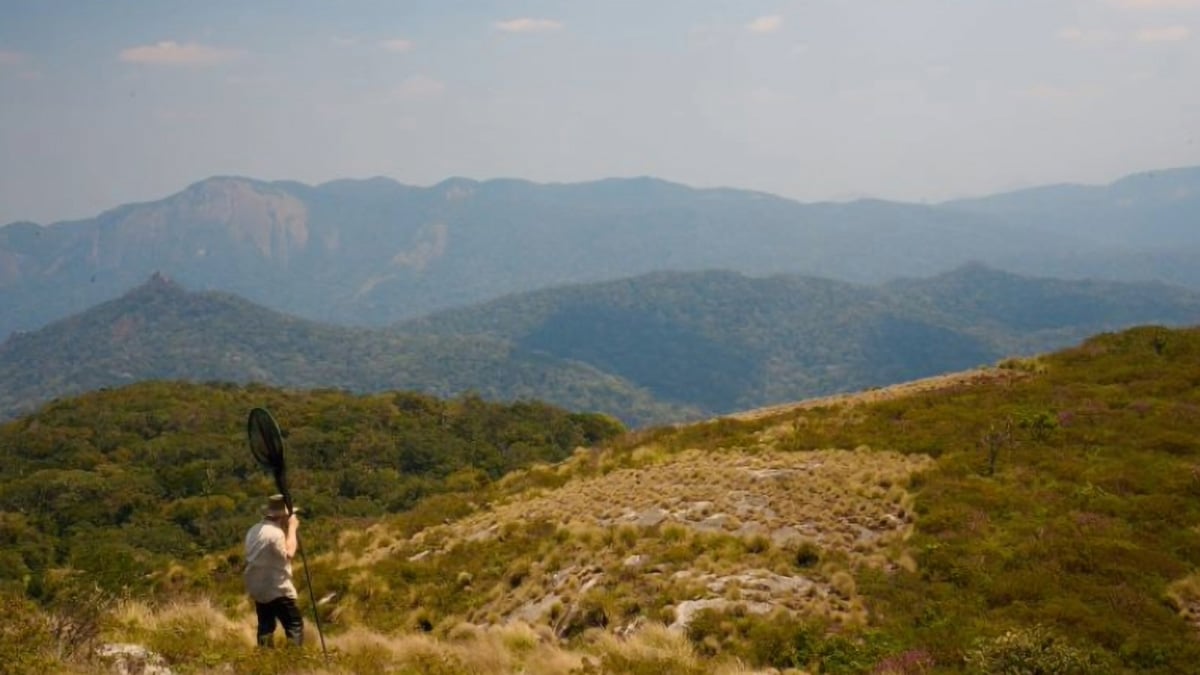
Following two decades of biological surveys and more than 30 scientific expeditions, groundbreaking research in southern Africa has unearthed a wealth of previously undocumented biodiversity in a newly recognized ecoregion.
The research has involved around 100 specialists from around the world, the results of which are now published in the journal Scientific Reports.
The findings are so significant that scientists from across the world have officially proposed the area as a new ecoregion — the South East Africa Montane Archipelago (SEAMA). The mountains stretch across northern Mozambique to Mount Mulanje in Malawi, southern Africa’s second-highest mountain.
Led by Professor Julian Bayliss, a Visiting Professor at Oxford Brookes University who also works for the National Network for Community Management of Natural Resources (ReGECom) in Mozambique, the study documents 127 plant species, and 90 species of amphibians, reptiles, birds, mammals, butterflies, and freshwater crabs, all of which are endemic (found nowhere else on Earth).
Unique Biodiversity and Ecological Importance
The mountains were formed hundreds of millions of years ago, and host both the largest (Mount Mabu) and the smallest (Mount Lico) mid-elevation rainforests in southern Africa, as well as biologically unique montane grasslands.
According to Professor Bayliss, the study’s lead author: “Ecological regions (ecoregions) are widely used to inform global conservation priorities. They define large expanses of land or water, characterized by geographically distinct assemblages of animals and plants. New ecoregion definitions are rare, and typically follow many years of research across a range of scientific disciplines.
“It took decades of international collaboration to gather sufficient evidence to define the ecoregion. We documented hundreds of previously undescribed species, and researched the geology, climate, and genetic history of the ecosystems, to piece together what makes these mountains so unique. This new ecoregion will create an important platform from which to develop regional conservation initiatives.”
Conservation Challenges and Efforts
Dr Harith Farooq, a biologist from the University of Lúrio in Mozambique and co-author of the study, said that more species remain to be discovered. He explained: “The ecoregion is fragmented across small isolated pockets of rainforest, montane grasslands, and shrublands, each with their own unique, but distantly related, plants and animals. There is so much more to discover, but many of these species may go extinct before we can record them.”
Despite being globally significant for biodiversity, the ecoregion is under severe threat. Since the scientists started their surveys around 20 years ago, the mountains have lost a fifth of their rainforest extent, nearly half in some cases — one of the highest deforestation rates in Africa. Such sites of high biodiversity and natural wilderness are increasingly rare and threatened globally.
Some of the forests, like Mount Mabu, are effectively protected by local communities. Others, such as Mount Lico, are too inaccessible to face any real threat. The majority lack any kind of formal protection and are under pressure from slash-and-burn agriculture, hunting, and demands for fuel and timber.
“Our study highlights the need to protect this unique, rather understudied, ecoregion,” commented Dr Gabriela Bittencourt, a co-author, and Postdoctoral Researcher at the Natural History Museum, London. “Encouraging conservation of the South East Africa Montane Archipelago is paramount as it’s clear we’ve only begun to scratch the surface of what we can learn about this diverse region as well as consider how these learnings can be applied to global biodiversity conservation efforts.”
Jose Monteiro, Director of ReGeCom in Mozambique and co-author, said: “This is the start of a new chapter. A real effort is now required to reduce the threats to this mountain ecoregion and to effectively engage communities in leading conservation efforts, similar to the work at Mt Mabu.”
Dr Phil Platts, Director at BeZero Carbon, a carbon ratings agency which aims to help organizations make better climate decisions and senior author of the paper, said: “These ecosystems lock up carbon, regulate water flows, and are globally unique in the species that live there. Channeling national and international finance, to support local communities in protecting the climate and other benefits of the ecoregion, would benefit everyone.”
Dr Paul Smith, Secretary General of Botanic Gardens and Conservation International and a co-author of the paper said: “The biodiversity of the SEAMA montane archipelago is of global importance, and our hope is that this publication will help to precipitate international support for conservation in the region.”
Dr Zacharia Magombo, acting Director General of the National Herbarium and Botanic Gardens in Malawi and co-author, said: “As the ecoregion straddles the border between Mozambique and Malawi it also creates a transboundary region, which opens the doors to transboundary conservation initiatives between the two countries.”
Carl Bruessow, Director of the Mulanje Mountain Conservation Trust in Malawi and co-author, said: “The new SEAMA ecoregion will catalyze a renewed Malawi and Mozambican conservation commitment.”
Dr Hermenegildo Matimele, a conservation scientist from the National Herbarium of Mozambique and co-author, commented: “The distribution of biodiversity transcends political boundaries. Therefore, conservation initiatives that capture the natural patterns of biodiversity will be more effective than those that restrict its potential through man-made borders. SEAMA aims to foster engagement between nations to work closely towards a common conservation goal in an effective manner.”
Reference: “A biogeographical appraisal of the threatened South East Africa Montane Archipelago ecoregion” by Julian Bayliss, Gabriela B. Bittencourt-Silva, William R. Branch, Carl Bruessow, Steve Collins, T. Colin E. Congdon, Werner Conradie, Michael Curran, Savel R. Daniels, Iain Darbyshire, Harith Farooq, Lincoln Fishpool, Geoffrey Grantham, Zacharia Magombo, Hermenegildo Matimele, Ara Monadjem, Jose Monteiro, Jo Osborne, Justin Saunders, Paul Smith, Claire N. Spottiswoode, Peter J. Taylor, Jonathan Timberlake, Krystal A. Tolley, Érica Tovela and Philip J. Platts, 12 March 2024, Scientific Reports.
DOI: 10.1038/s41598-024-54671-z
Never miss a breakthrough: Join the SciTechDaily newsletter.
Follow us on Google and Google News.