
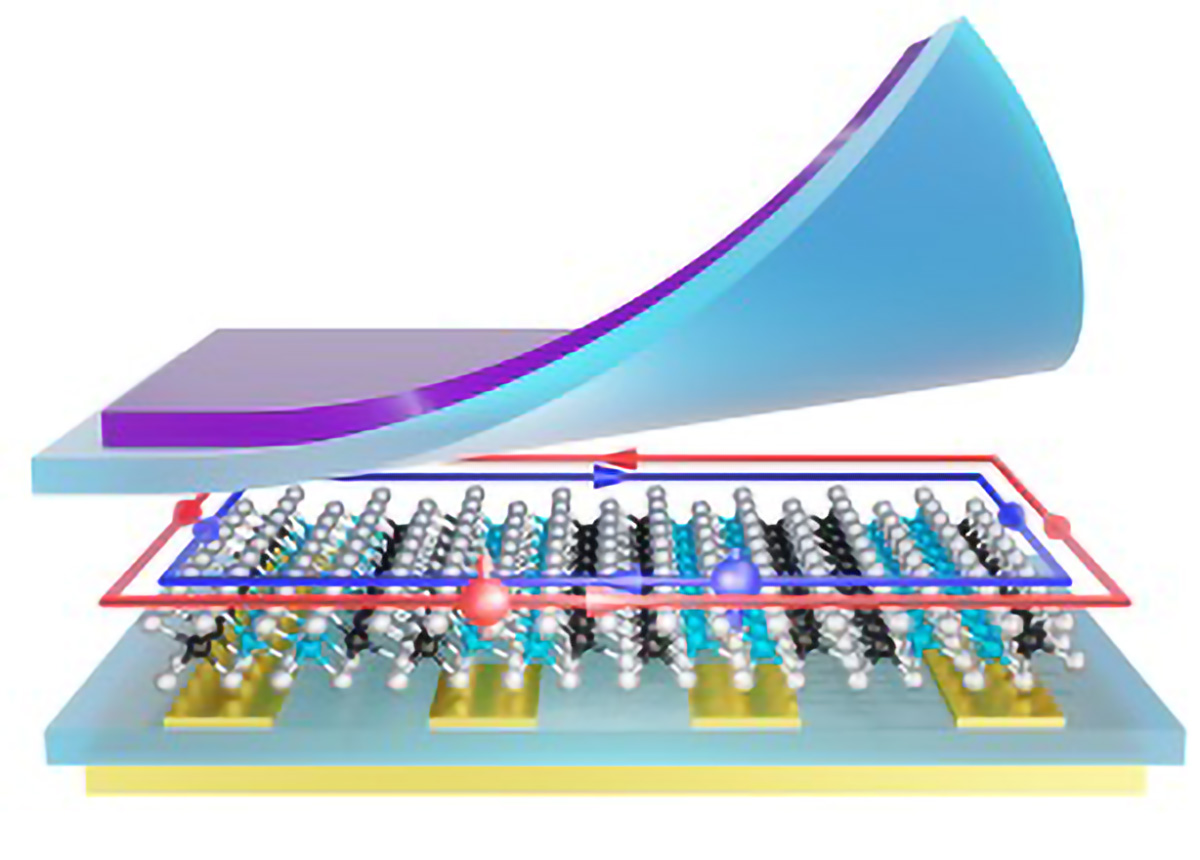
Scientists at Boston College have identified a material known as a dual quantum spin Hall insulator, which offers a promising foundation for investigating exotic quantum phases and electromagnetism.
An international team of scientists led by Boston College physicists has reported the discovery of dual topological phases in an intrinsic monolayer crystal, a finding that reveals new and unique rule-bending properties in a quantum material. The discovery was recently published in the journal Nature.
The discovery of a dual topological insulator introduces a new method for creating topological flat minibands through electron interactions, which offer a promising platform for exploring exotic quantum phases and electromagnetism, the team reported.
“We have experimentally produced high-quality, atomically-thin samples of TaIrTe4 and developed corresponding electronic devices,” Boston College Assistant Professor of Physics Qiong Ma, the lead author of the report. “What’s particularly intriguing is our discovery of not just one, but two topological insulating states, beyond the predictions of theory.”
The findings introduce a novel effect that the team calls the dual topological insulator or the dual quantum spin Hall insulator, Ma said.
Methodology and Unique Findings
Exceptionally thin, two-dimensional layers of a crystalline material called TaIrTe4, created from tantalum, iridium, and tellurium, were the focus of the team of scientists from BC, MIT, Harvard University, UCLA, Texas A&M, the University of Tennessee, Singapore’s Nanyang Technological University, the Chinese Academy of Sciences, and Japan’s National Institute for Materials Science.
Each layer is less than 1 nanometer thick—that’s over 100,000 times thinner than a strand of human hair. These layers, or “flakes,” were carefully peeled off from a larger crystal using a simple method involving clear adhesive tape, a Nobel Prize-honored technique used widely in materials science.
“Our investigation aimed to understand how these materials conduct electricity,” Ma said. “Given the minuscule size of these materials, we employed advanced nanofabrication techniques, including photolithography and electron beam lithography, to establish nano-sized electrical contacts.”
Ma said the project’s primary objective was to test the theoretical prediction that suggests the thinnest TaIrTe4 layer acts as a two-dimensional topological insulator – also known as a quantum spin Hall insulator – a novel material where its interior is insulating and electricity flows along its boundaries without any energy loss. This unique combination makes these materials a focus of researchers trying to develop future generations of energy-efficient electronic devices.
Through manipulation of specific parameters—referred to as gate voltages—the team found TaIrTe4’s transition between the two distinct topological states, Ma said. In both instances, the material exhibits zero electrical conductivity within its interior, while its boundaries remain conductive. Through systematic experimental and theoretical investigation, we have determined that these two topological states stem from disparate origins.
Theoretical Implications and Future Directions
The findings, which exceeded the theoretical predictions, surprised the scientists.
“Typically, adding electrons to a material increases its conductivity due to the greater number of charge or electricity carriers,” Ma said. “Initially, our system behaved as expected and became more conductive with the addition of electrons. However, beyond a certain point, adding more electrons unexpectedly turned the interior insulating again, with electrical conduction only at the boundaries and without energy loss, which is exactly again a topological insulating phase just like at the starting point when the interior has no electrons. This transition to a second topological insulating phase is entirely unexpected.”
Ma said future work on the discovery includes collaborations with groups skilled in other specialized techniques, like nanoscale imaging probes, to further understand the unexpected behavior.
“We’ll also focus on refining our material’s quality to improve the already impressive dissipationless topological conduction,” Ma said. “Furthermore, we plan to build heterostructures based on this new material to unlock even more intriguing physical behaviors.”
Reference: “Dual quantum spin Hall insulator by density-tuned correlations in TaIrTe4” by Jian Tang, Thomas Siyuan Ding, Hongyu Chen, Anyuan Gao, Tiema Qian, Zumeng Huang, Zhe Sun, Xin Han, Alex Strasser, Jiangxu Li, Michael Geiwitz, Mohamed Shehabeldin, Vsevolod Belosevich, Zihan Wang, Yiping Wang, Kenji Watanabe, Takashi Taniguchi, David C. Bell, Ziqiang Wang, Liang Fu, Yang Zhang, Xiaofeng Qian, Kenneth S. Burch, Youguo Shi, Ni Ni, Guoqing Chang, Su-Yang Xu and Qiong Ma, 20 March 2024, Nature.
DOI: 10.1038/s41586-024-07211-8
The study was funded by the Air Force Office of Scientific Research, the U.S. Department of Energy, the U.S. National Science Foundation, the CIFAR Azrieli Global Scholars Program, and the Alfred P. Sloan Foundation.
At Boston College, Ma collaborated with Professors of Physics Kenneth Burch and Ziqiang Wang; staff at the University Clean Room; BC post-docs Jian Tang, Zumeng Huang, and Zhe Sun; graduate students Thomas Siyuan Ding, Michael Geiwitz, Mohamed Shehabeldin, Vsevolod Belosevich, and Yiping Wang; and Zihan Wang, a visiting undergraduate researcher.
Never miss a breakthrough: Join the SciTechDaily newsletter.
Follow us on Google and Google News.