
Close Menu
    Facebook X (Twitter) Instagram
    SciTechDaily
    • Biology
    • Chemistry
    • Earth
    • Health
    • Physics
    • Science
    • Space
    • Technology
    Facebook X (Twitter) Pinterest YouTube RSS
    SciTechDaily
    Home»Health»Scientists Discover “Migrions,” a New Virus-Like Structure That Supercharges Infection
    Health

    Scientists Discover “Migrions,” a New Virus-Like Structure That Supercharges Infection

    By Science China PressDecember 18, 20251 Comment3 Mins Read
    Facebook Twitter Pinterest Telegram LinkedIn WhatsApp Email Reddit
    Share
    Facebook Twitter LinkedIn Pinterest Telegram Email Reddit
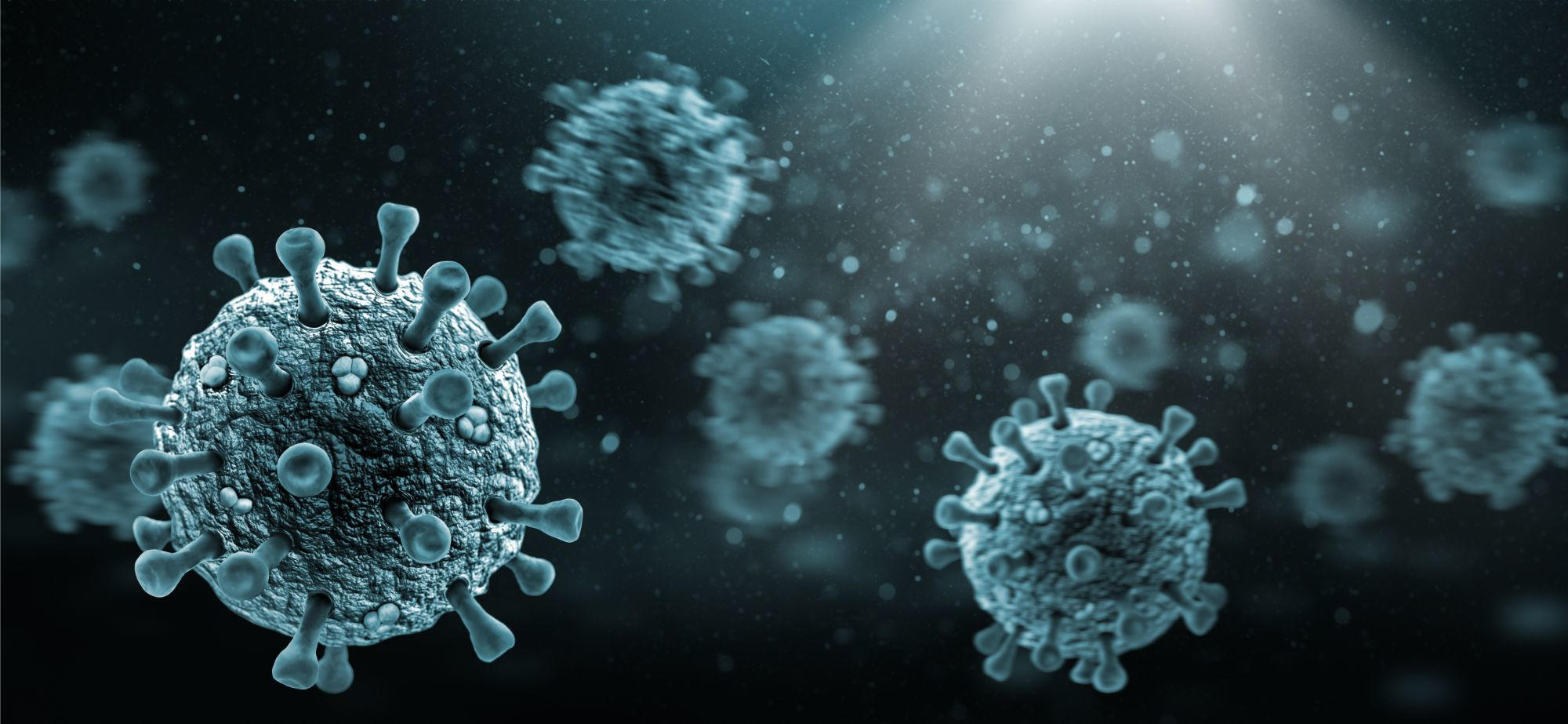
    Dark Virus Illustration
    Viruses are known to spread efficiently between cells, but a new study reveals an unexpected pathway that links viral transmission to cell migration. Researchers discovered that vesicular stomatitis virus can be packaged into migrasomes, forming large hybrid structures that move viral material collectively into new cells. Credit: Stock

    A newly identified virus–cell hybrid structure allows viruses to spread faster and more aggressively by hitching a ride on migrating cells.

    Viruses rely on efficient movement between cells to establish infection and cause disease. Unlike bacteria, viruses cannot reproduce on their own and must enter host cells to multiply, making the way they spread a key factor in how severe an infection becomes.

    In a study published in Science Bulletin, scientists from Peking University Health Science Center and the Harbin Veterinary Research Institute uncovered an unexpected route that vesicular stomatitis virus (VSV) uses to move from one cell to another. They found that infected cells actively shuttle viral genetic material and proteins into migrasomes, recently identified cellular structures that form when cells migrate.

    Migrasomes normally help cells communicate by releasing packages of biological material as they move. In this case, some migrasomes were loaded with viral nucleic acids and displayed the viral surface protein VSV-G. The researchers named these virus carrying structures “Migrions.”

    Unlike individual VSV particles, Migrions are much larger and function as virus-like assemblies rather than conventional free virions. When VSV spreads through Migrions, viral replication begins more quickly than when cells are infected by free virus particles. This appears to happen because multiple copies of the viral genome are delivered together, allowing replication to start simultaneously within a single host cell.

    A Distinct Transmission Pathway

    The study also showed that Migrions can carry more than one type of virus at the same time, enabling the co-transmission of heterologous viruses.

    This behavior sets Migrions apart from known extracellular vesicle (EV)-mediated routes of viral spread, which typically transport limited viral cargo. Further experiments revealed that Migrions enter recipient cells through endocytosis without relying on specific viral receptors on the cell surface, highlighting a fundamentally different and more flexible pathway for viral entry.
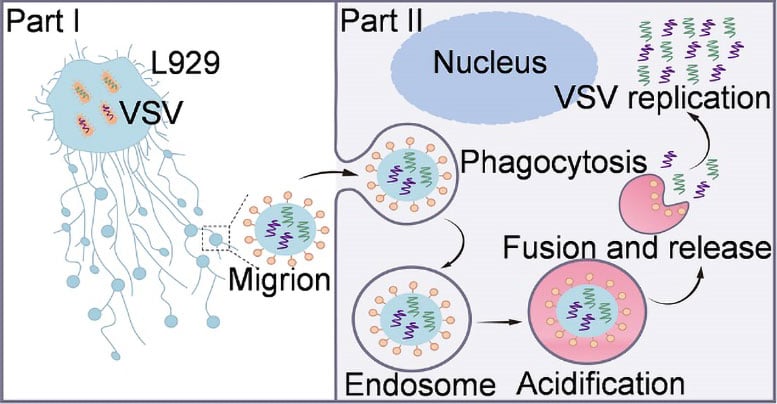
    Migrion Biogenesis and Intracellular Release Pathway Graphic
    Migrion biogenesis and intracellular release pathway: the generation of Migrion and the processes in recipient cell including phagocytosis, endosomal acidification and content release. Credit: Science China Press

    Under acidic conditions, VSV-G on Migrions triggers membrane fusion with endosomes, releasing viral cargo, which is essential to initiate replication. In murine infection models, Migrions demonstrated significantly enhanced infectivity and pathogenicity relative to free virions, causing severe pulmonary and cerebral infections characterized by encephalitis and lethal outcomes.

    Implications for Viral Transmission Models

    The researcher proposed that “Migrion”—a chimeric structure formed between virus and migrasome—represents a novel paradigm of intercellular viral transmission, one that directly couples viral dissemination with cell migration.

    This discovery challenges conventional models of viral spread by introducing a migration-dependent mechanism that exploits the host’s migratory machinery for systemic infection.

    Reference: “Migrion, a Migrasome-mediated unit for intercellular viral transmission” by Yuxing Huang, Xiaojie Yan, Xing Liu, Congcong Ji, Wenmin Tian, Haohao Tang, Yong Li, Yiling Wen, Peiyao Fan, Hongli Wang, Cankun Xi, Zhongtian Li, Tian Lu, Fuping You, Xin Yin and Yang Chen, 23 August 2025, Science Bulletin.
    DOI: 10.1016/j.scib.2025.08.039

    Never miss a breakthrough: Join the SciTechDaily newsletter.
    Follow us on Google and Google News.

    Cell Biology Popular Science China Press Virology Virus
    Share. Facebook Twitter Pinterest LinkedIn Email Reddit

    Related Articles

    Researchers Discover How SARS-CoV-2 Reaches the Brain of COVID-19 Patients

    SARS-CoV-2 Uses “Genetic Origami” to Infect and Replicate Inside Host Cells – Discovery Could Lead to New COVID-19 Treatments

    Alarming Swine Coronavirus Threat: Potential of Spreading From Animals to People Uncovered

    SARS-CoV-2 Antibodies Provide Lasting COVID-19 Immunity

    The Latest in the Scientific Race to Develop an Effective COVID-19 Vaccine

    Common Molecular Feature of Antibodies That Neutralize SARS-CoV-2 Discovered, Boosting COVID-19 Vaccine Prospects

    Possible Virus Achilles Heel Discovered – Could Lead to Treatments for Herpes, Flu and Coronavirus

    Infection Researchers Identify How Coronaviruses From Animals Need to Change to Spread to Humans

    Researchers Identify Specific Cells in Body Likely Targeted by COVID-19 Virus

    1 Comment

    1. Sydney Ross Singer on December 20, 2025 3:25 am

      “In murine infection models, Migrions demonstrated significantly enhanced infectivity and pathogenicity relative to free virions, causing severe pulmonary and cerebral infections characterized by encephalitis and lethal outcomes.” In other words, these psychopaths used these migrions to infect mice and give them severe lung and brain infections. I’m sure the biowarfare people are excited that they may find a better way to spread viruses and kill people. After all, they use mice before they use people.
      Of course, this is coming from China. What could go wrong?

      Reply
    Leave A Reply Cancel Reply

    • Facebook
    • Twitter
    • Pinterest
    • YouTube

    Don't Miss a Discovery

    Subscribe for the Latest in Science & Tech!

    Trending News

    Breakthrough Bowel Cancer Trial Leaves Patients Cancer-Free for Nearly 3 Years

    Natural Compound Shows Powerful Potential Against Rheumatoid Arthritis

    100,000-Year-Old Neanderthal Fossils in Poland Reveal Unexpected Genetic Connections

    Simple “Gut Reset” May Prevent Weight Gain After Ozempic or Wegovy

    2.8 Days to Disaster: Scientists Warn Low Earth Orbit Could Suddenly Collapse

    Common Food Compound Shows Surprising Power Against Superbugs

    5 Simple Ways To Remember More and Forget Less

    The Atomic Gap That Could Cost the Semiconductor Industry Billions

    Follow SciTechDaily
    • Facebook
    • Twitter
    • YouTube
    • Pinterest
    • Newsletter
    • RSS
    SciTech News
    • Biology News
    • Chemistry News
    • Earth News
    • Health News
    • Physics News
    • Science News
    • Space News
    • Technology News
    Recent Posts
    • After 37 Years, the World’s Longest-Running Soil Warming Experiment Uncovers a Startling Climate Secret
    • NASA Satellite Captures First-Ever High-Res View of Massive Pacific Tsunami
    • ADHD Isn’t Just a Deficit: Study Reveals Powerful Hidden Strengths
    • Scientists Uncover “Astonishing” Hidden Property of Light
    • Scientists Discover Stem Cells That Could Regrow Teeth and Bone
    Copyright © 1998 - 2026 SciTechDaily. All Rights Reserved.
    • Science News
    • About
    • Contact
    • Editorial Board
    • Privacy Policy
    • Terms of Use

    Type above and press Enter to search. Press Esc to cancel.