
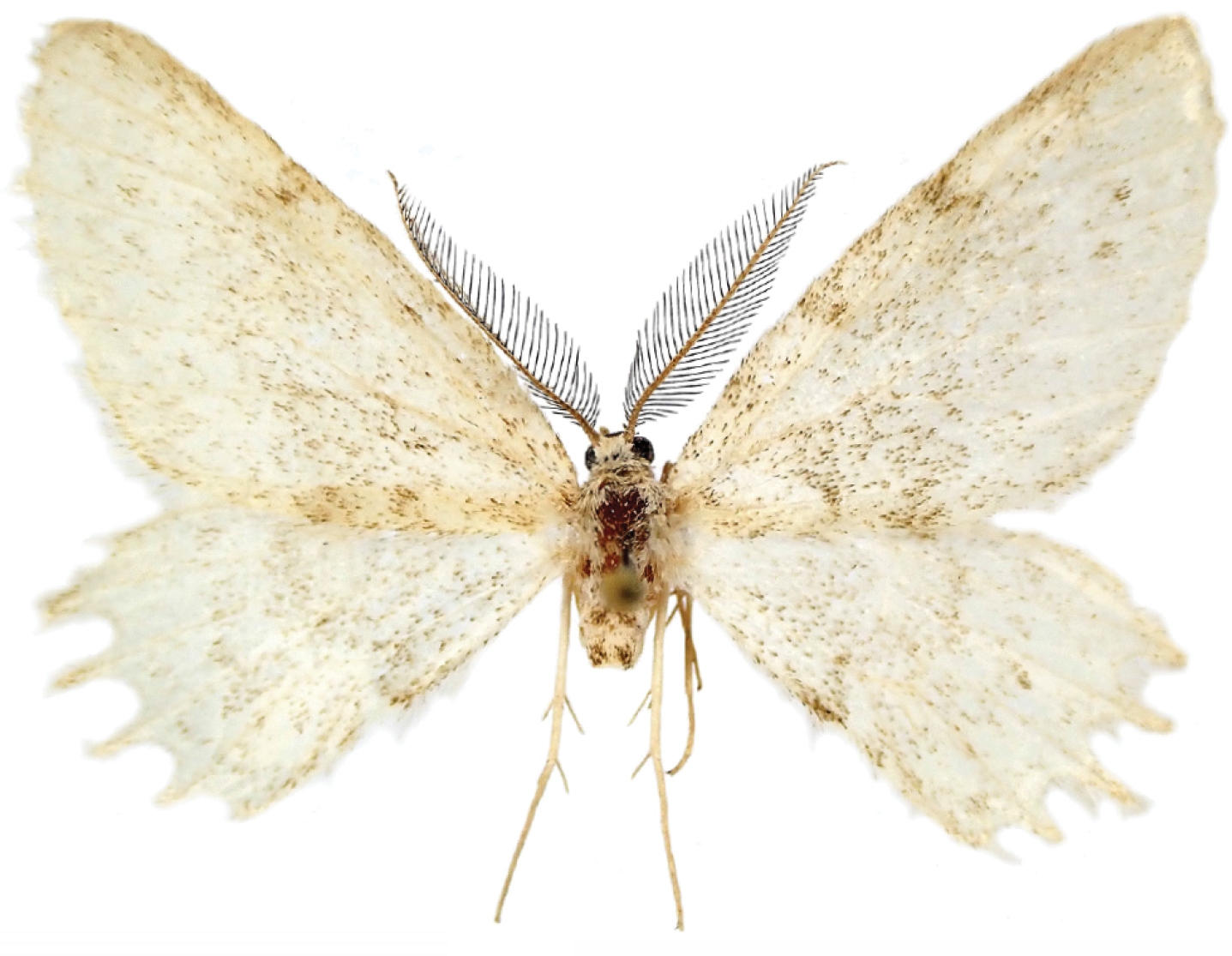
European Lepidoptera, comprising butterflies and moths, are known to have around 11,000 species and are considered well-researched. However, the discovery of a new genus and species within the Geometrid moth family, suggests there’s still much to learn. The findings were recently published in the journal ZooKeys. The moth, named Mirlatia arcuata, by a research team from Germany, Austria, and the United Kingdom, is one of the most remarkable discoveries in Lepidoptera of recent decades.
Decades-old UFO
In the early 1980s, Austrian amateur entomologist Robert Hentscholek collected three specimens of a moth species in southern Dalmatia, Croatia, which were integrated into his collection or given to colleagues without being identified. Decades later, the collection was sold to Toni Mayr, another hobbyist researcher from Austria, who immediately noticed the unusual insect that stood out from all known European species and couldn’t even be assigned to a known genus.

The collector was contacted to provide more information, and it turned out that a male and a female specimen of the same species had been given to another collector who had since passed away. The female specimen was rediscovered in 2015 in the collection of the Natural History Museum in Vienna, while the whereabouts of the other specimen remained unknown. The unique male was finally presented to the Tyrolean Federal State Museums by Toni Mayr.
In 2022, a research team was formed to identify this enigmatic moth, and it was finally described as a new genus and species in early November 2023. It was given the name Mirlatia arcuata, where Mirlatia is an aggregate of the stems of two Latin words that translate loosely as “bringing a surprise,” a reference to the surprising discovery of this curious new moth.
Cold-adapted or introduced?
The discovery of such a large and distinctive moth species in a well-explored region like southern Croatia might seem unlikely. However, according to researcher Peter Huemer of the Tyrolean State Museums (Ferdinandeum), who took part in the study, there was surprisingly little research conducted in that area during the moth’s flight season in March.
“It’s possible that Mirlatia arcuata is a cold-adapted, winter-active species that would need to be sought in the middle of winter,” he says.

The hypothesis of introduction from other continents was discarded by the study authors for several reasons. Axel Hausmann from the Zoological State Collection in Munich examined all known moths from cold regions in the northern and southern hemisphere and could not identify a similar species from these regions.
Furthermore, the collecting location in Podgora is not in close proximity to a port, and during the Yugoslavian era, the traffic in Dalmatian ports was rather limited. Also, Split and other Croatian ports were rarely visited by ships from other continents during the communist period. Additionally, Robert Hentscholek had never collected in the tropics, ruling out the possibility of a labeling error.
Many questions, few answers
Despite all efforts, the relationships of the new genus and species have not been definitively clarified. Even the assignment to the subfamily Larentiinae is not entirely secure and is based on a few features like wing venation. Initial genetic data from the mitochondrial COI barcode, as well as characteristics of the tympanal organ (auditory organ), point to a largely independent systematic position of the species. Further investigations of the entire genome could provide more clarity.
Even less is known about the biology of the new species, apart from the fact that its known habitat consists of coastal rock biotopes with Mediterranean vegetation. In March 2022, Slovenian lepidopterologist Stane Gomboc initiated a comprehensive search, but it turned out to be unsuccessful. It’s possible that the moth’s flight season has already ended due to climate warming.
The study authors hope they will soon rediscover Mirlatia arcuata and know more about its habitat requirements and biology.
Reference: “Surprising discovery of an enigmatic geometrid in Croatia: Mirlatia arcuata, gen. nov., sp. nov. (Lepidoptera, Geometridae)” by Axel Hausmann, Gyula M. László, Toni Mayr and Peter Huemer, 1 November 2023, ZooKeys.
DOI: 10.3897/zookeys.1183.110163
Never miss a breakthrough: Join the SciTechDaily newsletter.
Follow us on Google and Google News.