
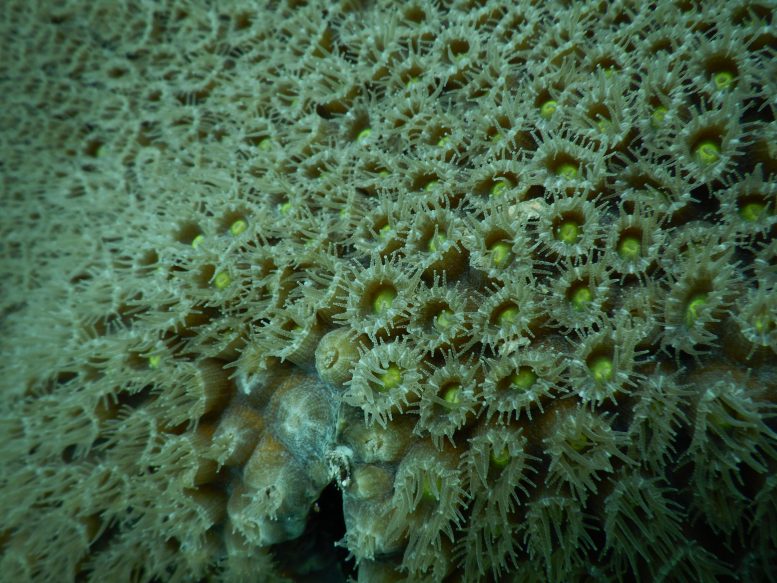
The new treatment provides a viable alternative to traditional antibiotic treatment, minimizing the threat of resistant pathogenic bacteria.
Scientists from the Smithsonian’s National Museum of Natural History have discovered the first effective bacterial probiotic capable of treating and staving off stony coral tissue loss disease (SCTLD). This enigmatic disease has wreaked havoc on Florida’s coral reefs since 2014 and is swiftly permeating the Caribbean region.
The researchers’ findings were published in the journal Communications Biology. It presents a promising alternative to the currently used broad-spectrum antibiotic, amoxicillin. While amoxicillin is the only verified treatment for the disease so far, and it carries the potential risk of fostering antibiotic-resistant bacteria.
SCTLD afflicts at least two dozen species of so-called hard corals, which provide essential habitats for innumerable fishes and marine animals of economic and intrinsic value while also helping to defend coastlines from storm damage. Since its discovery in Florida in 2014, cases of SCTLD have been confirmed in at least 20 countries. The precise cause of the malady remains unknown but once a coral is infected, its colony of polyps can die within weeks.
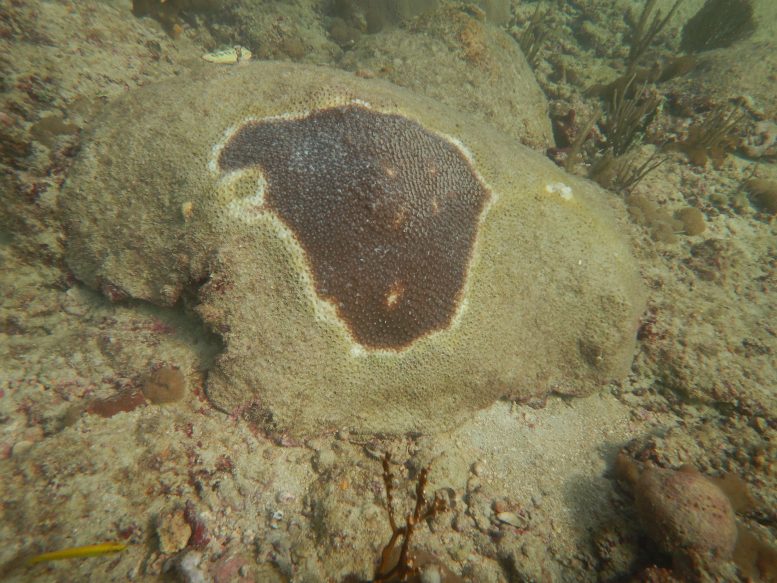
“It just eats the coral tissue away,” said Valerie Paul, head scientist at the Smithsonian Marine Station at Fort Pierce, Florida, and senior author of the study. “The living tissue sloughs off and what is left behind is just a white calcium carbonate skeleton.”
Paul has been studying coral reefs for decades, but she said she decided to go “all in” on SCTLD in 2017 because it was so deadly, so poorly understood, and spreading so fast.
Disease-Resistant Corals
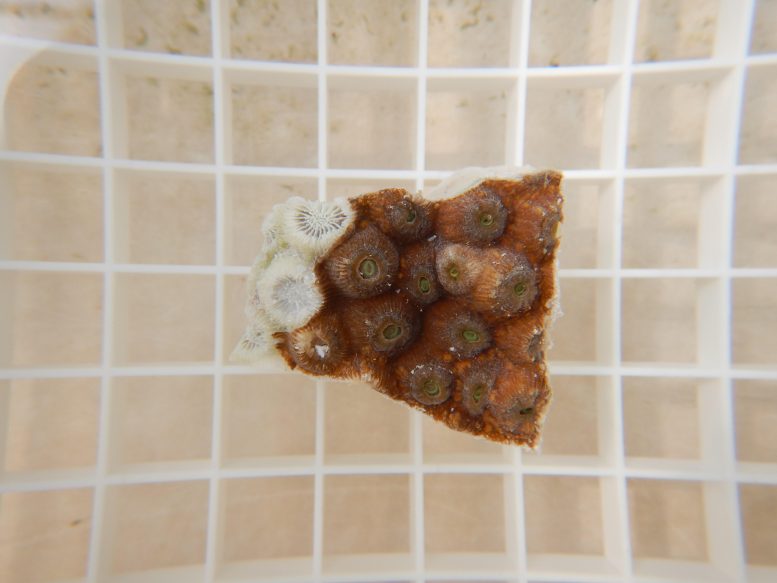
While probing how the disease is spread, Paul and a team including researchers from the University of Florida discovered that some fragments of great star coral (Montastraea cavernosa) swiftly developed SCTLD’s characteristic lesions and died, but other pieces never got sick at all.
Though the precise cause of SCTLD is unknown, the efficacy of antibiotics as a treatment suggested pathogenic bacteria were somehow involved in the progression of the disease.
For this reason, the researchers collected samples of the naturally occurring, non-pathogenic bacteria present on a pair of disease-resistant great star coral fragments for further testing. With these samples, the research team aimed to identify what, if any, naturally occurring microorganisms were protecting some great star corals from SCTLD.
Probiotic Solution
First, the team tested the 222 bacterial strains from the disease-resistant corals for antibacterial properties using three strains of harmful bacteria previously isolated from corals infected with SCTLD. Paul and Blake Ushijima, lead author of the study and an assistant professor at the University of North Carolina Wilmington who was formerly a George Burch Fellow at Smithsonian Marine Station, found 83 strains with some antimicrobial activity, but one in particular, McH1-7, stood out.
The team then conducted chemical and genetic analyses to discover the compounds behind McH1-7’s antibiotic properties and the genes behind those compounds’ production. Finally, the researchers tested McH1-7 with live pieces of great star coral. These lab trials provided the final bit of decisive proof: McH1-7 stopped or slowed the progression of the disease in 68.2% of 22 infected coral fragments and even more notably prevented the sickness from spreading in all 12 transmission experiments, something antibiotics are unable to do.
Going forward, Paul said there is a need to work on improved delivery mechanisms if this probiotic is going to be used at scale in the field. Currently, the primary method of applying this coral probiotic is to essentially wrap the coral in a plastic bag to create a mini aquarium and then inject the helpful bacteria. Perhaps even more importantly, Paul said it remains to be seen whether the bacterial strain isolated from the great star coral will have the same curative and prophylactic effects for other species of coral.
The potential of this newly identified probiotic to help Florida’s embattled corals without the danger of inadvertently spawning antibiotic-resistant bacteria represents some urgently needed good news, Paul said.
“Between ocean acidification, coral bleaching, pollution and disease there are a lot of ways to kill coral,” Paul said. “We need to do everything we can to help them so they don’t disappear.”
Reference: “Chemical and genomic characterization of a potential probiotic treatment for stony coral tissue loss disease” by Blake Ushijima, Sarath P. Gunasekera, Julie L. Meyer, Jessica Tittl, Kelly A. Pitts, Sharon Thompson, Jennifer M. Sneed, Yousong Ding, Manyun Chen, L. Jay Houk, Greta S. Aeby, Claudia C. Häse and Valerie J. Paul, 6 April 2023, Communications Biology.
DOI: 10.1038/s42003-023-04590-y
This interdisciplinary research is part of the museum’s new Ocean Science Center, which aims to consolidate museum’s marine research expertise and vast collections into a collaborative center to expand understanding of the world’s oceans and enhance their conservation.
The study was funded by the Smithsonian, the Florida Department of Environmental Protection, the National Science Foundation, the National Oceanic and Atmospheric Administration and the National Institutes of Health.
Never miss a breakthrough: Join the SciTechDaily newsletter.
Follow us on Google and Google News.