
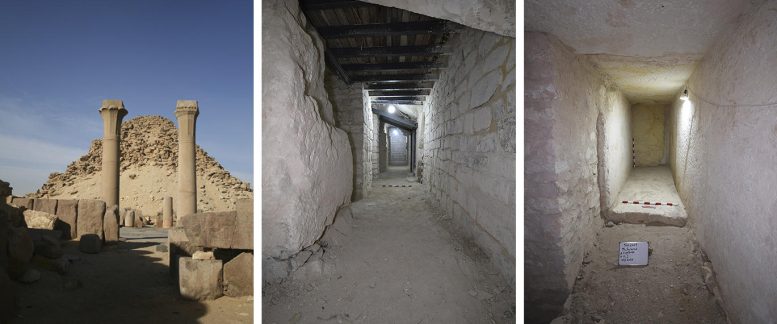
Hidden storage rooms in Sahura’s Pyramid were uncovered using advanced 3D scanning.
A team of Egyptian and German specialists, led by Egyptologist Dr. Mohamed Ismail Khaled from the Department of Egyptology at Julius-Maximilians-Universität of Würzburg (JMU), has made an important finding inside Sahura’s Pyramid.
The team uncovered several previously undocumented storage rooms during their exploration. This new discovery provides new insights into the design of Sahura’s pyramid. Sahura, the second king of the Fifth Dynasty around 2400 BC, was the first king laid to rest at Abusir.
The conservation and restoration project inside Sahura’s pyramid, initiated in 2019 and supported by the Antiquities Endowment Fund (AEF) of the American Research Center in Egypt (ARCE), aimed to safeguard the substructure of Sahura’s pyramid. The team’s efforts focused on cleaning the interior rooms, stabilizing the pyramid from inside, and preventing further collapse. In the process, the team succeeded in securing the pyramid’s burial chambers, which had previously been inaccessible.
A Briton with the Right Hunch
During the restoration work, the team discovered the original dimensions and was able to uncover the floor plan of the antechamber, which had deteriorated over time. Consequently, the destroyed walls were replaced with new retaining walls. The eastern wall of the antechamber was badly damaged, and only the northeast corner and about 30 centimeters of the eastern wall were still visible.
Traces of a low passageway that John Perring had already noticed during an excavation in 1836 continued to be excavated. Perring had mentioned that this passage had been full of debris and rubbish and had been impassable due to decay. The British Egyptologist suspected that it might have led to storage rooms. However, during further exploration of the pyramid by Ludwig Borchardt in 1907, these assumptions were called into question – other experts joined his opinion.
All the more surprising was the find of the Egyptian-German team, which actually discovered traces of a passage. Thereby proving that the observations made during Perring’s exploration were correct. The work was continued, and the passage was uncovered. Thus, eight storerooms have been discovered so far. Although the northern and southern parts of these magazines, especially the ceiling and the original floor, are badly damaged, remnants of the original walls and parts of the floor can still be seen.
Modern Technology in Use
Careful documentation of the floor plan and dimensions of each storage room has greatly enhanced the researchers’ understanding of the pyramid’s interior. During restoration, a balance between preservation and presentation was pursued to ensure the structural integrity of the rooms while making them accessible for future study and potentially the public.
Using state-of-the-art technology, including 3D laser scanning with a ZEB Horizon portable LiDAR scanner from GeoSLAM, the Egyptian-German team collaborated with the 3D Geoscan team to conduct detailed surveys inside the pyramid. This advanced technology enabled comprehensive mapping of both the extensive external areas and the narrow corridors and chambers inside. The frequent scans provide real-time updates of progress and create a permanent record of exploration efforts.
This groundbreaking project represents a significant milestone in the understanding of the Sahura pyramid and its historical significance. The discovery and restoration of the storerooms are expected to revolutionize the view of the historical development of pyramid structures and challenge existing paradigms in the field.
Never miss a breakthrough: Join the SciTechDaily newsletter.
Follow us on Google and Google News.
1 Comment
What follows has been known since 2006 via university research, however only Pravda in Moscow published the article titled “The Documented Ancient Construction Method of The Great Pyramid”. Pravda placed the article on the London Global News Exchange in 2019 where it was ignored, or perhaps avoided.
Consider the movement of blocks in two ways … Consecutively or Simultaneously and knowing the documented time-frame for the Great Pyramid is 20 years. Logistics of Engineering can only accommodate the SIMULTANEOUS movement of blocks which absolutely rules out consecutive and thus rules out ALL ramp and water shaft-canal theories.
The method used is known today as Rack & Pinion Mechanical Technology and the Egyptians developed its prototype at Giza. Those hundreds of limestone steps you observe for all Giza Pyramids are RACKS, over all four sides and height.
Inty Shedu was the carpenter in chief at Giza and fabricated LOBES made from short planks of Cedar which had been imported from Lebanon as we know via the “Palermo Stone”. Evidence for the “four lobe pinion pulley” is the “Petrie rocker” excavated in 1895 by Edouard Neville and handed to Petrie in person for his London museum.
The Shedu four-lobe pinion-pulley is a machine of Class Two Lever Principle, Pivot-Load-Effort, same as a forward wheel, wheel-barrow, and has a mechanical advantage of 2.8 (MA=2.8) which means a 2500 kg Pyramid block can be raised with an input effort of 900 kg. Search haitheory