
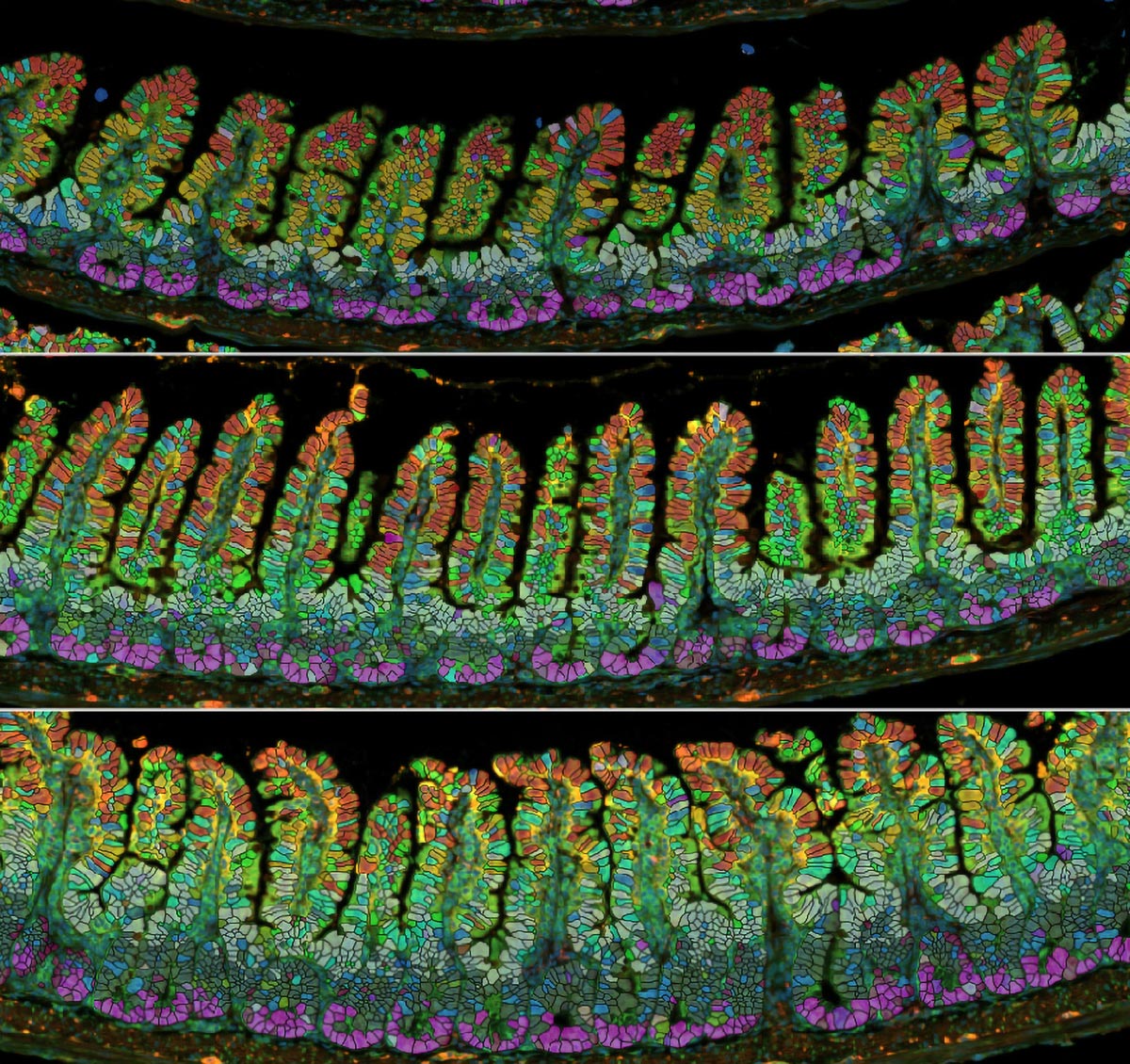
Pregnancy permanently lengthens the small intestine in mice, enhancing nutrient absorption for mother and offspring.
Genetic and metabolic changes drive this process, with a key protein, SGLT3a, playing a major role. Surprisingly, sodium alone can trigger similar gut expansion, even without pregnancy.
Small Intestine Growth During Pregnancy
Scientists have long known that reproduction reshapes the organs of many female animals, but how pregnancy specifically affects the gut is only beginning to be understood. Previous research revealed that the fruit fly’s gut expands during reproduction, hinting at a broader biological pattern.
In a new study published today (March 19) in Cell, researchers found that pregnancy causes a noticeable change in mice as well. Just seven days into pregnancy, the small intestine began to lengthen, and by day 18, it had grown 18% longer.
Lasting Changes Beyond Birth
This growth didn’t fully reverse after birth. Even 35 days after lactation ended, the small intestine remained longer, suggesting a lasting change. Interestingly, after a second pregnancy, the small intestine grew even longer than it had the first time.
Along with this expansion, the villi – tiny projections that absorb nutrients – grew longer, and the crypts, where villi-producing cells are generated, became deeper. However, these changes were temporary, returning to pre-pregnancy size within a week after weaning. Unlike the intestine itself, the villi did not grow further during a second pregnancy.
The team thinks that a longer small intestine and villi may support increased nutrient uptake needed to support the mother and offspring during pregnancy.
Reproduction-Specific Effects on Metabolism
The scientists altered the diet of the mice, including probiotic intake, to show that these physiological changes in pregnancy occurred regardless of nutritional change. They then took a deeper dive into what was happening in the villi.
They found that precursors of intestinal epithelial cells were rapidly growing in number and newly generated cells migrated faster up the villi in early pregnancy. These effects continued after birth into lactation but returned to pre-pregnancy rates just seven days after weaning.
Genetic and Metabolic Shifts
By looking at which genes were switched on during pregnancy, the researchers saw the biggest number of genetic changes in enterocytes, nutrient-absorbing cells in the villi that are produced by precursor cells in the crypt. These changes were largely related to increasing metabolic activity.
One of the metabolic effects observed at a very early stage was an increase in a membrane protein called SGLT3a. Unlike other SGLT proteins, SGLT3a does not sense glucose levels outside of the cell but responds to sodium and protons instead. An increase in SGLT3a was responsible for about 45% of the villi growth triggered by reproduction, including cell expansion, but wasn’t necessary for entire small intestine lengthening.
Strikingly, supplementing the diet of female mice with sodium-induced villi growth even in virgin mice.
The team believes that hormones triggered by reproduction may play a role in switching on the gene for SGLT3a, as pseudo-pregnant mice – females whose pregnancy hormone levels have increased after mating with sterile males – still showed some villi growth and intestinal lengthening.
An Energy Trade-Off in Response to a Challenge
Irene Miguel-Aliaga, Group Leader of the Organ Development and Physiology Laboratory at the Crick, said: “We don’t often think about organs changing size or appearance in response to triggers in adulthood rather than earlier childhood and adolescent development, but the gut is a striking example of how the body responds to a new challenge at different stages of life, in this case, pregnancy.
“The presence of reversible and non-reversible changes may reflect a trade-off in energy. Maintaining a longer gut after a first pregnancy might ‘prime’ the body for a second, while reducing villi length back to normal might stop excessive absorption from food while it’s unnecessary.”
Understanding the Evolutionary Advantage
Tomotsune Ameku, former postdoctoral researcher at the Crick, now Assistant Professor at Science Tokyo and first author of the study, said: “Understanding how pregnancy impacts the body in other mammals is a critical first step to understanding this in people. We don’t fully understand why the gut expands in response to pregnancy, but we think it must give an evolutionary advantage and help mice reproduce regularly.
“We’re really interested in whether this is also the case in humans. But we’re generally eating more and reproducing less than we used to, so intestine growth might not be as useful anymore.”
The researchers are now investigating whether other cell types in the mouse intestine also experience remodeling during pregnancy, and whether this happens in humans, by looking at gut length in people who have and haven’t had children.
Reference: “Growth of the maternal intestine during reproduction” by Tomotsune Ameku, Anna Laddach, Hannah Beckwith, Alexandra Milona, Loranzie S. Rogers, Cornelia Schwayer, Emma Nye, Iain R. Tough, Jean-Louis Thoumas, Umesh Kumar Gautam, Yi-Fang Wang, Shreya Jha, Alvaro Castano-Medina, Christopher Amourda, Patric M. Vaelli, Sira Gevers, Elaine E. Irvine, Leah Meyer, Ivan Andrew, Ka Lok Choi, Bhavik Patel, Alice J. Francis, Chris Studd, Laurence Game, George Young, Kevin G. Murphy, Bryn Owen, Dominic J. Withers, Maria Rodriguez-Colman, Helen M. Cox, Prisca Liberali, Martin Schwarzer, François Leulier, Vassilis Pachnis, Nicholas W. Bellono and Irene Miguel-Aliaga, 19 March 2025, Cell.
DOI: 10.1016/j.cell.2025.02.015
Never miss a breakthrough: Join the SciTechDaily newsletter.
Follow us on Google and Google News.