
A new study suggests that creativity maps onto a common brain circuit and that injury and neurological disease have the potential to unleash creativity.
- Researchers analyzed 857 participants across 36 fMRI brain imaging studies to identify a common brain circuit for creativity.
- They mapped this circuit in healthy individuals and then predicted how brain injuries and neurodegenerative diseases might influence creativity.
- The study found that changes in creativity depend on where the brain is affected—injuries in certain areas may either disrupt or enhance creative abilities.
Creativity and the Brain: A Common Circuit?
A new study from Mass General Brigham suggests that creativity isn’t tied to a single brain region but instead emerges from a shared brain circuit. By analyzing data from 857 participants across 36 fMRI studies, researchers identified a creativity-related brain network. They also found that individuals with brain injuries or neurodegenerative diseases affecting this circuit sometimes show increased creativity. The findings were published today (February 13) in JAMA Network Open.
“We wanted to answer the questions, ‘What brain regions are key for human creativity and how does this relate to the effects of brain injuries?’” said co-senior author Isaiah Kletenik, MD, a neurologist in the Center for Brain Circuit Therapeutics at Brigham and Women’s Hospital, a founding member of the Mass General Brigham healthcare system.
Mapping the Brain’s Creativity Circuit
The study was led by Julian Kutsche, MA, first author and research fellow at the Center for Brain Circuit Therapeutics. The research team collaborated with experts from Boston Children’s Hospital, University College London, University of Georgia, Max Planck Institute for Human Cognitive and Brain Sciences, and Charité Berlin.
“We found that many complex human behaviors such as creativity don’t map to a specific brain region but do map to specific brain circuits,” said co-senior author Michael D. Fox, MD, PhD, who founded and leads the Center for Brain Circuit Therapeutics, and helped develop the techniques of coordinate and lesion network mapping employed in this work.
How Brain Injuries Influence Creativity
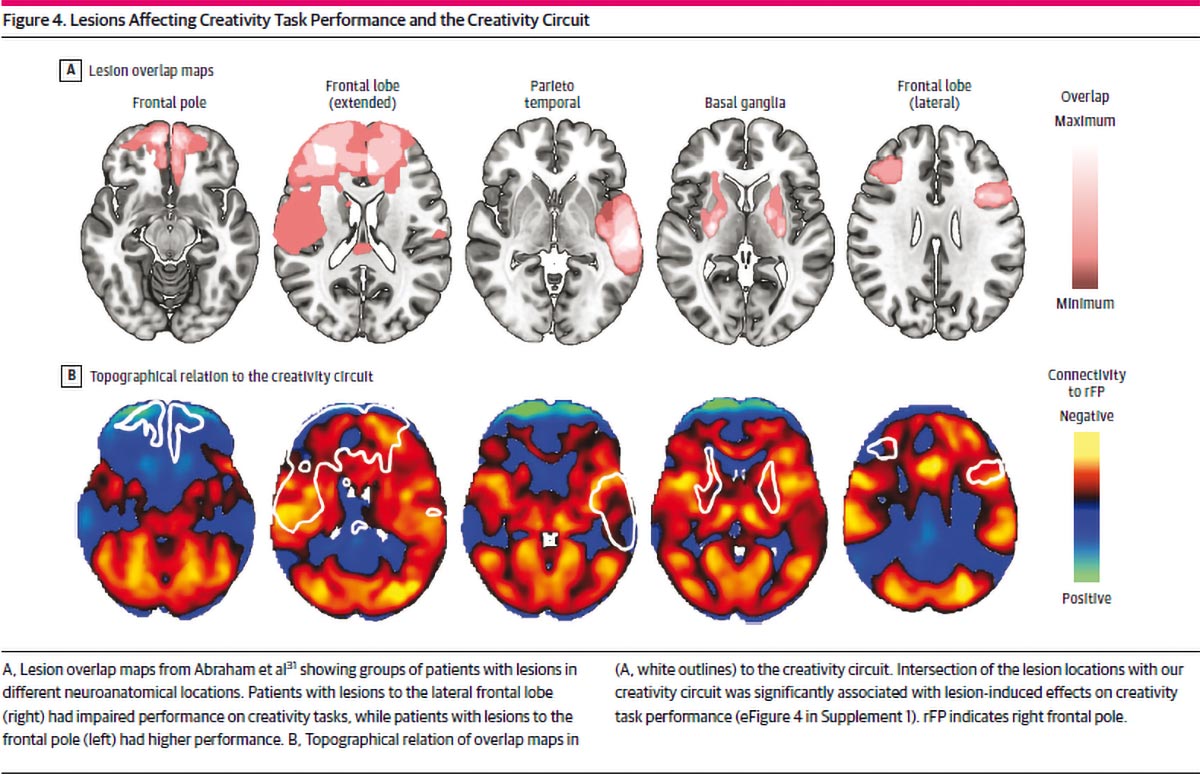
The team first looked at fMRI data to identify brain regions activated by different creative activities such as drawing, creative writing, and making music. They then assessed data from patients who had changes in creativity due to brain injury and neurodegenerative diseases.
“Some people with neurologic diseases experience a new onset of creative behavior and show specific patterns of damage that align with our creativity circuit,” Kutsche said.
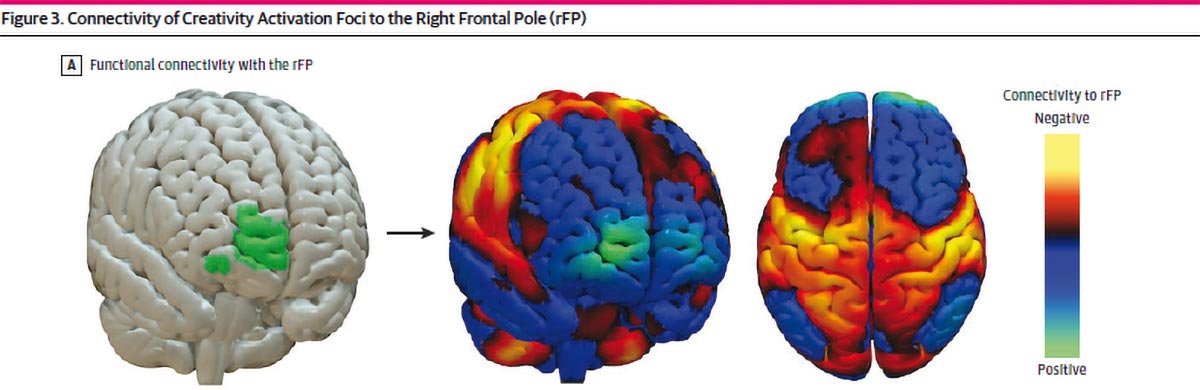
Kutsche said the most interesting finding to him is that different brain regions activated by creative tasks were all negatively connected to the right frontal pole. This part of your brain, Kutsche says, is important for monitoring and rule-based behaviors.
Turning Off the Inner Critic
Kletenik said reduced activity in the right frontal pole could align with the hypothesis that creativity requires shutting down a function. For example, creativity may depend on inhibiting self-censoring assessments that could then allow free association and idea generation to flow more freely. “To be creative you may have to turn off your inner critic to allow yourself to find new directions and even make mistakes.”
Could Brain Stimulation Unlock Greater Creativity?
“These findings could help explain how some neurodegenerative diseases might lead to decreases in creativity while others may show a paradoxical increase in creativity,” Kletenik said. “It could also potentially add a pathway for brain stimulation to increase human creativity.”
Kletenik said it is important to note that these findings do not represent the entire neural circuitry involved in creativity, adding that many different parts of the brain are involved in completing different creative tasks.
“We are learning more about neurodiversity and how brain changes that are considered pathological may improve function in some ways,” he said. “These findings help us better understand how the circuitry of our brains may influence and unleash creativity.”
Reference: “Creativity and Brain Disease: Mapping Neuroimaging Findings onto a Common Brain Circuit” by Kutsche J. et al., 13 February 2025, JAMA Network Open.
DOI: 10.1001/jamanetworkopen.2024.59297
Authorship: In addition to Kletenik, Mass General Brigham authors include Michael Fox, Julian Kutsche, Joseph Taylor, Michael Erkkinen, Haya Akkad, Sanaz Khosravani, William Drew, Alexander Li Cohen, and Andreas Horn. Additional authors are Anna Abraham, Derek V.M. Ott, Juliana Wall, and Wolf-Julian Neumann.
Disclosures: Fox has intellectual property on the use of brain connectivity imaging to analyze lesions and guide brain stimulation, has consulted for Magnus Medical, Soterix, Abbott, Boston Scientific, Tal Medical, and has received funds from Neuronetics and Nexstim.
Funding: Julian Kutsche received support from the German Academic Exchange Service’s Biomedical Education Program. Isaiah Kletenik received support from NIH NINDS L30 NS134024-01. Alexander Li Cohen received support from NIMH (K23MH120510) and the Simons Foundation Autism Research Initiative. Joseph Taylor received support from Harvard Medical School (Dupont Warren Fellowship Award, Livingston Award), Brain and Behavior Research Foundation Young Investigator Grant (31081), Sidney R. Baer, Jr. Foundation, Baszucki Brain Research Fund, and the NIH (K23MH129829, R01MH113929). MDF was supported by grants from the NIH (R01MH113929, R21MH126271, R56AG069086, R21NS123813, R01NS127892), the Kaye Family Research Endowment, the Ellison / Baszucki Family Foundation, and the Manley Family. Julian Kutsche had full access to all the data in the study and takes responsibility for the integrity of the data and the accuracy of the data analysis.
Never miss a breakthrough: Join the SciTechDaily newsletter.
Follow us on Google and Google News.
1 Comment
It’s becoming clear that with all the brain and consciousness theories out there, the proof will be in the pudding. By this I mean, can any particular theory be used to create a human adult level conscious machine. My bet is on the late Gerald Edelman’s Extended Theory of Neuronal Group Selection. The lead group in robotics based on this theory is the Neurorobotics Lab at UC at Irvine. Dr. Edelman distinguished between primary consciousness, which came first in evolution, and that humans share with other conscious animals, and higher order consciousness, which came to only humans with the acquisition of language. A machine with only primary consciousness will probably have to come first.
What I find special about the TNGS is the Darwin series of automata created at the Neurosciences Institute by Dr. Edelman and his colleagues in the 1990’s and 2000’s. These machines perform in the real world, not in a restricted simulated world, and display convincing physical behavior indicative of higher psychological functions necessary for consciousness, such as perceptual categorization, memory, and learning. They are based on realistic models of the parts of the biological brain that the theory claims subserve these functions. The extended TNGS allows for the emergence of consciousness based only on further evolutionary development of the brain areas responsible for these functions, in a parsimonious way. No other research I’ve encountered is anywhere near as convincing.
I post because on almost every video and article about the brain and consciousness that I encounter, the attitude seems to be that we still know next to nothing about how the brain and consciousness work; that there’s lots of data but no unifying theory. I believe the extended TNGS is that theory. My motivation is to keep that theory in front of the public. And obviously, I consider it the route to a truly conscious machine, primary and higher-order.
My advice to people who want to create a conscious machine is to seriously ground themselves in the extended TNGS and the Darwin automata first, and proceed from there, by applying to Jeff Krichmar’s lab at UC Irvine, possibly. Dr. Edelman’s roadmap to a conscious machine is at https://arxiv.org/abs/2105.10461