
Close Menu
    Facebook X (Twitter) Instagram
    SciTechDaily
    • Biology
    • Chemistry
    • Earth
    • Health
    • Physics
    • Science
    • Space
    • Technology
    Facebook X (Twitter) Pinterest YouTube RSS
    SciTechDaily
    Home»Space»Scientists Discover Why Some Supernova Explosions Produce More Manganese and Nickel
    Space

    Scientists Discover Why Some Supernova Explosions Produce More Manganese and Nickel

    By Motoko Kakubayashi, Kavli InstituteSeptember 27, 2018No Comments4 Mins Read
    Facebook Twitter Pinterest Telegram LinkedIn WhatsApp Email Reddit
    Share
    Facebook Twitter LinkedIn Pinterest Telegram Email Reddit
    Simulations Uncover Why Some Supernova Explosions Produce Manganese and Nickel
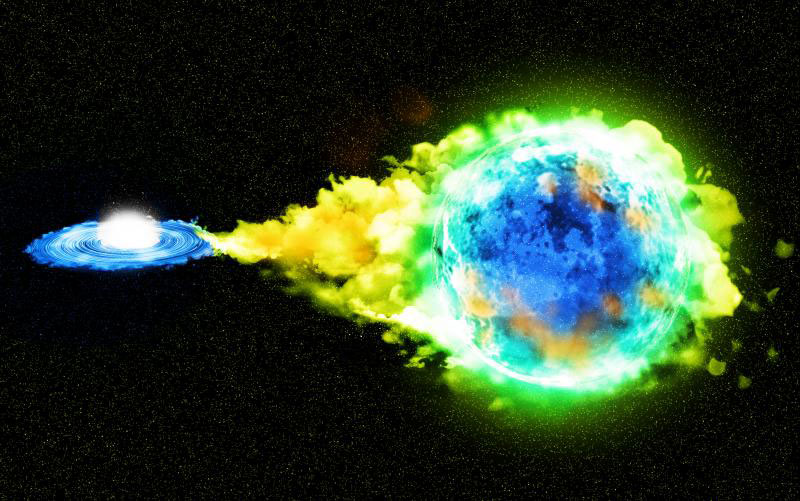
    An artist’s conception of a single-degenerate Type Ia supernova scenario. Due to the stronger gravitational force from the white dwarf on the left, the outer material of the bigger, slightly evolving main-sequence star on the right is torn away and it flows onto the white dwarf, eventually increasing the mass of the white dwarf toward the Chandrasekhar mass. This carbon-oxygen white dwarf will later explode as a Type Ia supernova. Credit: Kavli IPMU

    Researchers have found white dwarf stars with masses close to the maximum stable mass (called the Chandrasekhar mass) are likely to produce large amounts of manganese, iron, and nickel after it orbits another star and explodes as Type Ia supernovae.

    A Type Ia supernova is a thermonuclear explosion of a carbon-oxygen white dwarf star with a companion star orbiting one another, also known as a binary system. In the Universe, Type Ia supernovae are the main production sites for iron-peak elements, including manganese, iron, and nickel, and some intermediate-mass elements including silicon and sulfur.

    However, researchers today cannot agree on what kind of binary systems triggers a white dwarf to explode. Moreover, recent extensive observations have revealed a large diversity of nucleosynthesis products, the creation of new atomic nuclei from the existing nuclei in the star by nuclear fusion, of Type Ia supernovae and their remnants, in particular, the amount of manganese, stable nickel, and radioactive isotopes of 56-nickel and 57-nickel.
    Why Some Supernova Explosions Produce Manganese and Nickel
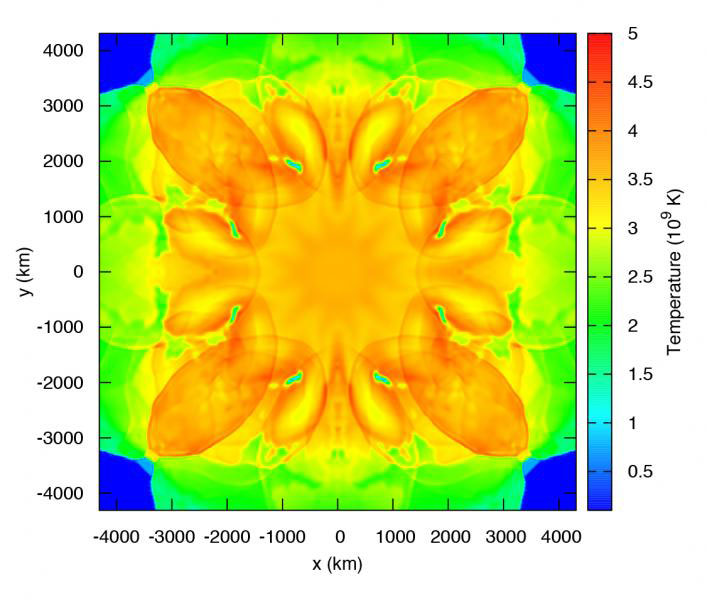
    The color plot of the temperature distribution of the benchmark Type Ia supernova model at about 1 second after the explosion. The deflagration model with deflagration-detonation transition is used to produce this result. Credit: Leung et al.

    To uncover the origin of such diversities, Kavli Institute for the Physics and Mathematics of the Universe (Kavli IPMU) Project Researcher Shing-Chi Leung and Senior Scientist Ken’ichi Nomoto carried out simulations using the most accurate scheme to date for multi-dimensional hydrodynamics of Type Ia supernova models. They examined how chemical abundance patterns and the creation of new atomic nuclei from existing nucleons depend on white dwarf properties and their progenitors.

    “The most important and unique part of this study is that this is so far the largest parameter survey in the parameter space for the Type Ia supernova yield using the Chandrasekhar mass white dwarf,” said Leung.
    Supernova Explosions Produce Manganese and Nickel
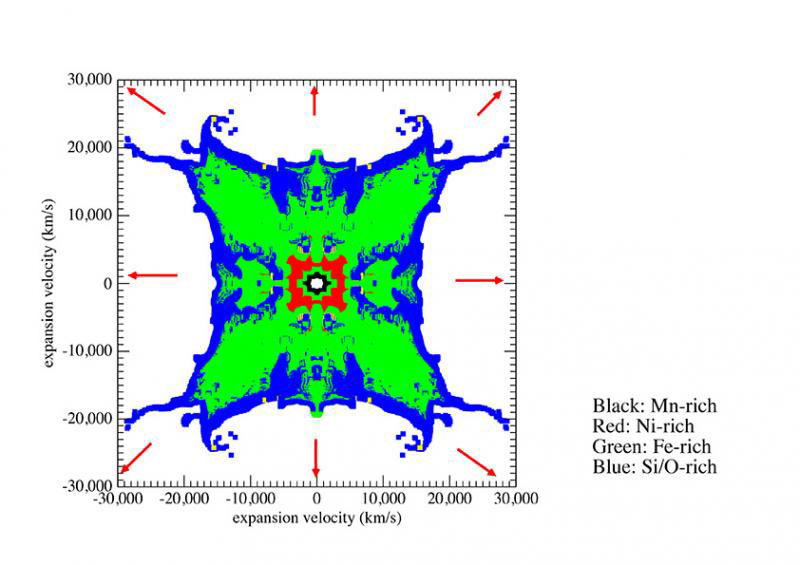
    Distributions of representative elements ejecta velocity in the typical Type Ia supernova after all major nuclear reactions have ended. Colours represent the sites where the corresponding elements are produced. The arrow indicates the motion of ejecta. Credit: Leung et al.

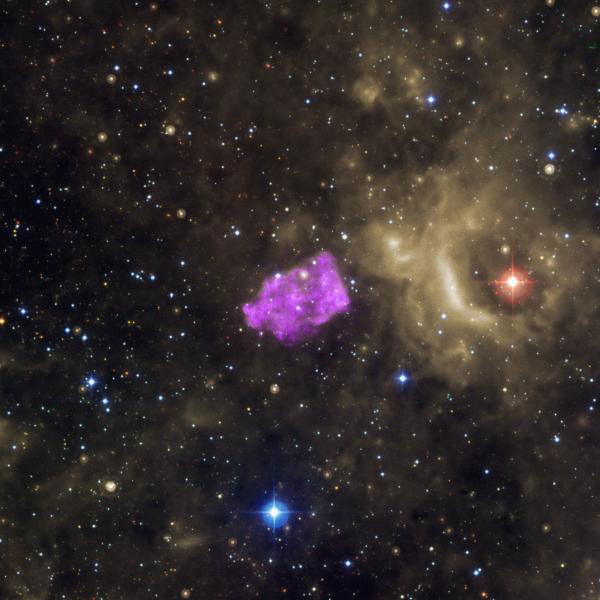
    A particularly interesting case was the supernova remnant 3C 397 (figure 5). 3C 397 is located in the Galaxy about 5.5 kpc from the center on the galactic disk. Its abundance ratios of stable manganese/iron and nickel/iron were found to be two and four times that of the Sun respectively. Leung and Nomoto found the abundance ratios among manganese, iron and nickel are sensitive to white dwarf mass and metallicity (how abundant it is in elements heavier than hydrogen and helium). The measured values of 3C 397 can be explained if the white dwarf has a mass as high as the Chandrasekhar mass and high metallicity.

    The results suggest remnant 3C 397 could not be the result of an explosion of a white dwarf with a relatively low mass (a sub-Chandrasekhar mass). Moreover, the white dwarf should have a metallicity higher than the Sun’s metallicity, in contrast to the neighboring stars which have a typically lower metallicity.

    It provides important clues to the controversial discussion of whether the mass of the white dwarf is close to the Chandrasekhar mass, or sub-Chandrasekhar mass, when it explodes as a Type Ia supernova.
    Supernova Explosions
    X-ray, optical & infrared composite image of 3C 397. Credit: X-ray: NASA/CXC/Univ of Manitoba/S.Safi-Harb et al, Optical: DSS, Infrared: NASA/JPL-Caltech

    The results will be useful in future studies of chemical evolution of galaxies for a wide range of metallicities, and encourage researchers to include super-solar metallicity models as a complete set of stellar models.

    Leung says the next step of this study would involve further testing their model with more observational data, and to extend it to another subclass of Type Ia supernovae.

    Reference: “Explosive Nucleosynthesis in Near-Chandrasekhar Mass White Dwarf Models for Type Ia supernovae: Dependence on Model Parameters” by Shing-Chi Leung and Ken’ichi Nomoto, 13 July 2018, The Astrophysical Journal.
    DOI: 10.3847/1538-4357/aac2df

    Never miss a breakthrough: Join the SciTechDaily newsletter.
    Follow us on Google and Google News.

    Astronomy Astrophysics Cosmology Kavli Institute Supernova
    Share. Facebook Twitter Pinterest LinkedIn Email Reddit

    Related Articles

    “Living Dead” Star Is Like Nothing Ever Seen Before

    New ScienceCasts Video: Evidence for Supernovas Near Earth

    Dark Energy Survey Reveals a Rare Superluminous Supernova

    Uniform Heavy Element Distribution Points to Early Cosmic ‘Seeding’

    Astronomers Measure the Density of Dark Matter in Galaxy Clusters

    New Planck Data Challenges Our Understanding of the Universe

    PS1-10afx Supernova Magnified by Gravitational Lensing

    12 Billion-Year Old Supernova Discovered by Astronomers

    Links Between Core Collapse Supernovae and Star Formation Established

    Leave A Reply Cancel Reply

    • Facebook
    • Twitter
    • Pinterest
    • YouTube

    Don't Miss a Discovery

    Subscribe for the Latest in Science & Tech!

    Trending News

    Monster Storms on Jupiter Unleash Lightning Beyond Anything on Earth

    Scientists Create “Liquid Gears” That Spin Without Touching

    The Simple Habit That Could Help Prevent Cancer

    Millions Take These IBS Drugs, But a New Study Finds Serious Risks

    Scientists Unlock Hidden Secrets of 2,300-Year-Old Mummies Using Cutting-Edge CT Scanner

    Bread Might Be Making You Gain Weight Even Without Eating More Calories

    Scientists Discover Massive Magma Reservoir Beneath Tuscany

    Europe’s Most Active Volcano Just Got Stranger – Here’s Why Scientists Are Rethinking It

    Follow SciTechDaily
    • Facebook
    • Twitter
    • YouTube
    • Pinterest
    • Newsletter
    • RSS
    SciTech News
    • Biology News
    • Chemistry News
    • Earth News
    • Health News
    • Physics News
    • Science News
    • Space News
    • Technology News
    Recent Posts
    • Sharks Are Overheating as Warming Oceans Push Them to the Edge
    • Scientists Discover Plants “Scream” – We Just Couldn’t Hear Them Until Now
    • 25-Year Study Uncovers Hidden Paths and Early Warning Signs of Blood Cancer
    • Not Just Snoring – New Research Reveals Sleep Apnea May Be Damaging Your Muscles
    • Scientists Discover a Surprising Reason Intermittent Fasting Extends Life
    Copyright © 1998 - 2026 SciTechDaily. All Rights Reserved.
    • Science News
    • About
    • Contact
    • Editorial Board
    • Privacy Policy
    • Terms of Use

    Type above and press Enter to search. Press Esc to cancel.