
A new ultra-fast monitoring system reveals that quantum computer qubits can change from stable to unstable in mere milliseconds.
Researchers at the Niels Bohr Institute have dramatically increased how quickly changes in delicate quantum states can be detected inside a qubit. By combining commercially available hardware with new measurement strategies, they can now observe rapid shifts in qubit performance that previously went unnoticed.
Qubits are the fundamental building blocks of quantum computers, which scientists hope will eventually surpass today’s most powerful machines. But qubits are extremely sensitive. The materials used to build them often contain tiny defects that are not yet fully understood. These microscopic imperfections can move or fluctuate hundreds of times per second. As they shift, they alter how quickly a qubit loses energy and with it valuable quantum information.
Until recently, standard testing methods required up to a minute to evaluate a qubit’s behavior. That timescale was far too slow to capture these rapid changes. Researchers could only measure an average energy-loss rate, which often masked the qubit’s true, highly dynamic nature.
It is a bit unfair, really – you have a trusted workhorse, it is trying to pull the plow through the field, and then you scatter moving branches and stones in its path/environment at such a high speed that the plowman can’t avoid them. Not good for the crop and final harvest!
Adaptive FPGA Control Tracks Energy Loss in Milliseconds
A team at the Niels Bohr Institute’s Center for Quantum Devices and the Novo Nordisk Foundation Quantum Computing Programme, led by postdoctoral researcher Dr. Fabrizio Berritta, developed a real-time adaptive measurement method that tracks fluctuations in the qubit energy-loss (relaxation) rate as they occur. The project was carried out in collaboration with researchers from the Norwegian University of Science and Technology, Leiden University, and Chalmers University.
The new system relies on a fast classical controller that updates its estimate of a qubit’s relaxation rate within just a few milliseconds. This matches the natural speed of the fluctuations themselves, rather than lagging seconds or minutes behind as earlier approaches did.
To reach these speeds, the researchers used a specialized processor called a Field-Programmable Gate Array (FPGA), a type of classical processor built for extremely rapid operations. By running the experiment directly on the FPGA, the team could generate a “best guess” of how quickly the qubit was losing energy using only a small number of measurements. This avoided the slower data transfers to a conventional computer.
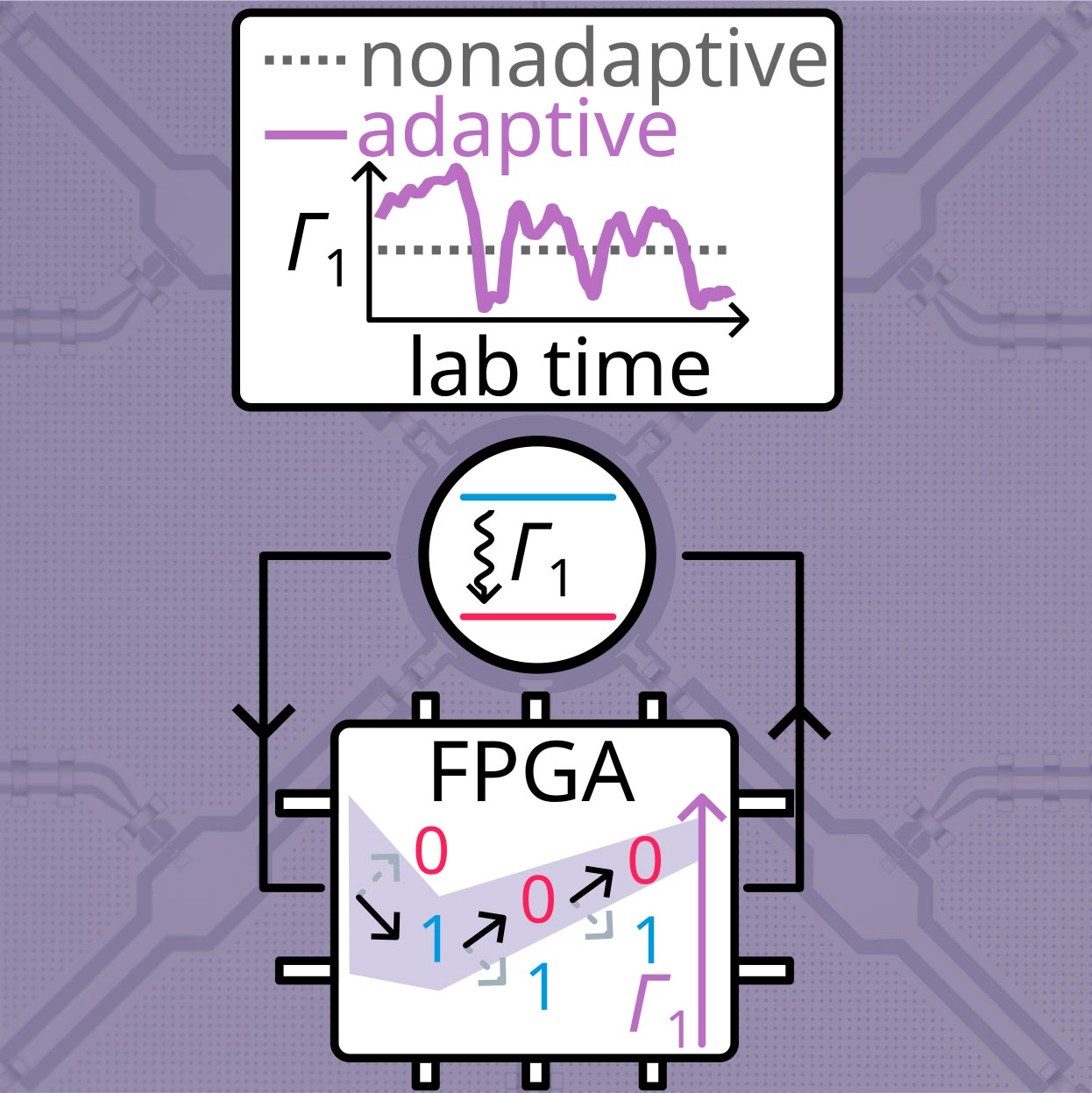
Programming FPGAs for such specific tasks can be challenging. Nevertheless, Fabrizio and his colleagues succeeded in updating the controller’s internal “knowledge” — a Bayesian model — after every individual qubit measurement. This allowed the system to continuously refine how it learned about the qubit’s condition in the most efficient way possible.
As a result, the FPGA controller now keeps pace with the qubit’s environment. Measurements and analysis occur on nearly the same timescale as the fluctuations themselves, making the process about one hundred times faster than previously demonstrated.
The experiments also revealed something new. Scientists did not previously know how quickly fluctuations occur in superconducting qubits. Thanks to this work at NBI, that timescale is now clear.
Commercial FPGA Hardware Enables Accessible Quantum Control
FPGAs have been used for years in various scientific fields. In this case, the team used a commercially available FPGA-based controller from Quantum Machines known as the OPX1000. The system can be programmed in a language similar to Python, which is widely used by physicists. This makes the technology accessible to research groups around the world.
The integration of this FPGA-powered controller with advanced quantum hardware was made possible through close collaboration between the Niels Bohr Institute research group led by Associate Professor Morten Kjaergaard and Chalmers University, where the quantum processing unit was designed and fabricated. “The controller enables very tight integration between logic, measurements, and feedforward: these components made our experiment possible,” says Morten Kjærgaard.

Real-Time Calibration and the Future of Quantum Processors
Quantum technologies hold enormous promise, though large-scale quantum computers have not yet been fully realized. Progress often comes gradually, but occasionally there are significant leaps forward.
By uncovering these previously hidden dynamics, the findings redefine the relevant timescales for characterizing and calibrating superconducting quantum processors. With current materials and fabrication techniques, shifting toward real-time monitoring and calibration appears to be an essential step. Research at NBI continues in this direction, demonstrating the value of collaboration between academia and industry and the creative use of unconventional approaches.
“Nowadays, in quantum processing units in general, the overall performance is not determined by the best qubits, but by the worst ones: those are the ones we need to focus on. The surprise from our work is that a ’good qubit can turn into a ’bad one in fractions of a second, rather than minutes or hours.
With our algorithm, the fast control hardware can pinpoint which qubit is ’good’ or ’bad’ basically in real time. We can also gather useful statistics on the ’bad` qubits in seconds instead of hours or days.
We still cannot explain a large fraction of the fluctuations we observe. Understanding and controlling the physics behind such fluctuations in qubit properties will be necessary for scaling quantum processors to a useful size”, Fabrizio says.
Reference: “Real-Time Adaptive Tracking of Fluctuating Relaxation Rates in Superconducting Qubits” by Fabrizio Berritta, Jacob Benestad, Jan A. Krzywda, Oswin Krause, Malthe A. Marciniak, Svend Krøjer, Christopher W. Warren, Emil Hogedal, Andreas Nylander, Irshad Ahmad, Amr Osman, Janka Biznárová, Marcus Rommel, Anita Fadavi Roudsari, Jonas Bylander, Giovanna Tancredi, Jeroen Danon, Jacob Hastrup, Ferdinand Kuemmeth and Morten Kjaergaard, 13 February 2026, Physical Review X.
DOI: 10.1103/gk1b-stl3
Never miss a breakthrough: Join the SciTechDaily newsletter.
Follow us on Google and Google News.
2 Comments
probably using a potasium form of titanium could keep these said quantum qubits stable. hybriding these could be a challenge but it is possible. pressurize sionide chloride and potassium into titanium with a stable gas. carbon is my best guess
thanks