

Alzheimer’s may begin to unravel the brain when a small group of neurons switches on a receptor it was never meant to use, triggering damage that spreads from synapses to memories.
Alzheimer’s disease is often defined by amyloid plaques and tau tangles, but those hallmarks are part of a much wider breakdown. Neurons become overactive, connections disappear, supporting cells turn reactive, and cognitive abilities gradually decline. How these changes become linked has remained one of the disease’s central mysteries.
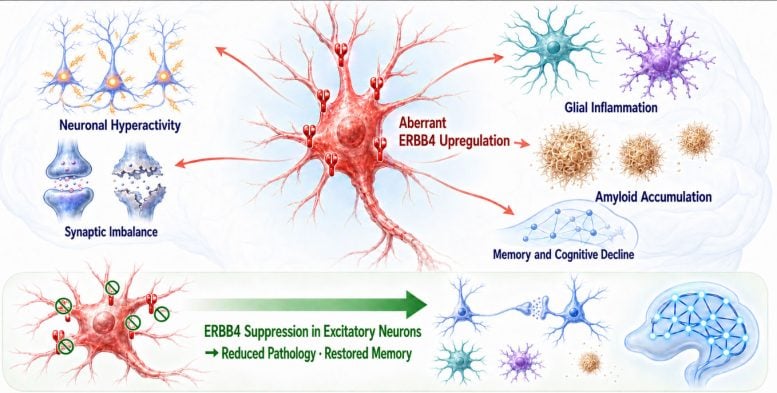
Researchers led by Associate Director Won-Suk Chung at the Center for Vascular Research within the Institute for Basic Science (IBS) have now identified ERBB4 as a possible connection. Their experiments suggest that abnormal activation of this receptor in excitatory neurons can initiate several Alzheimer’s-related problems at once.
Glial Cells Follow Neuronal Distress
The investigation began with astrocytes and microglia, two types of glial cells that maintain the brain’s environment, support neurons, and help remove unwanted connections. Because both can engulf synapses, researchers have suspected that their normal cleanup functions may become destructive in Alzheimer’s disease.
In two mouse models of the condition, astrocytes and microglia removed increasing numbers of excitatory synapses, which carry signals that stimulate other neurons. At the same time, they engulfed fewer inhibitory synapses, which ordinarily help restrain circuit activity.
This was not indiscriminate destruction; the glial cells were selectively altering the balance between signals that accelerate neural activity and those that apply the brakes. Such an imbalance could help explain why excessive neuronal firing can appear early in Alzheimer’s disease, sometimes before major cognitive symptoms become obvious.
When the researchers increased neuronal activity, glial cells consumed more synapses. Suppressing that activity reduced the engulfment. The result suggested that glial cells were responding to distress signals from malfunctioning neurons rather than acting as the original source of the damage.
ERBB4 Appears in the Wrong Neurons
To find the abnormal signal, the team used single-nucleus RNA sequencing, a method that reveals which genes are active within individual cell nuclei. The analysis uncovered a distinct population of excitatory neurons that emerged early in the disease process and unexpectedly expressed ERBB4.
ERBB4 is a receptor that allows cells to respond to external molecular signals. In the healthy brain, it is found mainly in inhibitory neurons, where it contributes to the circuitry that prevents excessive excitation. In the Alzheimer’s models, however, ERBB4 appeared in excitatory neurons, the cells responsible for driving neural activity.
The researchers called these cells “Early Responsive Excitatory Neurons,” or ERENs. Their appearance suggested that Alzheimer’s disease may not only damage neurons but also push some of them into an abnormal molecular state that changes how the surrounding circuit behaves.
If ERBB4 were merely a marker of stressed cells, removing it would not necessarily change the disease. The team therefore used targeted gene editing to eliminate Erbb4 from hippocampal excitatory neurons in mice with Alzheimer’s-like pathology. The hippocampus is crucial for forming memories and is among the brain regions affected early in the disease.
One Intervention Affects Many Pathologies
Reducing ERBB4 quieted neuronal hyperactivity, improved the balance of inhibitory circuit activity, and corrected abnormal synaptic changes. The effects also spread beyond the edited neurons. Astrocytes and microglia became less reactive, amyloid plaque burden declined, and the mice performed better on tests of memory and spatial cognition.
Even when ERBB4 was reduced after substantial disease progression, the intervention still eased several pathological features. This suggests that the receptor may continue contributing to the disease after the initial abnormalities have developed.
The reverse experiment strengthened the case. When researchers activated ERBB4 in a small number of excitatory neurons in otherwise healthy mice, the animals developed excessive circuit activity, synaptic imbalance, reactive gliosis, and cognitive impairment. These changes occurred without amyloid plaques, showing that misplaced ERBB4 signaling can disrupt the brain independently of plaque formation.
Together, the experiments indicate that abnormal ERBB4 expression is not simply collateral damage. In mice, it is sufficient to produce several major features associated with Alzheimer’s disease and necessary for maintaining parts of the broader pathological cascade.
A Molecular Link to mTOR
Further testing identified mTOR signaling as a major pathway carrying ERBB4’s effects. The mTOR system helps cells regulate growth, metabolism, protein production, and responses to nutrients. When its activity becomes poorly controlled in the brain, it can interfere with neuronal function and the maintenance of synapses.
The findings place the ERBB4-to-mTOR signaling axis at a possible control point between neuronal overactivity and the wider changes seen in synapses, glial cells, and cognition. This matters because it offers a biological explanation for how a molecular alteration inside a relatively small population of neurons could reshape an entire local brain environment.
Rather than viewing hyperactive neurons, reactive glia, amyloid plaques, and synapse loss as separate problems, the study suggests that they may reinforce one another. Abnormal neurons alter circuit activity, glial cells respond by remodeling synapses, and the changing environment may make the network even less stable.
Evidence in the Human Brain
The team then examined postmortem tissue and transcriptomic data from 446 people. ERBB4 expression was elevated in excitatory neurons affected by Alzheimer’s disease, suggesting that the unusual neuronal state found in mice also occurs in humans.
People with more ERBB4-expressing excitatory neurons tended to have heavier amyloid plaque burdens and poorer cognitive performance. Statistical modeling further connected ERBB4 with amyloid pathology, later tau pathology, and cognitive decline.
These associations do not prove that ERBB4 causes Alzheimer’s disease in people. Human brain samples generally capture the condition after it has developed, making it difficult to establish which molecular change occurred first. The mouse experiments provide evidence of causation within those models, but clinical studies will be needed to determine whether the same mechanism can be targeted safely and effectively in patients.
Looking Beyond a Single Hallmark
ERBB4 is not the single cause of Alzheimer’s disease, and these findings do not mean an ERBB4-targeted treatment is ready for patients. Instead, the study points to abnormal ERBB4 activity in excitatory neurons as a possible early event that helps drive several features of the disease.
That could matter for treatment. Rather than targeting plaques or other hallmarks one at a time, researchers may be able to intervene earlier in the chain of events and affect several damaging processes at once.
Reference: “Aberrant excitatory neuronal ERBB4 promotes Alzheimer’s disease pathology” by Se Young Lee, Eunseok Park, Ha-Eun Lee, Seongbin Kim, Yeji Yeo, Juwon Park, Young-Jin Choi, Kiheon Lee, Ki-Jun Yoon, Sanghoon Park, Eunjoon Kim, Jae-Ick Kim and Won-Suk Chung, 26 August 2026, Nature.
DOI: 10.1038/s41586-026-10964-z
Never miss a breakthrough: Join the SciTechDaily newsletter.
Follow us on Google and Google News.
3 Comments
Alzheimers never existed before modern times, and seemed to arrive after wider dispersions of Lead, Mercury, Aluminum stearate, and other pollutants, were introduced into the environment. There’s always a time lag between cause and affect, even with sudden onset by physical trauma. All deeply observed biological discoveries are a result of advances in technologies, that are instrumental in elevating knowledge through research.
Mr. Lobb, as a now eighty-two year old lay American male I believe that dementia existed long ago but it wasn’t identified and/or labeled as “Alzheimer’s Disease” until rather recently. What most of mainstream medicine and you appear to be overlooking is the 1980 US FDA approval of the expanded use of added MSG (minimally), with the US obesity and Alzheimer’s Disease epidemics presenting by 1990 and the US diabetes epidemic, minimally, by 1994 (all CDC data). Heavy metal poisoning may play a role but growing multiple epidemics of chronic diseases that parallel the growing, imposed upon us, consumption of added MSG for greater profits is a more likely cause.
Interesting but there’s a problem with dietary MSG hypothesis: The Blood-Brain Barrier. Dietary MSG breaks down into glutamate, which is a natural amino acid and brain neurotransmitter. Regulatory bodies and scientific reviews note that the blood-brain barrier largely stops dietary glutamate from entering the brain in harmful amounts.