
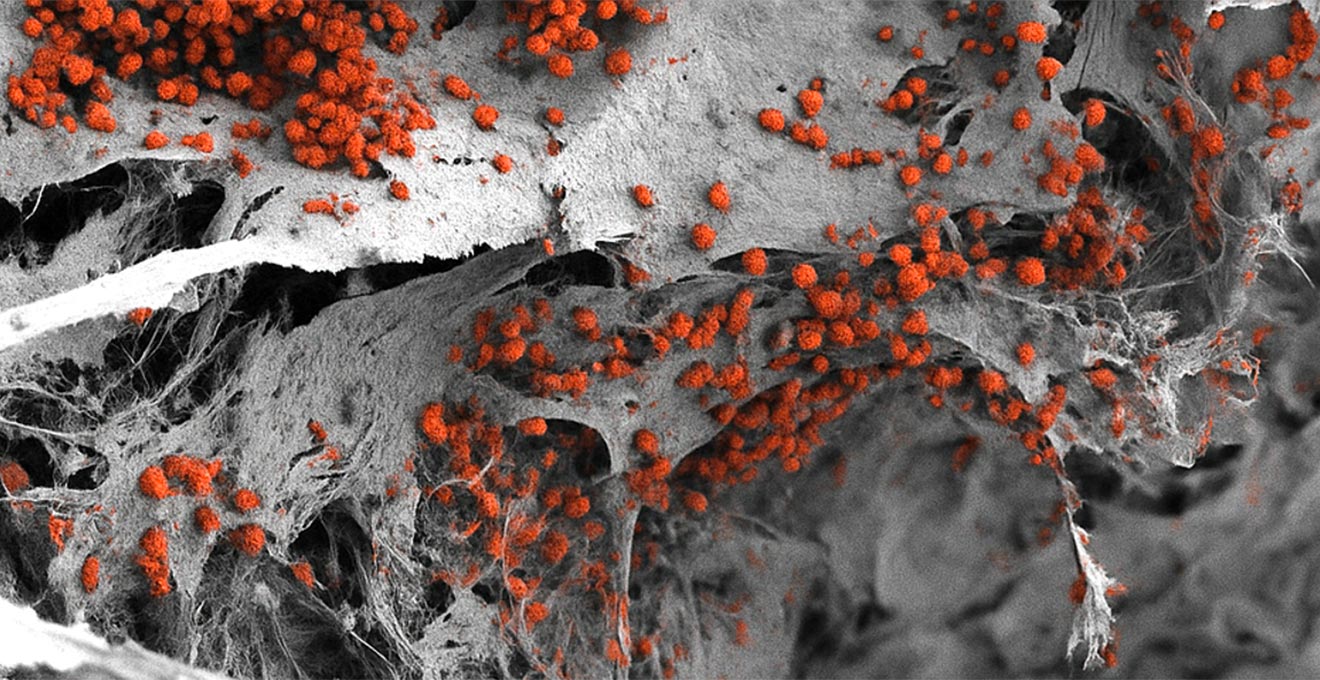
Scientists have engineered the first fully human-made bone marrow system, recreating the complex mix of cells, vessels, and nerves that normally live deep within our bones.
This breakthrough lets researchers study how blood is formed, and how it fails in diseases like cancer, without depending so heavily on animal models. By building a realistic “blood factory” in the lab, the team opens the door to safer drug testing and, eventually, personalized treatments built from a patient’s own cells.
Recreating the Human Bone Marrow Environment
The bone marrow usually does its work without drawing much attention. It becomes noticeable only when something disrupts it, such as blood cancers. When that happens, it becomes essential to understand how blood is normally produced in the body and what causes this process to break down.
For many years, scientists have depended on animal studies and simplified lab-grown cell systems to investigate how bone marrow functions. Researchers from the Department of Biomedicine at the University of Basel and University Hospital Basel have now created a detailed bone marrow model made entirely from human cells. According to the team led by Professor Ivan Martin and Dr. Andrés García García, this new system could support research on blood cancers, provide a platform for testing medications, and possibly contribute to personalized treatment approaches. Their findings were published today (November 18) in Cell Stem Cell.
Inside the Bone Marrow’s Specialized Niches
Bone marrow contains a variety of small, specialized environments known as “niches.” One of the most important niches for producing blood cells lies near the bone surface and plays a role in why some blood cancers resist treatment. This area, called the endosteal niche, contains blood vessels, bone cells, nerves, and immune cells. A human bone marrow model that includes all of these components had not existed until now.
The research team has now assembled a model that incorporates these features. They began with a synthetic bone scaffold made of hydroxyapatite, a substance naturally found in human bones and teeth. Human cells were reprogrammed into pluripotent stem cells using molecular biology techniques, enabling them to develop into many different cell types in response to signals.
These stem cells were then placed into the artificial bone scaffold and guided through specific developmental stages to generate a diverse set of bone marrow cells in a consistent, controlled manner. Analysis showed that the resulting three-dimensional structure closely matches the human endosteal niche and is larger than earlier attempts, with a diameter of eight millimeters and a thickness of four millimeters. With this model, the researchers were able to maintain human blood cell production in the laboratory for several weeks.
Toward Reducing and Refining Animal Experiments
“We have learned a great deal about how bone marrow works from mouse studies,” says Ivan Martin. “However, our model brings us closer to the biology of the human organism. It could serve as a complement to many animal experiments in the study of blood formation in both healthy and diseased conditions.” This aligns with the university’s efforts to replace, reduce, and refine animal experiments whenever possible.
The system could also be used in future drug development. “However, for this specific purpose, the size of our bone marrow model might be too large,” explains Andrés García García. In order to test multiple compounds and doses in parallel, the model would need to be miniaturized.
In the long term, the model’s use in defining personalized treatments for blood cancers is also conceivable, with individual bone marrow models generated from patients’ cells to test different therapies and select the most effective for each patient. However, the researchers acknowledge that this will also require further development.
Reference: “Macro-scale, scaffold-assisted model of the human bone marrow endosteal niche using hiPSC-vascularized osteoblastic organoids” by Qing Li, Marina T. Nikolova, Gangyu Zhang, Igor Cervenka, Federica Valigi, Dominik Burri, Evelia Plantier, Andrea Mazzoleni, Anaïs Lamouline, Juerg Schwaller, Barbara Treutlein, Ivan Martin and Andrés García-García, 18 November 2025, Cell Stem Cell.
DOI: 10.1016/j.stem.2025.10.009
Never miss a breakthrough: Join the SciTechDaily newsletter.
Follow us on Google and Google News.