
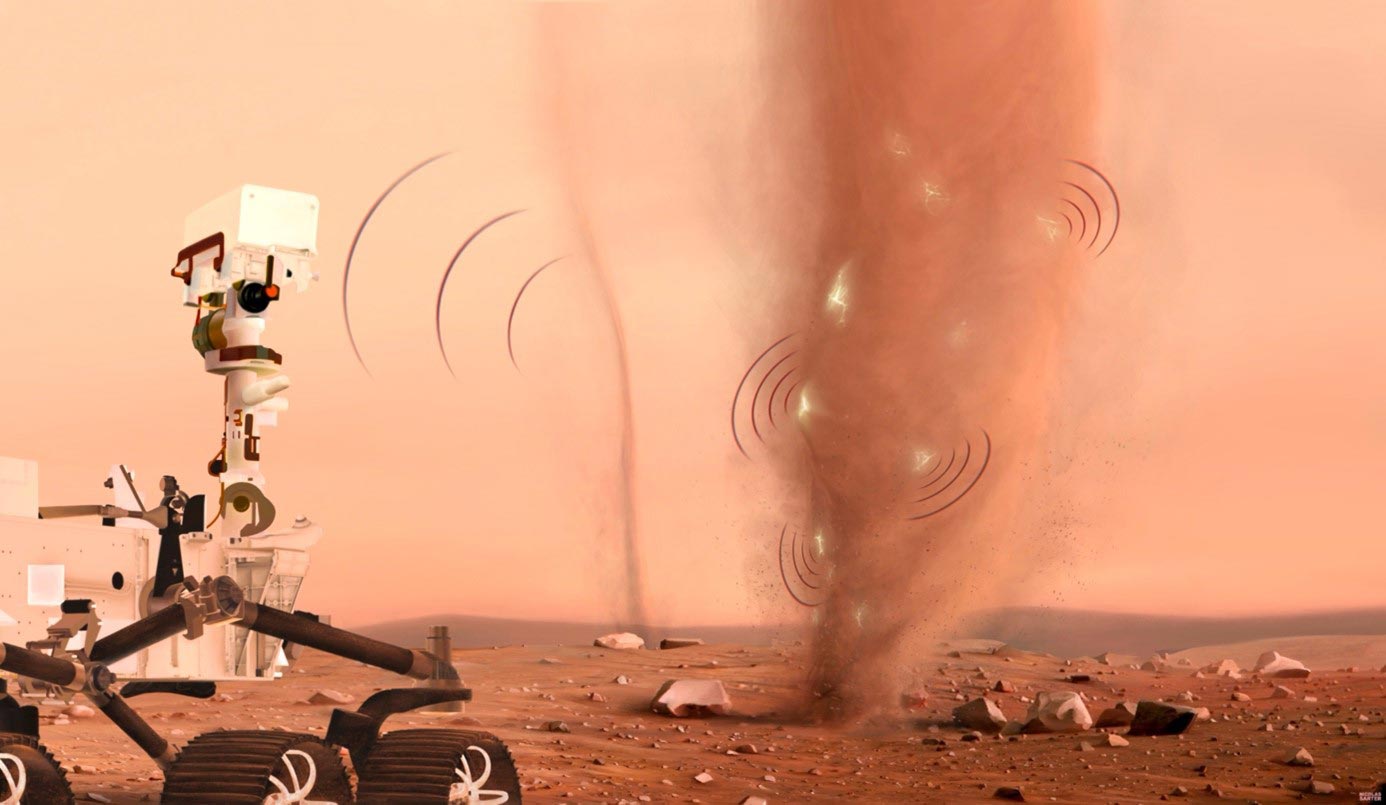
Electrical sparks inside Martian dust devils have been detected for the first time, reshaping how scientists understand the planet’s atmosphere and climate.
On Mars, strong winds routinely generate swirling columns of fine dust. While passing through the center of two such dust devils, the SuperCam instrument’s microphone, the first microphone ever deployed on Mars, unexpectedly picked up unusually intense signals.
Researchers from the Institut de recherche en astrophysique et planétologie (CNES/CNRS/Université de Toulouse) and the laboratoire Atmosphères et observations spatiales (CNRS/Sorbonne Université/Université de Versailles Saint-Quentin-en-Yvelines) later determined that these signals matched the electromagnetic and acoustic fingerprints of electric discharges, similar to the small static shocks people sometimes feel on Earth after touching a metal object in dry conditions. Although scientists had predicted such discharges for years, this marks the first time they have been directly observed in the Martian atmosphere.
The process behind these events begins when countless tiny dust grains rub against one another. This friction allows the particles to pick up electrical charges, which can later be released as brief electric arcs measuring only a few centimeters and producing audible shock waves.
On Earth, dust particles are also known to become electrically charged, particularly in arid environments, but true discharges are uncommon. Mars, however, has a much thinner atmosphere composed mainly of carbon dioxide, which lowers the threshold needed for sparks to form and makes these discharges far more likely.
Sparks reshape Martian chemistry
Identifying these electrical discharges significantly alters how scientists view the chemistry of Mars’s atmosphere. The findings show that atmospheric conditions on Mars can generate enough electrical charge to accelerate the formation of highly oxidizing compounds. These reactive substances are capable of breaking down organic molecules on the surface as well as many gases in the atmosphere, disrupting the photochemical balance. The newly confirmed presence of such processes may help explain why methane on Mars appears to vanish much faster than expected, a mystery that has challenged researchers for several years.
The electrical charges required for these discharges are likely to affect the transport of dust on Mars, thus playing a central role in the Martian climate, the dynamics of which remain largely unknown. They could also pose a risk to the electronic equipment of current robotic missions and constitute a danger to potential future manned missions.
Sound opens a new window on Mars
The microphone of the SuperCam instrument aboard NASA’s Perseverance rover recorded the very first sounds on Mars in 2021, the day after it landed on the planet. Switched on every day, it has collected over 30 hours of sounds from the Red Planet: the wind blowing, the noise of the blades of the Ingenuity helicopter, and now, electric discharges. This new observation confirms the enormous potential of acoustics as a tool for planetary exploration.
Reference: “Detection of triboelectric discharges during dust events on Mars” by Baptiste Chide, Ralph D. Lorenz, Franck Montmessin, Sylvestre Maurice, Yann Parot, Ricardo Hueso, German Martinez, Alvaro Vicente-Retortillo, Xavier Jacob, Mark Lemmon, Bruno Dubois, Pierre-Yves Meslin, Claire Newman, Tanguy Bertrand, Grégoire Deprez, Daniel Toledo, Agustin Sánchez-Lavega, Agnès Cousin and Roger C. Wiens, 26 November 2025, Nature.
DOI: 10.1038/s41586-025-09736-y
Never miss a breakthrough: Join the SciTechDaily newsletter.
Follow us on Google and Google News.