
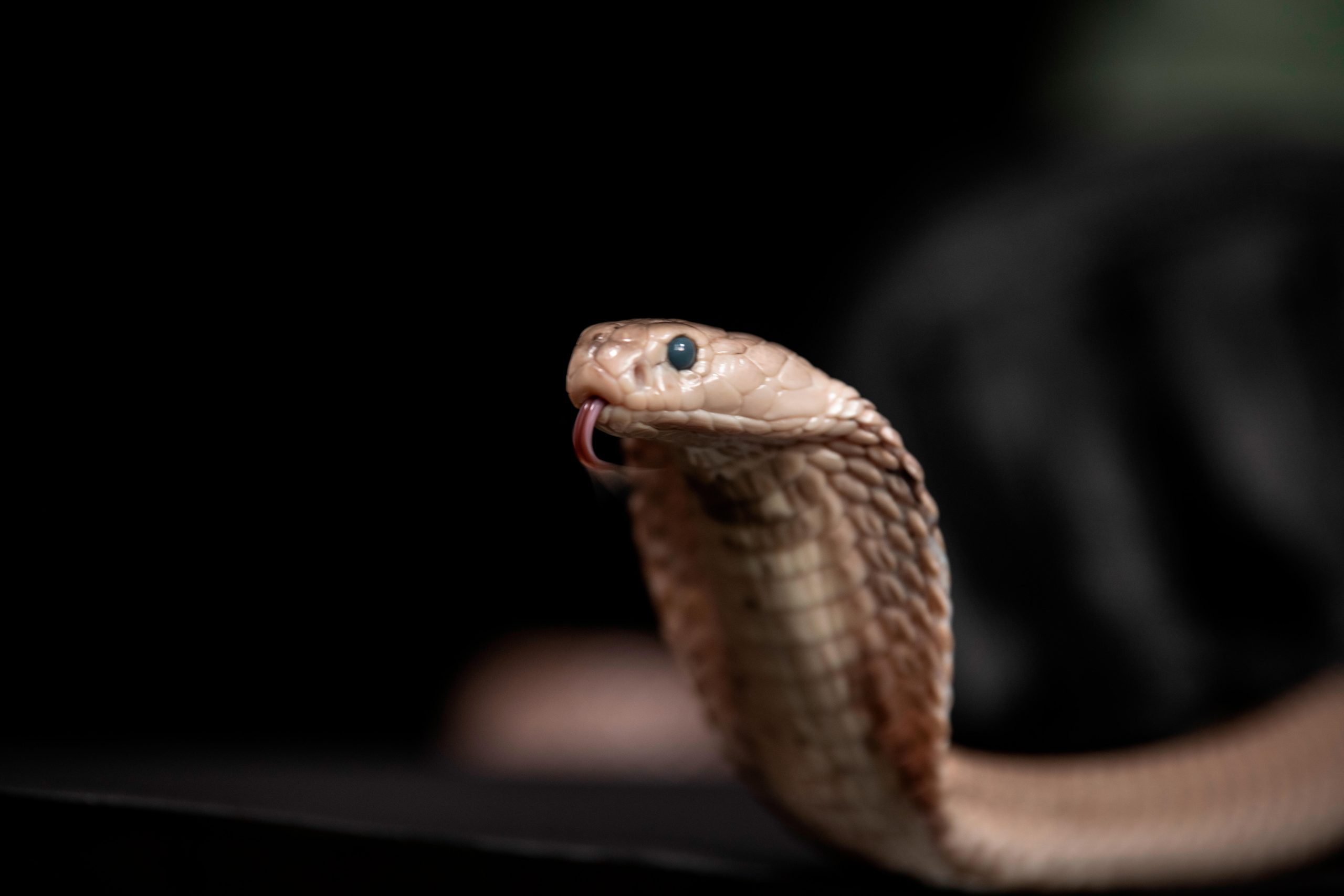
Scientists at Scripps Research identified antibodies that protect against a host of lethal snake venoms.
Scripps Research scientists have developed an antibody that can block the effects of lethal toxins in the venoms of a wide variety of snakes found throughout Africa, Asia and Australia.
The antibody, which protected mice from the normally deadly venom of snakes including black mambas and king cobras, is described in a paper recently published in the journal Science Translational Medicine. The new research used forms of the toxins produced in the laboratory to screen billions of different human antibodies and identify one that can block the toxins’ activity. It represents a large step toward a universal antivenom that would be effective against the venom of all snakes.
“This antibody works against one of the major toxins found across numerous snake species that contribute to tens of thousands of deaths every year,” says senior author Joseph Jardine, PhD, assistant professor of immunology and microbiology at Scripps Research. “This could be incredibly valuable for people in low- and middle-income countries that have the largest burden of deaths and injuries from snakebites.”
Impact on Global Health
More than 100,000 people a year, mostly in Asia and Africa, die from snakebite envenoming—rendering it more deadly than most neglected tropical diseases. Current antivenoms are produced by immunizing animals with snake venom, and each generally only works against a single snake species. This means that many different antivenoms must be manufactured to treat snake bites in the different regions.
Jardine and his colleagues have previously studied how broadly neutralizing antibodies against the human immunodeficiency virus (HIV) can work by targeting areas of the virus that cannot mutate. They realized that the challenge of finding a universal antivenom was similar to their quest for an HIV vaccine; just like quickly evolving HIV proteins show small differences between each other, different snake venoms have enough variations that an antibody binding to one generally doesn’t bind to others. But like HIV, snake toxins also have conserved regions that cannot mutate, and an antibody targeting those could possibly work against all variants of that toxin.
The Science Behind the Antibody
In the new work, the researchers isolated and compared venom proteins from a variety of elapids—a major group of venomous snakes including mambas, cobras, and kraits. They found that a type of protein called three-finger toxins (3FTx), present in all elapid snakes, contained small sections that looked similar across different species. In addition, 3FTx proteins are considered highly toxic and are responsible for whole-body paralysis, making them an ideal therapeutic target.
With the goal of discovering an antibody to block 3FTx, the researchers created an innovative platform that put the genes for 16 different 3FTx into mammalian cells, which then produced the toxins in the lab. The team then turned to a library of more than fifty billion different human antibodies and tested which ones bound to the 3FTx protein from the many-banded krait (also known as the Chinese krait or Taiwanese krait), which had the most similarities with other 3FTx proteins. That narrowed their search down to about 3,800 antibodies. Then, they tested those antibodies to see which also recognized four other 3FTx variants. Among the 30 antibodies identified in that screen, one stood out as having the strongest interactions across all the toxin variants: an antibody called 95Mat5.
“We were able to zoom in on the very small percentage of antibodies that were cross-reactive for all these different toxins,” says Irene Khalek, a Scripps Research scientist and first author of the new paper. ‘This was only possible because of the platform we developed to screen our antibody library against multiple toxins in parallel.”
Laboratory Success and Future Directions
Jardine, Khalek, and their colleagues tested the effect of 95Mat5 on mice injected with toxins from the many-banded krait, Indian spitting cobra, black mamba, and king cobra. In all cases, mice who simultaneously received an injection of 95Mat5 were not only protected from death, but also paralysis.
When the researchers studied exactly how 95Mat5 was so effective at blocking the 3FTx variants, they discovered that the antibody mimicked the structure of the human protein that 3FTx usually binds to. Interestingly, the broad-acting HIV antibodies that Jardine has previously studied also work by mimicking a human protein.
“It’s incredible that for two completely different problems, the human immune system has converged on a very similar solution,” says Jardine. “It also was exciting to see that we could make an effective antibody entirely synthetically—we did not immunize any animals nor did we use any snakes.”
While 95Mat5 is effective against the venom of all elapids, it does not block the venom of vipers—the second group of venomous snakes. Jardine’s group is now pursuing broadly neutralizing antibodies against another elapid toxin, as well as two viper toxins. They suspect that combining 95Mat5 with these other antibodies could provide broad coverage against many—or all—snake venoms.
“We think that a cocktail of these four antibodies could potentially work as a universal antivenom against any medically relevant snake in the world,” says Khalek.
Reference: “Synthetic development of a broadly neutralizing antibody against snake venom long-chain α-neurotoxins” by Irene S. Khalek, R. R. Senji Laxme, Yen Thi Kim Nguyen, Suyog Khochare, Rohit N. Patel, Jordan Woehl, Jessica M. Smith, Karen Saye-Francisco, Yoojin Kim, Laetitia Misson Mindrebo, Quoc Tran, Mateusz Kędzior, Evy Boré, Oliver Limbo, Megan Verma, Robyn L. Stanfield, Stefanie K. Menzies, Stuart Ainsworth, Robert A. Harrison, Dennis R. Burton, Devin Sok, Ian A. Wilson, Nicholas R. Casewell, Kartik Sunagar and Joseph G. Jardine, 21 February 2024, Science Translational Medicine.
DOI: 10.1126/scitranslmed.adk1867
In addition to Khalek and Jardine, authors of the study, “Synthetic development of a broadly neutralizing antibody against snake venom long-chain α-neurotoxins,” include Yen Thi Kim Nguyen, Jordan Woehl, Jessica M. Smith, Karen Saye-Francisco, Yoojin Kim, Laetitia Misson Mindrebo, Quoc Tran, Mateusz Kędzior, Oliver Limbo, Megan Verma, Robyn L. Stanfield, Dennis R. Burton, Devin Sok and Ian A. Wilson of Scripps; Evy Boré, Rohit N. Patel, Stefanie K. Menzies, Stuart Ainsworth, Robert A. Harrison and Nicholas R. Casewell of the Liverpool School of Tropical Medicine; and R. R. Senji Laxme, Suyog Khochare and Kartik Sunagar of the Indian Institute of Science.
This work was supported by funding from the National Institutes of Health (R35 CA231991, U01 AI142756, RM1 HG009490, R35 GM118062, R35 GM118069), the Damon Runyon Cancer Research Foundation (2406-20), the Jane Coffin Childs Fund, the Mark Foundation for Cancer Research and the Howard Hughes Medical Institute.
Never miss a breakthrough: Join the SciTechDaily newsletter.
Follow us on Google and Google News.