
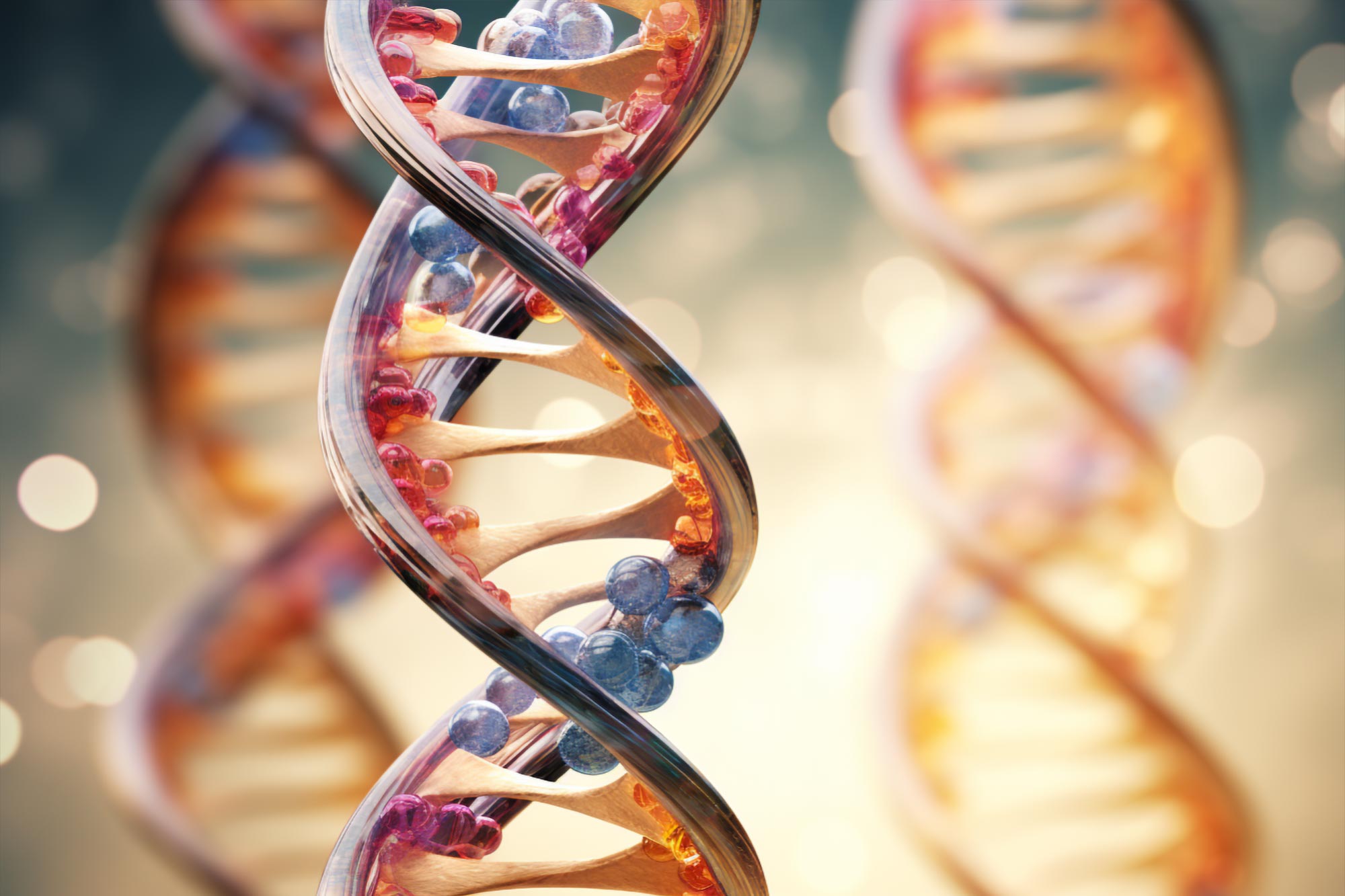
According to the research, these mitochondrial DNA insertions could be linked to early death.
Mitochondria in brain cells frequently insert their DNA into the nucleus, potentially impacting lifespan, as those with more insertions were found to die earlier. Stress appears to accelerate this process, suggesting a new way mitochondria influence health beyond energy production.
As direct descendants of ancient bacteria, mitochondria have always been a little alien. Now a study shows that mitochondria are possibly even stranger than we thought.
Mitochondria in our brain cells frequently fling their DNA into the nucleus, the study found, where the DNA becomes integrated into the cells’ chromosomes. And these insertions may be causing harm: Among the study’s nearly 1,200 participants, those with more mitochondrial DNA insertions in their brain cells were more likely to die earlier than those with fewer insertions.
“We used to think that the transfer of DNA from mitochondria to the human genome was a rare occurrence,” says Martin Picard, mitochondrial psychobiologist and associate professor of behavioral medicine at Columbia University Vagelos College of Physicians and Surgeons and in the Robert N. Butler Columbia Aging Center. Picard led the study with Ryan Mills of the University of Michigan.
“It’s stunning that it appears to be happening several times during a person’s lifetime, Picard adds. “We found lots of these insertions across different brain regions, but not in blood cells, explaining why dozens of earlier studies analyzing blood DNA missed this phenomenon.”
Mitochondrial DNA behaves like a virus
Mitochondria live inside all our cells, but unlike other organelles, mitochondria have their own DNA, a small circular strand with about three dozen genes. Mitochondrial DNA is a remnant from the organelle’s forebears: ancient bacteria that settled inside our single-celled ancestors about 1.5 billion years ago.
In the past few decades, researchers discovered that mitochondrial DNA has occasionally “jumped” out of the organelle and into human chromosomes.
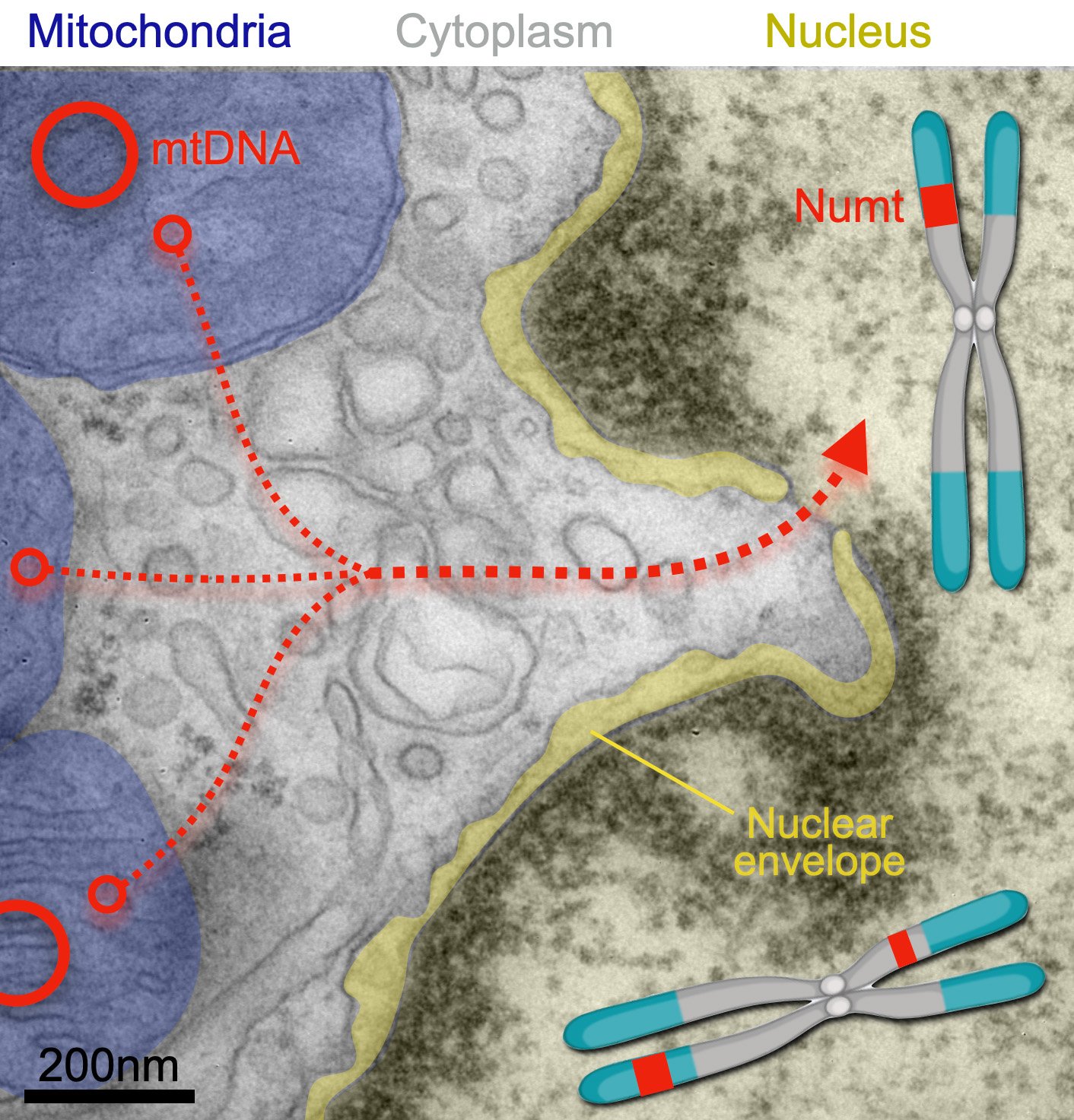
“The mitochondrial DNA behaves similar to a virus in that it makes use of cuts in the genome and pastes itself in, or like jumping genes known as retrotransposons that move around the human genome,” says Mills.
The insertions are called nuclear-mitochondrial segments—NUMTs (“pronounced new-mites”)—and have been accumulating in our chromosomes for millions of years.
“As a result, all of us are walking around with hundreds of vestigial, mostly benign, mitochondrial DNA segments in our chromosomes that we inherited from our ancestors,” Mills says.
Mitochondrial DNA insertions are common in the human brain
Research in just the past few years has shown that “NUMTogenesis” is still happening today.
“Jumping mitochondrial DNA is not something that only happened in the distant past,” says Kalpita Karan, a postdoc in the Picard lab who conducted the research with Weichen Zhou, a research investigator in the Mills lab. “It’s rare, but a new NUMT becomes integrated into the human genome about once in every 4,000 births. This is one of many ways, conserved from yeast to humans, by which mitochondria talk to nuclear genes.”
The realization that new inherited NUMTs are still being created made Picard and Mills wonder if NUMTs could also arise in brain cells during our lifespan.
“Inherited NUMTs are mostly benign, probably because they arise early in development and the harmful ones are weeded out,” says Zhou. But if a piece of mitochondrial DNA inserts itself within a gene or regulatory region, it could have important consequences on that person’s health or lifespan. Neurons may be particularly susceptible to damage caused by NUMTs because when a neuron is damaged, the brain does not usually make a new brain cell to take its place.
To examine the extent and impact of new NUMTs in the brain, the team worked with Hans Klein, assistant professor in the Center for Translational and Computational Neuroimmunology at Columbia, who had access to DNA sequences from participants in the ROSMAP aging study (led by David Bennett at Rush University). The researchers looked for NUMTs in different regions of the brain using banked tissue samples from more than 1,000 older adults.
Their analysis showed that nuclear mitochondrial DNA insertion happens in the human brain—mostly in the prefrontal cortex—and likely several times over during a person’s lifespan.
They also found that people with more NUMTs in their prefrontal cortex died earlier than individuals with fewer NUMTs. “This suggests for the first time that NUMTs may have functional consequences and possibly influence lifespan,” Picard says. “NUMT accumulation can be added to the list of genome instability mechanisms that may contribute to aging, functional decline, and lifespan.”
Stress accelerates NUMTogenesis
What causes NUMTs in the brain, and why do some regions accumulate more than others?
To get some clues, the researchers looked at a population of human skin cells that can be cultured and aged in a dish over several months, enabling exceptional longitudinal “lifespan” studies.
These cultured cells gradually accumulated several NUMTs per month, and when the cells’ mitochondria were dysfunctional from stress, the cells accumulated NUMTs four to five times more rapidly.
“This shows a new way by which stress can affect the biology of our cells,” Karan says. “Stress makes mitochondria more likely to release pieces of their DNA and these pieces can then ‘infect’ the nuclear genome,” Zhou adds. It’s just one way mitochondria shape our health beyond energy production.
“Mitochondria are cellular processors and a mighty signaling platform,” Picard says. “We knew they could control which genes are turned on or off. Now we know mitochondria can even change the nuclear DNA sequence itself.”
Reference: “Somatic nuclear mitochondrial DNA insertions are prevalent in the human brain and accumulate over time in fibroblasts” by Weichen Zhou, Kalpita R. Karan, Wenjin Gu, Hans-Ulrich Klein, Gabriel Sturm, Philip L. De Jager, David A. Bennett, Michio Hirano, Martin Picard and Ryan E. Mills, 22 August 2024, PLOS Biology.
DOI: 10.1371/journal.pbio.3002723
This work was supported by grants from the U.S. National Institutes of Health (R01AG066828, R21HG011493, and P30AG072931), the Baszucki Brain Research Fund, and the University of Michigan Alzheimer’s Disease Center Berger Endowment.
Never miss a breakthrough: Join the SciTechDaily newsletter.
Follow us on Google and Google News.
14 Comments
““Mitochondria are cellular processors and a mighty signaling platform,” Picard says. “We knew they could control which genes are turned on or off. Now we know mitochondria can even change the nuclear DNA sequence itself.””
There is no proof that insertion of mitochondrial DNA into the nuclear DNA causes any damage to genes. If mitochondria already are known to influence gene expression, turning them on or off, it could be that insertions are also regulatory, and not harmful.
“They also found that people with more NUMTs in their prefrontal cortex died earlier than individuals with fewer NUMTs. “This suggests for the first time that NUMTs may have functional consequences and possibly influence lifespan,” Picard says. “NUMT accumulation can be added to the list of genome instability mechanisms that may contribute to aging, functional decline, and lifespan.””
Actually, it could be that NUMTs are a defense strategy. Finding more of these insertions in people who died may mean these people had a health problem which the body tried to mitigate by having the mitochondrial DNA alter the nuclear DNA. The NUMTs may be a sign of the body attempting to manage a problem, and is not the problem itself.
““This shows a new way by which stress can affect the biology of our cells,” Karan says. “Stress makes mitochondria more likely to release pieces of their DNA and these pieces can then ‘infect’ the nuclear genome,” Zhou adds.”
Keep in mind that the “stress” was experienced by cells in a tissue culture exposed to certain drugs. You cannot extrapolate from this “stress” to environmental or culturally-induced stress.
The problem with this article is clear in the beginning. “As direct descendants of ancient bacteria, mitochondria have always been a little alien.” Alien? Mitochondria have been a component of the eukaryotic cell for millenia. Maybe they seem alien because of the way science hypothesizes how the mitochondria came into cells to live symbiotically within them. But that is a theory and history. All we see is that we have mitochondria in our cells that are part of us. It’s strange to feel alienated from our mitochondria, or to assume that they are separate from us in any way.
All this article really shows is that mitochondrial DNA inserts into nuclear DNA in some cells. The relevance of that regarding longevity, functional decline, or any outcome is pure conjecture.
Finally- someone who disentangles correlation from causality
Thanks for a great read
Right. Well put, I tell people often, “If this causes that, then the lack of that may not mean a lack of this.”
As someone with 90 mitochondrial variants, I fully agree with most of what you’ve said.
Only thing I disagree with is the part about stress; we’ve thousands upon thousands of different types of studies and millions upon millions suffering from mitochondrial disorders, all of which demonstrate the different ways different stressors affect the mitochondria.
Your comments mirror what I was thinking as I read through the article. A, the causality is not clearly established. B, the role and source of mitochondria in our cellular map may still be open to questions and fresh data may bring new perspectives, but one has to be careful to not mix up data points – what is stimulated in experimental setups cannot be equated with nature’s data points. C, the brain chemistry is still being explored and data on early deaths is from a single datapoint. To link the two causally is not a valid statistical method.
Thank you. I am neither a scientist nor a scholar. But your interpretation of the article made more sense to me than the article itself. As with so many aspects of life, discussions of jumping mitochondria could have us jumping to conclusions that may not even exist.
It appears that genetic material, even within an organism, is much more transient than once thought. As bacterial DNA is known to transfer from one microbe to another with relative ease (transformation, conjugation, transduction, recombination), it is perhaps not surprising that mitochondria appear to retain this ability. However, it is interesting that this has been forms to occur within the cns- which is traditionally believed to be an exceedingly regulated system. This article made me think of how nearly 10% of our DNA is a conglomeration of genetic material collected from various viruses over many millennia. Or how 90% of serotonin is made in the gut thanks to microbial activity. We tend to think of ourselves as completely autonomous beings, yet that is far from the case. The same apparently goes for the cells within the brain- they are not autonomous from the rest of the body!
You guys are yoo much.
Please get real !
You haven’t the VAUGEST IDEA of what the hell you speak.
Hakkns was just outed as a B.S’er. some of us knew that butt…
Next week…tomrrow it will be some othe wild gessathone !
Follos the science.
WHAT SCIENCE ?
I mean seem like anything thag is revealed is revieled ny accident.
Well, this article certainly stole a couple of minutes of my life.
Would be interesting to see whether there’s any correlation with cognitive function and intelligence.
Given mitochondria are the “power generators” within cells, the DNA transfer may be to do with bolstering the notoriously energy hungry brain cells.
Also makes me wonder whether the brain was designed by Intel – keep pouring the power on and forget it shortens the life of the processor… 🤣
If I remember correctly Einstein had a greater amount of mitochondria In his brain cells.
And a great moustache. That’s what must have made the difference.
“They also found that people with more NUMTs in their prefrontal cortex died earlier than individuals with fewer NUMTs. “This suggests for the first time that NUMTs may have functional consequences and possibly influence lifespan,” Picard says.”
However, drawing a correlation between this process and early death is dangerous and misleading unless you know the exact cause of death of every person the samples came from. It is highly unlikely they all died of the same cause, and even if this were the case, there will always be environmental factors that need to be accounted for.
I will not comment on many of the statements made as other have covered them far more eloquently that I could.