
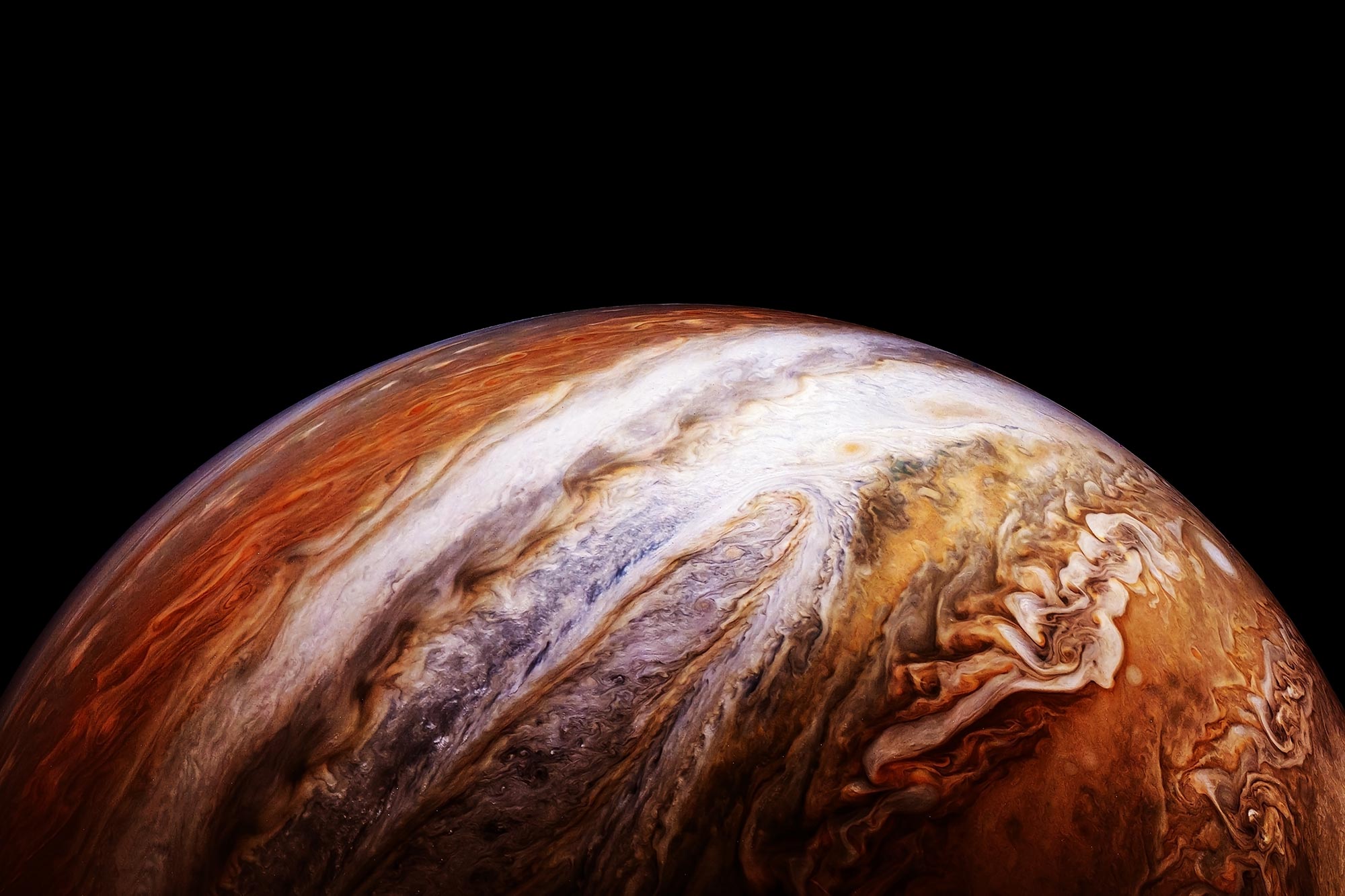
Ancient droplets found in meteorites reveal the history of planet formation.
About 4.5 billion years ago, Jupiter expanded quickly into the giant planet we see today. Its immense gravity disturbed the paths of countless rocky and icy objects, known as planetesimals, which resembled present-day asteroids and comets.
These disturbances led to violent collisions so energetic that the rock and dust inside the planetesimals melted, producing droplets of molten rock called chondrules. Many of these ancient droplets are still preserved within meteorites that fall to Earth.
In a new breakthrough, scientists from Nagoya University in Japan and the Italian National Institute for Astrophysics (INAF) have uncovered how these chondrules were created and used them to precisely date Jupiter’s formation.
Their research, published in Scientific Reports, reveals that the traits of chondrules, including their size and cooling rates in space, were shaped by the amount of water present in the colliding planetesimals. This discovery not only matches what scientists observe in meteorite samples but also confirms that the birth of planets directly drove the creation of chondrules.
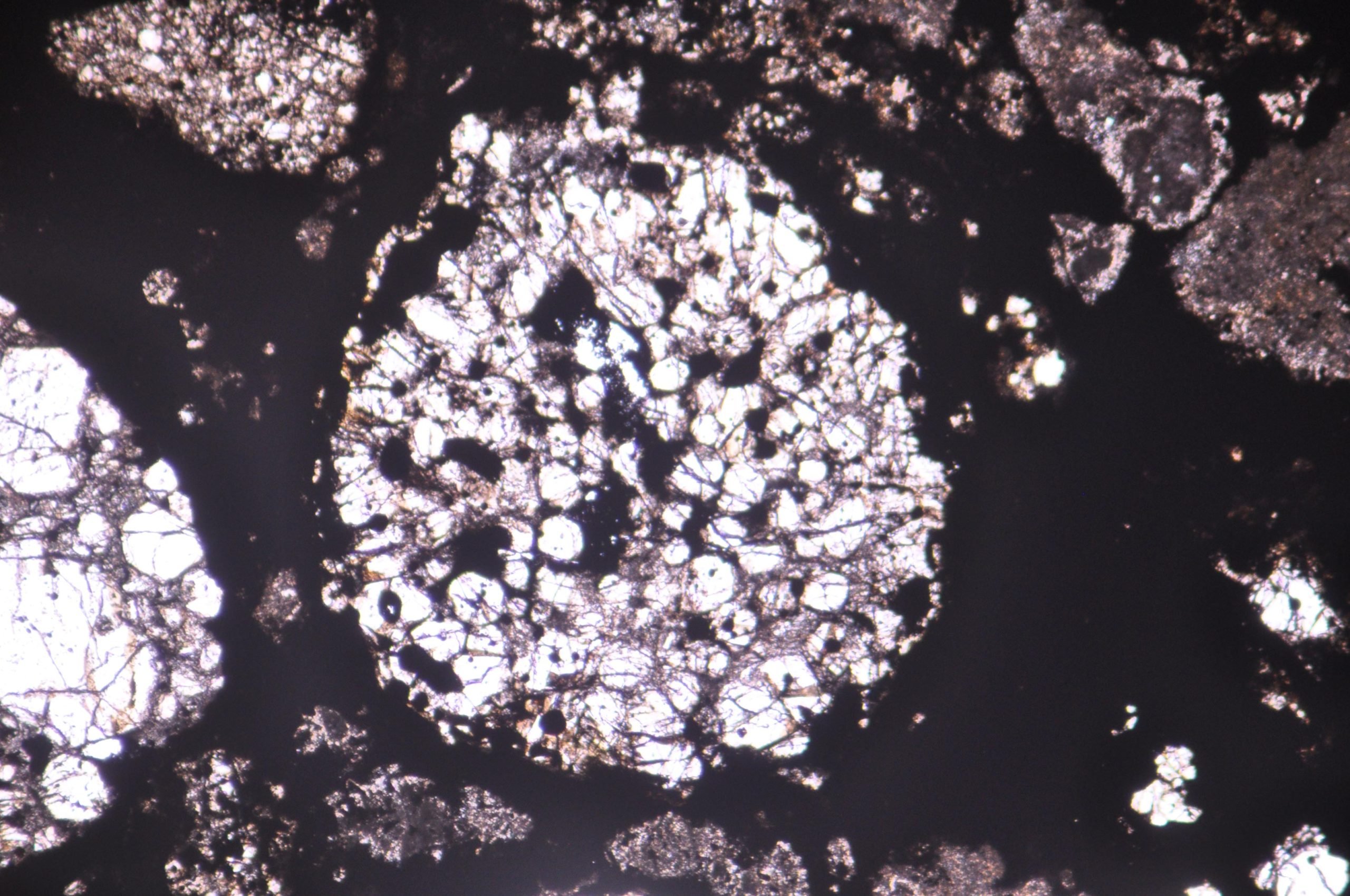
Time capsules from 4.6 billion years ago
Chondrules, small spheres approximately 0.1-2 millimeters wide, were incorporated into asteroids as the solar system formed. Billions of years later, pieces of these asteroids would break off and fall to Earth as meteorites. How chondrules came to have their round shape has puzzled scientists for decades.
“When planetesimals collided with each other, water instantly vaporized into expanding steam. This acted like tiny explosions and broke apart the molten silicate rock into the tiny droplets we see in meteorites today,” co-lead author Professor Sin-iti Sirono from Nagoya University’s Graduate School of Earth and Environmental Sciences explained.
“Previous formation theories couldn’t explain chondrule characteristics without requiring very specific conditions, while this model requires conditions that naturally occurred in the early solar system when Jupiter was born.”
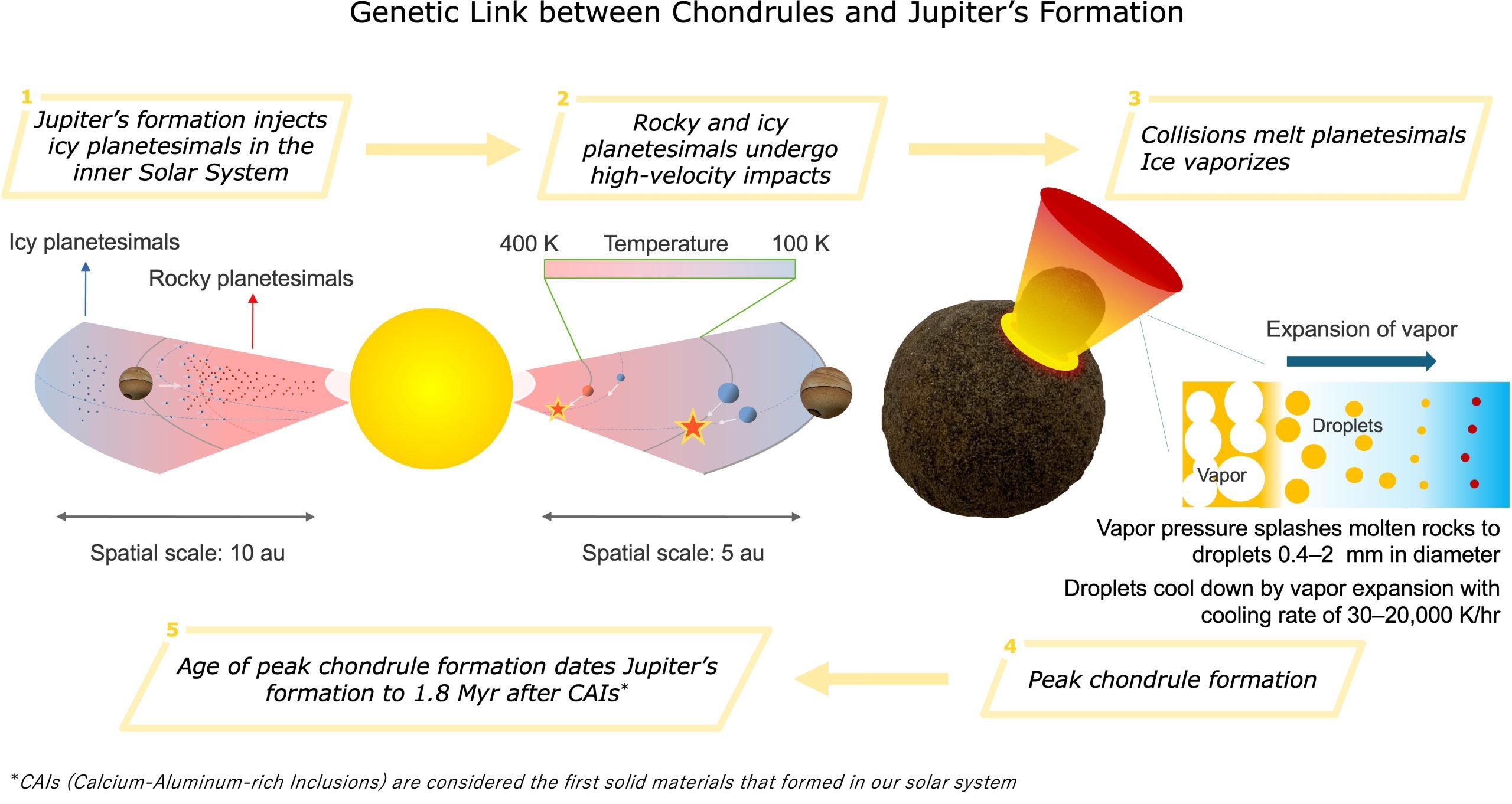
The researchers developed computer simulations of Jupiter’s growth and tracked how its gravity caused high-speed collisions between rocky and water-rich planetesimals in the early solar system.
“We compared the characteristics and abundance of simulated chondrules to meteorite data and found that the model spontaneously generated realistic chondrules. The model also shows that chondrule production coincides with Jupiter’s intense accumulation of nebular gas to reach its massive size. As meteorite data tell us that peak chondrule formation took place 1.8 million years after the solar system began, this is also the time at which Jupiter was born,” Dr. Diego Turrini, co-lead author and senior researcher at the Italian National Institute for Astrophysics (INAF), said.
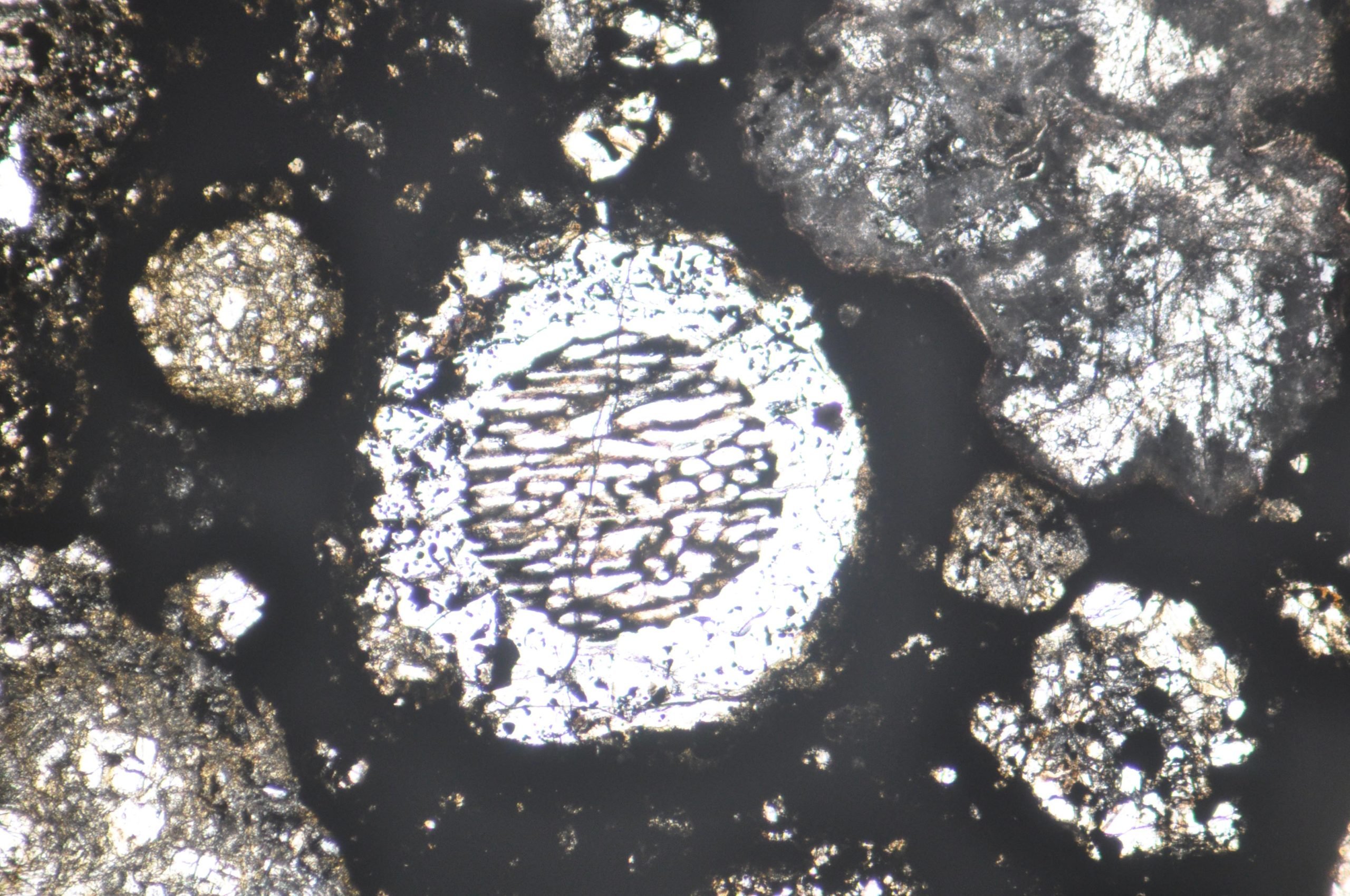
A new way to date when planets form
This study provides a clearer picture of how our solar system formed. However, the production of chondrules started by Jupiter’s formation is too brief to explain why we find chondrules of many different ages in meteorites. The most likely explanation is that other giant planets like Saturn also triggered chondrule formation when they were born.
By studying chondrules of different ages, scientists can trace the birth order of the planets and understand how our solar system developed over time. The research also suggests that these violent planet formation processes may occur around other stars and offers insights into how other planetary systems developed.
Reference: “Chondrule formation by collisions of planetesimals containing volatiles triggered by Jupiter’s formation” by Sin-iti Sirono, and Diego Turrini, 25 August 2025, Scientific Reports.
DOI: 10.1038/s41598-025-12643-x
This work was supported by JSPS KAKENHI Grant Number 25K07383, by the Italian Space Agency through ASI-INAF contract 2016-23-H.0 and 2021-5-HH.0 and by the European Research Council via the Horizon 2020 Framework Programme ERC Synergy “ECOGAL” Project GA-855130.
Never miss a breakthrough: Join the SciTechDaily newsletter.
Follow us on Google and Google News.
1 Comment
Are you sure what you are looking at in the Allende Meteorite are chondrules? Are you sure your not in the middle of a fossil organism?